


Custom metal stamping service from a factory that owns its presses, dies and inspection equipment. We run 25 to 400 tonne presses with progressive, compound and transfer dies designed and built in our own tool room — so the tooling, the parts and the tolerances all come from one supplier instead of three. ISO 9001:2015, registration 34025Q30296R0S. No minimum order quantity.
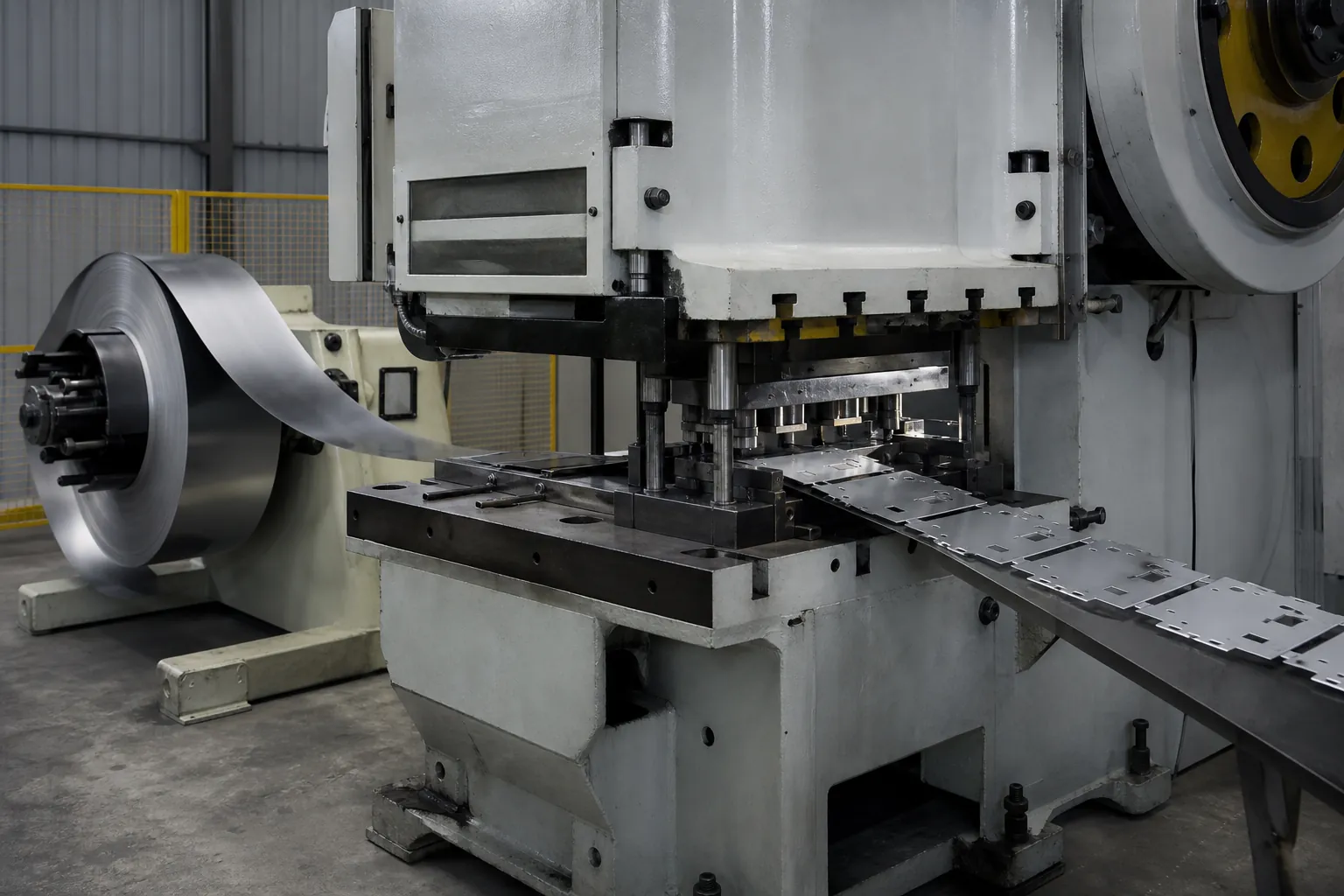
| 25–400 t | stamping press range |
| Progressive / compound / transfer | dies, designed and built in-house |
| ISO 9001:2015 | reg. 34025Q30296R0S |
| No MOQ | from 1 piece |
| ≤3 hours | engineering response |
| 15,000 m² | plant, 6 production lines |
Why choose our custom metal stamping service
We build the die ourselves. Most suppliers who quote you a stamped part are buying the tooling from a third party and adding margin. Our tool room designs and builds the dies, which means one party owns the tolerance stack — and one party answers when something drifts.
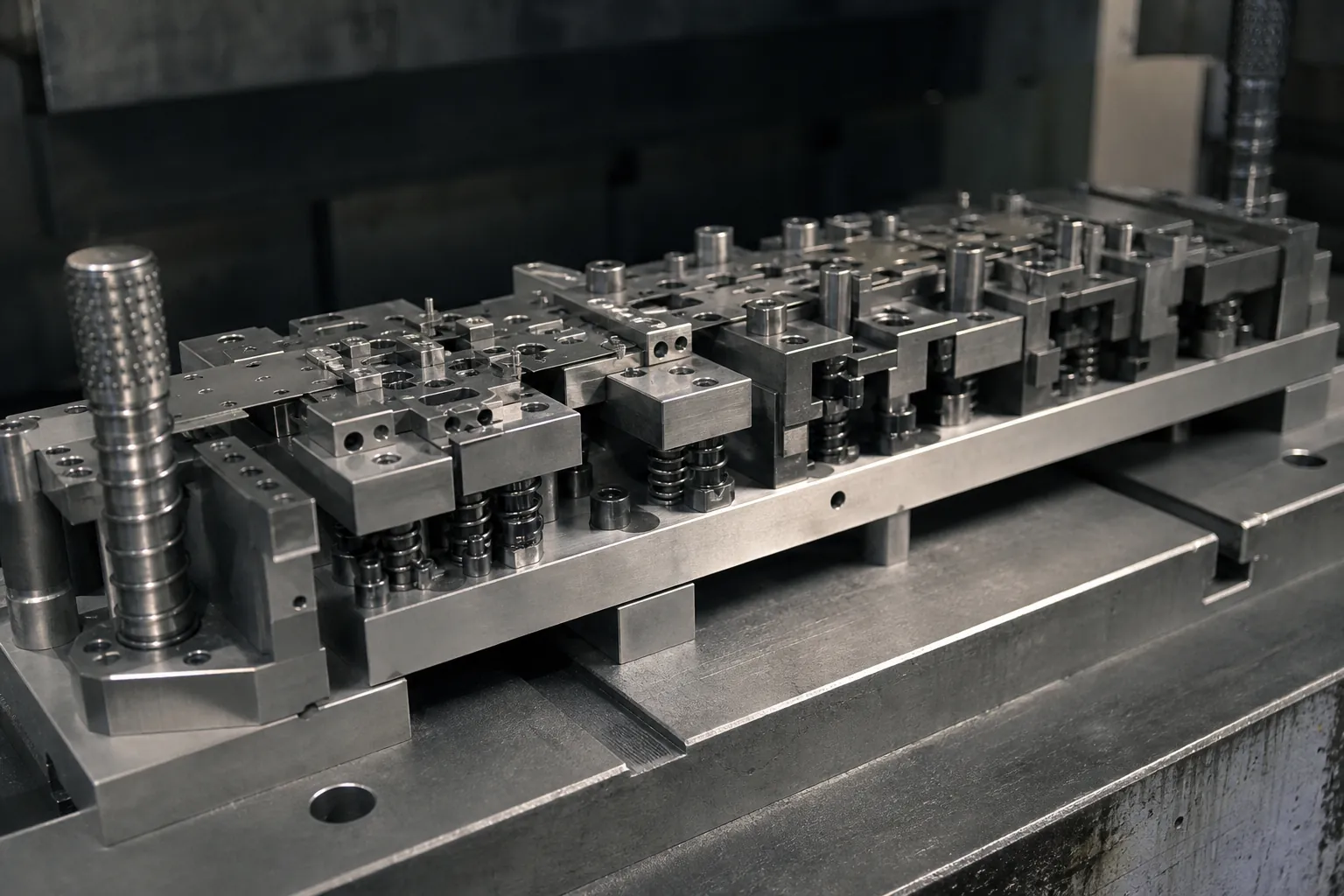
The presses are ours. 25 to 400 tonnes, progressive, compound and transfer. We do not broker your job to a factory you never see. The plant is 15,000 m² in Nanpi County, Hebei, with six production lines covering stamping, multi-stage deep drawing, laser cutting, bending, welding and machining — parts move between processes on a single work order and a single inspection record.
Verifiable, not vague. Our ISO 9001:2015 registration number is published. Our equipment is named: presses to 400 tonnes, a 12,000 W fibre laser, a 3,200 mm CNC press brake and an HDL-OKK DMU38 five-axis machining centre. CMM reports and EN 10204 material certificates ship with the order. For the part-making detail, see our custom metal stamping parts page.
Nothing is subcontracted without telling you. If a process falls outside our equipment, we say so before quoting, not after.
What is metal stamping?
Metal stamping is a high-volume forming process in which a press drives a shaped die into flat sheet metal or coil strip, cutting and forming it into a finished 3D part in one or a few strokes. Because the shape lives in the tool rather than in the operator’s hands, every part that comes off the press is dimensionally identical — which is why stamping becomes the cheapest way to make a part once volumes are high enough to justify the die.
Common metal stamping methods
Progressive die stamping — Coil strip feeds through a series of stations, each performing one operation: pierce, form, bend, emboss, trim, separate. The part is finished when it leaves the last station, so there is no manual handling. This is the method for high-volume, complex parts and for anything where per-piece cost matters most.
Compound die stamping — All cutting operations happen in a single stroke, which keeps blank profile and hole positions in perfect relationship to each other. Chosen where concentricity or hole-to-edge accuracy is the critical dimension.
Transfer die stamping — Individual blanks are carried between stations by mechanical grippers rather than by the strip. Used for large, deep or heavy parts that cannot be coil-fed, and for parts where the strip would not be strong enough to carry the shape.
Blanking and fine blanking — Produces a flat 2D profile, usually the first operation in a stamping sequence. Fine blanking adds a counter-pressure ring to produce a fully sheared, square edge in one stroke, removing the need for secondary machining on the cut face.
Deep drawing — Draws a flat blank into a cup, can or enclosure over multiple stages using in-house hydraulic presses. Where a stamped part also needs to become a container, this happens under the same work order. See our deep drawn parts capabilities.
Coining and embossing — Extreme local pressure forms fine detail: logos, part numbers, ribs, micro-relief. Useful when traceability or stiffness has to be built into the part rather than added later.
Key advantages of custom metal stamping
| Advantage | What it means commercially |
|---|---|
| Lowest per-piece cost at volume | Once the die is amortised, unit cost is driven by material and press time only |
| Repeatability across millions | The shape is in the tool, not the operator — batch ten matches batch one |
| High production rate | Progressive presses run continuously, which is why stamping wins on volume lead time |
| Material efficiency | Strip nesting keeps scrap to a minimum, which matters most on stainless and copper — the grades that carry the highest cost per kilo |
| Integrated features | Bends, ribs, holes, embossing and logos in one die — fewer parts, no assembly steps |
| Tolerance stability | No thermal distortion, unlike welding or heat-driven processes |
Common applications and scenarios of custom stamped metal parts
This is the question buyers actually search for — what stamping is used for. Grouped by the industries we stamp for:
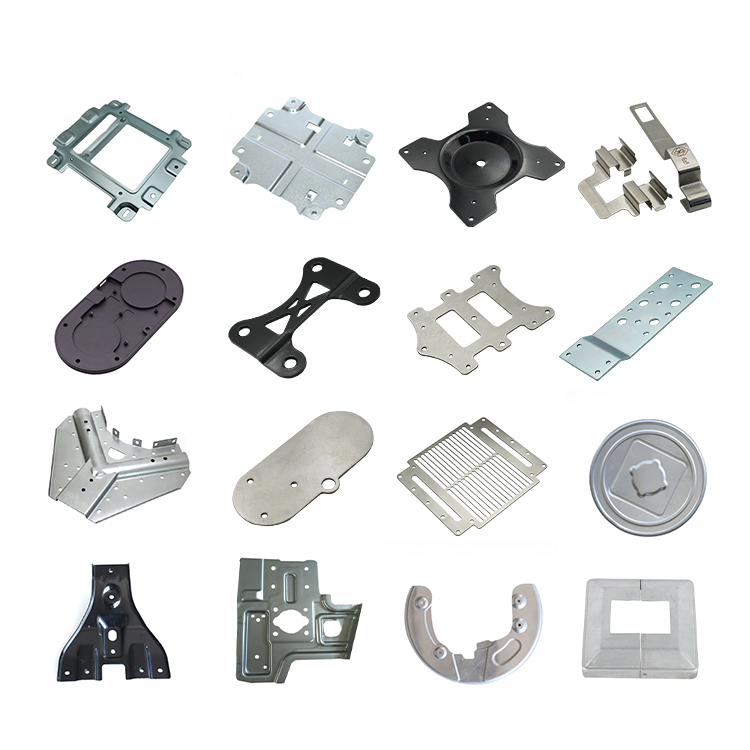
Automotive and EV — Battery module brackets, busbar supports, motor mounts, shims, terminals, chassis brackets, sensor housings, EV charging connector parts. Stamping suits these because the volumes are high and the parts must be identical across a production run that lasts years. Bracket geometry is where most of these parts live; our custom metal brackets guide covers the design side.
Electronics and electrical — Connectors, contacts, EMI shielding cans, heat-sink brackets, PCB mounting frames, terminal blocks, junction-box components, enclosure panels. Here the driver is usually fine features and flatness rather than tonnage.
Energy and infrastructure — Solar mounting brackets, wind turbine brackets, transformer laminations and clamps, cable trays, earthing components. Materials are chosen for corrosion resistance over decades in service.
Industrial machinery and equipment — Machine guards, mounting plates, coupling brackets, spring clips, retaining clips, conveyor components, hydraulic system brackets.
Construction and hardware — Hinges, latches, angle brackets, joist hangers, scaffold clips, door hardware, tool components. Galvanised and zinc-plated finishes dominate.
Medical and laboratory equipment — Instrument brackets, tray components, housing frames, sterilisation-safe stainless parts. Material traceability matters more than cost here.
Agricultural and off-highway — Implement brackets, PTO components, mounting hardware, guards. Heavy-gauge, hot-dip galvanised, built for impact.
Home, garden and consumer hardware — Furniture brackets, shelving clips, tool hardware, appliance frames, fasteners.
When stamping is the wrong answer — and we will tell you so: below roughly 1,000 pieces the tooling rarely pays back against laser cutting and bending; for very large or very deep single parts deep drawing or fabrication is usually cheaper; and where the design changes every few months, stamped tooling locks you in. If that describes your project, we will quote the competing process instead.
How our custom metal stamping service works
1. Send the drawing and the quantity. DXF, STEP, STP, SLDPRT, PDF or DWG — our knowledge base explains what we need for a first-pass review. Tell us the annual volume, not just the first order: it changes the tooling decision more than the part geometry does. Engineering responds within 3 hours on working days.
2. DFM review before you commit to tooling. We check strip layout, feed direction, feature strength, minimum hole-to-edge distances, bend radii against material thickness, and springback. This is where tooling cost usually comes down, and it is free.
3. Die design and build in our own tool room. Progressive, compound or transfer die, designed for your annual volume and designed to be maintainable. Dies are proven out and first-article samples are submitted for your approval before production.
4. First article approval. You sign off on the sample and the dimensional report before we run the batch. Nothing goes to volume on an unapproved first article.
5. Production. Press runs with in-process checks. For long runs we set up inspection intervals tied to the critical dimensions rather than to a fixed schedule.
6. Inspection and shipment. CMM dimensional reports, EN 10204 material certificates and coating thickness readings ship with the order. Packed for sea or air, with export palletising and part-to-part protection for cosmetic surfaces.
Metal stamping capabilities and specifications
| Parameter | Capability |
|---|---|
| Press range | 25–400 tonnes |
| Die types | Progressive, compound, transfer |
| Tooling | Designed and built in-house |
| Materials | Carbon steel, stainless steel, aluminium, copper, brass, galvanised and pre-coated strip |
| Surface finishes | Zinc plating, powder coating, anodising, passivation, deburring, heat treatment |
| Tolerance | ±0.02 mm on critical features |
| Minimum order quantity | None — from 1 piece |
| Engineering response | ≤3 hours on working days |
| Quality system | ISO 9001:2015, reg. 34025Q30296R0S |
| Records supplied | CMM reports, FAI, EN 10204 material certificates |
| Plant | 15,000 m², 6 production lines, 85 employees |
Sheet thickness is the parameter that changes a stamped part most often, because the same nominal gauge behaves differently across carbon steel, stainless and aluminium. Our sheet metal thickness chart lists the equivalents.
Materials we stamp
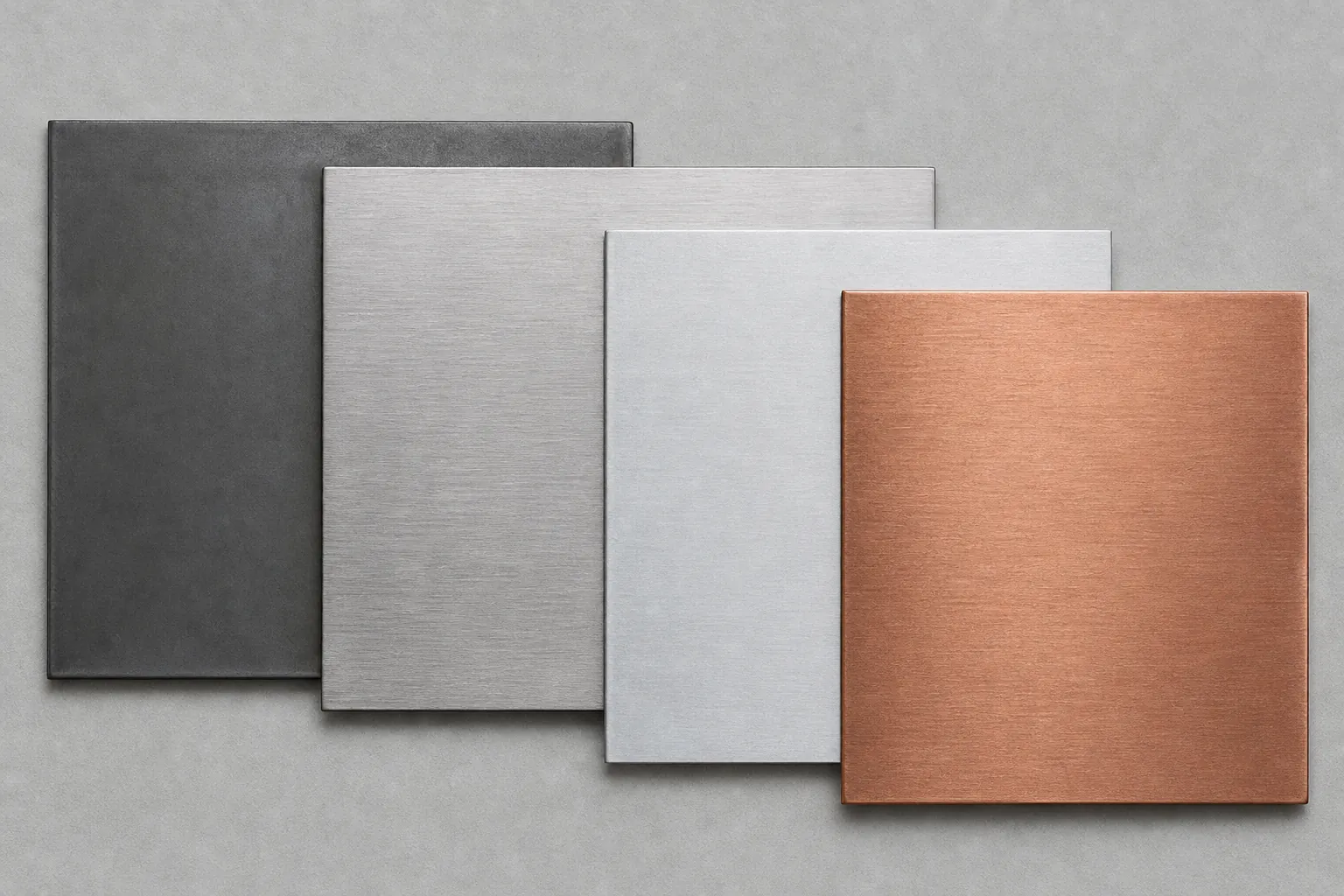
Carbon steel — The default for structural brackets, clips and mounting plates where strength per cost matters. CR4/SPCC cold-rolled for cosmetic parts, hot-rolled for heavier gauges, and pre-galvanised strip where the edge does not need to be recoated.
Stainless steel — 301, 304 and 316/316L. 301 for parts that need spring temper or high strength from a thin section; 304 for general corrosion resistance; 316L for chloride exposure, food contact and medical work. Stainless work-hardens, so tooling clearances and bend radii are set differently from carbon steel.
Aluminium — 1050, 1100, 5052 and 6061. 5052 is the workhorse for bent and stamped enclosures because it forms without cracking; 6061 where the part needs machined features or higher strength; 1100 where conductivity or cost dominates.
Copper and brass — C110 and C260. Busbars, terminals, contacts and EMI parts, where electrical conductivity and solderability are the reason the part exists.
Galvanised, Galvalume and pre-coated strip — For outdoor and construction parts where the coating does the corrosion work. Tooling is designed so the coating is not cracked at the bend.
Grade selection is a DFM decision, not a preference. If you send a part number without a grade, we will propose one and explain why. See our sheet metal fabrication materials guide for the grades we hold most often.
Surface finishes for stamped parts
Zinc plating — The default protection for carbon steel brackets and clips. Barrel or rack plating, clear or yellow passivate.
Powder coating — Colour and durability for parts that are seen as well as used. We specify the coating thickness range so it does not close out critical hole tolerances.
Anodising — Aluminium only. Type II for appearance and general protection, Type III hard anodising where wear resistance matters.
Passivation and deburring — Standard for stainless parts that will be handled or that need a clean cut edge. Also removes the free iron left by tooling contact. See metal surface treatment.
Heat treatment — Stress relief for parts that must stay flat, and hardening for spring-temper 301 components.
Laser marking — Part numbers, batch codes and logos, either on our 12,000 W fibre laser or in the die itself for high-volume work.
Quality control on stamped parts
Incoming material is verified against the mill certificate before it is released to the press. In-process checks track the critical dimensions across the run, not just at the start. Final inspection produces the report that ships with your order.
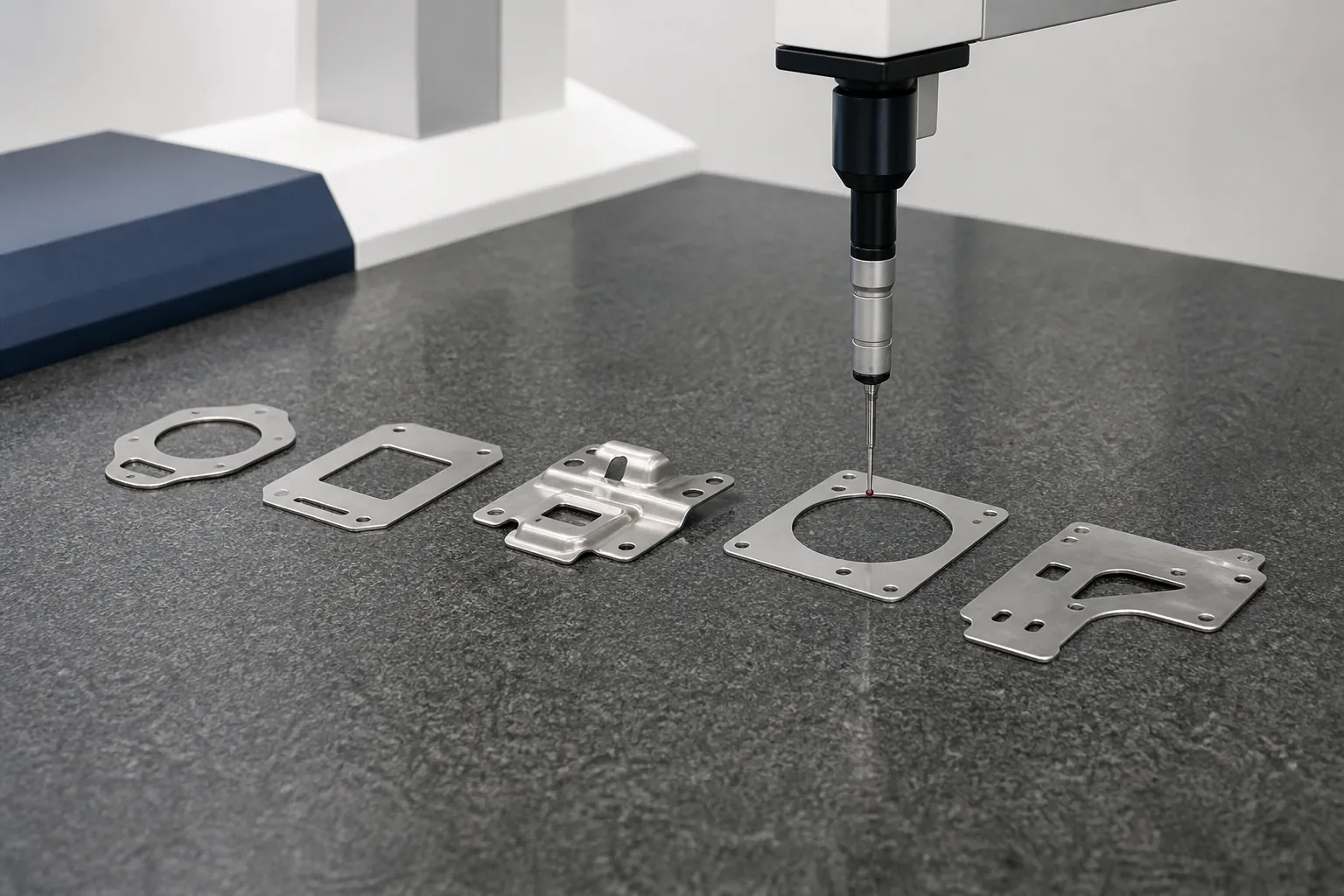
The records we can supply: CMM dimensional report, first article inspection (FAI), EN 10204 material certificate, coating thickness readings, and hardness results where heat treatment is involved. If your QA needs a specific format, tell us in the RFQ and we will match it.
Third-party inspection is welcome — SGS, TÜV, BV or your own engineer, at any point in the run. Die wear is a real cost driver on long runs; if you are already in production elsewhere, our note on extending stamping die service life explains what normally shortens it.
Frequently asked questions about custom metal stamping
What is the minimum order quantity for custom metal stamping?
There is no minimum order quantity — we will run a single piece for prototype validation. The real threshold is the tooling: below roughly 1,000 pieces, and especially below 500, a die often costs more than the parts. For those volumes we will quote laser cutting and metal bending instead, and tell you why.
When does metal stamping become cheaper than other processes?
As a working rule: below about 1,000 pieces, fabrication (laser cutting plus bending) is usually cheaper. Above roughly 5,000 to 10,000 pieces, progressive die stamping normally wins on total cost. Between those figures it depends on part complexity — send the drawing and we will quote both routes so you can compare on real numbers. Our guides to reducing metal stamping costs and lowering sheet metal stamping costs cover the design choices that move this line.
Do you design and build the dies, or subcontract them?
In-house. Our tool room designs and builds progressive, compound and transfer dies, which is why one party owns the tolerance stack and one party answers if a dimension drifts.
Do you supply inspection documentation?
Yes. CMM dimensional reports, first article inspection reports, EN 10204 material certificates and coating thickness readings are available on the order, and third-party inspection by SGS, TÜV or BV can be arranged.
What tolerances can you hold on stamped parts?
±0.02 mm on critical features is our normal working tolerance. Tighter is possible on selected dimensions with a dedicated die, but it has to be engineered in from the start, not requested afterwards.
Can you stamp stainless steel and aluminium, or only carbon steel?
All three, plus copper and brass. Stainless is the one that needs the most care because it work-hardens: tooling clearances, bend radii and lubrication are set differently, and springback has to be compensated in the die rather than corrected by the operator.
What is the difference between progressive, compound and transfer dies?
Progressive dies move a coil through sequential stations, so the part is finished when it exits the last one — best for high volumes and complex shapes. Compound dies complete all cutting in one stroke, which keeps holes and profile in exact relationship — best where concentricity matters. Transfer dies carry separate blanks between stations by gripper — best for large, deep or heavy parts that cannot be coil-fed.
Can you handle a part that also needs welding or assembly?
Yes — welding runs in the same plant, so a stamped part can arrive finished as a welded sub-assembly rather than as loose components. There is no second supplier in the tolerance chain. Our welding and riveting parts page covers that side.
Get a metal stamping quote
Send the drawing, the material grade if it is fixed, and your annual volume. You will get a DFM review, a tooling price and a per-piece price — normally within one working day. Tooling is quoted separately from the part price so you can see exactly what you are buying. For how tooling and volume interact with price, see how we price metal fabrication.
Submit through the RFQ form, or email and WhatsApp the drawing directly.
Other capabilities in our plant
A stamped part rarely travels alone. Where a job needs a second process, it runs under the same work order rather than through a subcontractor:
- Custom metal fabrication — the general case: cut, formed and joined sheet metal parts
- Metal deep drawing — multi-stage hydraulic drawing for cups, cans and enclosures
- CNC machining — five-axis milling and turning to ±0.005 mm
- Laser cutting — 12,000 W fibre laser for flat blanks and profiles
- Metal welding — MIG, TIG, spot and laser welding for sub-assemblies
- Surface finishing — plating, powder coating, anodising and passivation
Related solutions and resources
Stamping sits between prototyping and volume. These are the pages most often read alongside it:
- High-volume production — running a stamped part at scale
- Metal deep drawing — forming a shell instead of a flat part
- Rapid prototyping — proving the part before the tool is cut
- Stamped metal parts — worked examples from production
- Automotive and electronics — industries we stamp for
- Metal fabrication prices — how tooling amortisation affects unit cost
See how a repeat European buyer reviewed stamped and formed stainless work: France case study.
Standards referenced
- ASTM International — material and test standards
- worldsteel Association — steel grade and property reference
- IATF — automotive quality management requirements