


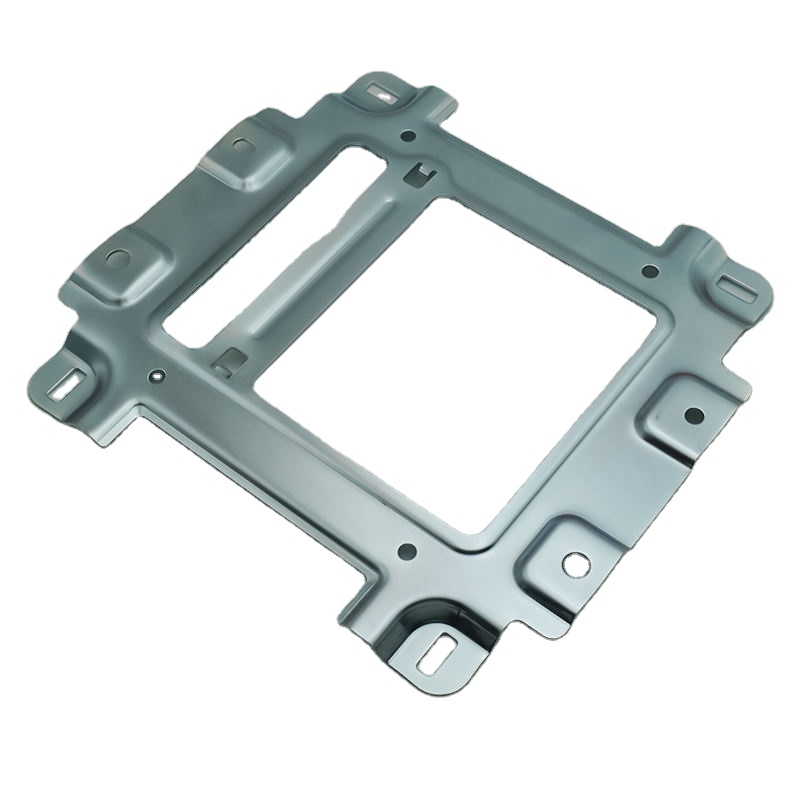
Sheet metal thickness is specified three different ways — millimetres, gauge number, and inches — and they do not convert cleanly. This chart gives the equivalent values, and shows which thicknesses we process for laser cutting, press brake bending and stamping.
Why gauge is the confusing one
Millimetres and inches are absolute. Gauge is not. A gauge number refers to a standard table, and different standards apply to different metals:
| Metal | Gauge standard | Why it matters |
|---|---|---|
| Carbon steel sheet | US Standard Gauge (USS) | The values below are for carbon steel |
| Stainless steel | A different table | The same gauge number is a different thickness than carbon steel |
| Aluminium | Different again | Aluminium gauge tables do not match steel either |
| Galvanised steel | Usually USS plus coating | Coating thickness adds to the finished dimension |
Practical consequence: if a drawing says "18 gauge" without naming the material and the standard, the part can come out the wrong thickness. Specify millimetres and you remove the ambiguity entirely.
Standard thickness chart (carbon steel sheet, US Standard Gauge)
| Gauge | Inch (nominal) | mm | Typical use |
|---|---|---|---|
| 30 | 0.0120" | 0.305 | Shims, light screens |
| 28 | 0.0149" | 0.378 | Shims, precision washers |
| 26 | 0.0179" | 0.455 | Light covers, shields |
| 24 | 0.0239" | 0.607 | Small enclosures, covers |
| 22 | 0.0299" | 0.759 | Brackets, panels |
| 20 | 0.0359" | 0.912 | General brackets, covers |
| 18 | 0.0478" | 1.214 | Standard sheet metal fabrication |
| 16 | 0.0598" | 1.519 | Structural brackets, chassis |
| 14 | 0.0747" | 1.897 | Load-bearing brackets, frames |
| 12 | 0.1046" | 2.657 | Heavy brackets, machine guards |
| 11 | 0.1196" | 3.038 | Frames, supports |
| 10 | 0.1345" | 3.416 | Structural fabrication |
| 9 | 0.1495" | 3.797 | Heavy structural |
| 8 | 0.1644" | 4.176 | Heavy structural, base plates |
| 7 | 0.1793" | 4.554 | Base plates |
| 6 | 0.1943" | 4.935 | Heavy plates |
| 5 | 0.2092" | 5.314 | Heavy plates |
| 4 | 0.2242" | 5.695 | Heavy plate work |
| 3 | 0.2391" | 6.073 | Heavy plate work |
Practical note on thickness tolerance. Sheet arrives within a tolerance band rather than at a nominal figure, and that band matters more than the nominal value for a stamped or drawn part. Where the acceptable band is not stated, we will flag it during DFM review.
Common metric thicknesses (what drawings usually specify)
| mm | Inch | Gauge equivalent (carbon steel) | Common in |
|---|---|---|---|
| 0.5 | 0.0197 | ≈ 26–25 | Light covers, shields |
| 0.8 | 0.0315 | ≈ 21 | Enclosures, brackets |
| 1.0 | 0.0394 | ≈ 20 | General sheet metal |
| 1.2 | 0.0472 | ≈ 18 | General fabrication |
| 1.5 | 0.0591 | ≈ 16 | Structural brackets |
| 2.0 | 0.0787 | ≈ 14 | Frames, load-bearing parts |
| 2.5 | 0.0984 | ≈ 13 | Heavy brackets |
| 3.0 | 0.1181 | ≈ 11 | Structural fabrication |
| 4.0 | 0.1575 | ≈ 9 | Heavy structural |
| 5.0 | 0.1969 | ≈ 6 | Plates |
| 6.0 | 0.2362 | ≈ 3–4 | Plates |
Most of our work sits between 0.5 mm and 6 mm. Metric drawings are the norm for European, Australian and most Asian customers; inch drawings are common from the United States.
Thickness tolerance — the part buyers forget
The nominal thickness is not what you receive. Sheet arrives within a tolerance band, and that band matters more than the nominal value for a stamped or drawn part.
| Standard | Typical thickness tolerance | Note |
|---|---|---|
| Cold rolled (DC01–DC04) | Tight band | Best for stamping and drawing |
| Hot rolled (SPHC) | Wider band, plus scale | Cheaper; surface preparation often needed |
| Hot-dip galvanised | Base plus coating thickness | Coating adds to the finished dimension |
Why this matters commercially: a stamped part is tooled to a nominal thickness. If the incoming coil sits at the top of its tolerance band, or a different supplier sends material at the bottom, the die clearance is wrong and you get burrs, cracking or poor dimensional control. Tell us the thickness tolerance your part can accept, not just the nominal.
Thickness and process selection
| Thickness range | Best process | Why |
|---|---|---|
| 0.3–1.5 mm | Stamping, laser cutting, bending | Thin material forms and cuts economically |
| 1.5–3 mm | Laser cutting, bending, light stamping | Good balance of rigidity and formability |
| 3–6 mm | Laser cutting, heavy bending, machining | Bending forces rise; press capacity matters |
| 6 mm and above | Machining, waterjet, heavy fabrication | Laser cutting becomes slow and heat-affected zone grows |
Frequently asked questions
What gauge is 1 mm steel sheet? 1 mm is very close to 20 gauge in US Standard Gauge for carbon steel (20 ga is 0.0359" or 0.912 mm). 1 mm is thicker than 20 ga and thinner than 19 ga. Because gauge tables differ by metal, specify 1 mm rather than a gauge number.
Is 16 gauge thicker than 18 gauge? Yes. In sheet metal gauge, a lower gauge number is thicker. 16 ga is 1.519 mm and 18 ga is 1.214 mm.
Does the same gauge mean the same thickness for stainless steel? No. Stainless steel and aluminium use different gauge tables from carbon steel, so the same gauge number gives a different thickness. Always confirm which standard applies, or specify millimetres.
What thickness can you laser cut? We cut thin gauge sheet through heavy plate on a high-power fiber laser. Send the material, thickness and part size and we will confirm the cut quality and edge condition for your specific job rather than quoting a single maximum.
What is the thinnest sheet you can stamp? Stamping is practical from roughly 0.3 mm upward depending on part geometry. Very thin material needs tighter die clearance control, which we confirm during DFM review against your drawing.
Does thickness affect bending radius? Yes. Minimum bend radius scales with thickness, and the achievable radius depends on the material. As a working rule the inside radius should not be smaller than the material thickness for most steels, and greater for high-strength or hardened grades. We review this per part during DFM.