


Custom laser cutting service on a 12,000 W fibre laser, for flat blanks, brackets, panels and profile parts in carbon steel, stainless and aluminium. Laser cutting is the process that needs no tooling, which makes it the correct first step from a single prototype to the volume where stamping tooling starts to pay — and it is the operation that establishes the edge every later bend and weld is measured from. ISO 9001:2015, registration 34025Q30296R0S. No minimum order quantity.
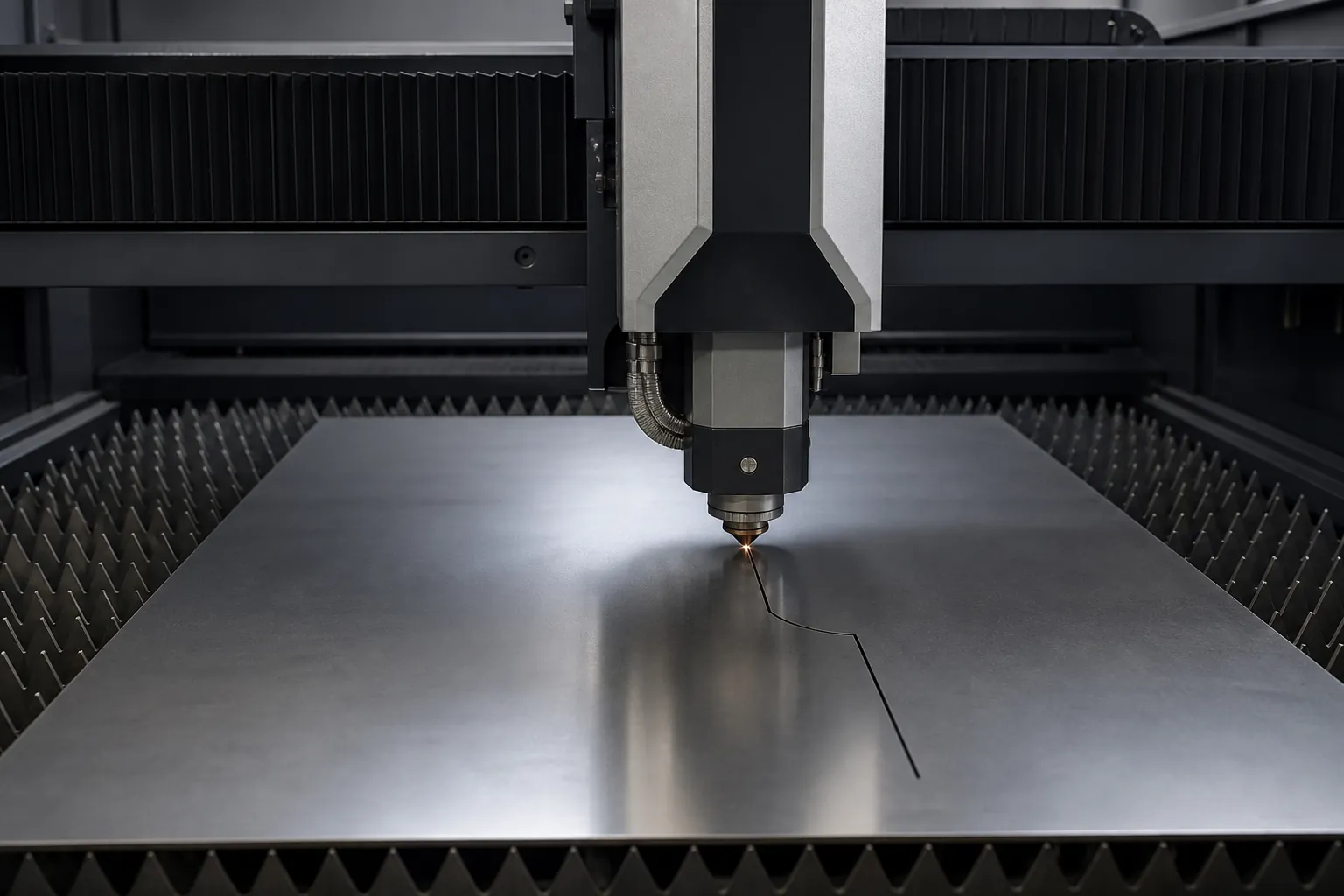
| 12,000 W | fibre laser source |
| No tooling | from 1 piece to mid volume |
| Carbon / stainless / aluminium | plus copper and brass |
| 3,200 mm | CNC press brake for downstream forming |
| ISO 9001:2015 | reg. 34025Q30296R0S |
| No MOQ | from 1 piece |
Why choose us for laser cutting
No tooling means no minimum. A laser does not care whether it is cutting one part or two thousand — there is no die to justify. That is why laser cutting is the right answer for prototypes, for one-offs and for any part whose design is still moving, and why we will quote it instead of stamping whenever the volume does not support a die.
The edge is the datum for everything after it. A bent part is only as accurate as the blank it came from, and a welded assembly is only as square as the plates that were cut for it. Cutting and forming run in the same plant, so the edge established on the laser is the edge the press brake works to.
12,000 W is about speed and thickness, not just power. A higher-power source cuts production gauges faster and handles heavier plate without the heat input that distorts thin material. It also means nitrogen or air cutting can be used where an oxide-free edge matters for a later weld or a cosmetic face.
Heat input is managed, not ignored. Laser cutting puts heat into a narrow band at the cut. On thin material that can mean a hard edge or a slight bow. We set the process parameters for the material and thickness rather than running one recipe for everything.
What is laser cutting?
Laser cutting uses a focused beam of light to melt and eject material along a programmed path, producing a finished edge without physical contact between tool and workpiece. Because the beam is positioned by a motion system rather than shaped by a die, the geometry is changed by editing the program — which is why a design can be revised and re-cut in hours rather than weeks.
Common laser cutting methods and considerations
Fusion cutting with nitrogen — An inert assist gas blows the molten material clear without oxidising the cut face. Slower than oxygen cutting but leaves a clean, oxide-free edge, which matters on stainless and aluminium where an oxidised edge would need cleaning before welding or painting.
Oxygen-assisted cutting — The oxygen reacts with the material, adding heat and increasing speed on carbon steel. It leaves a slightly oxidised edge, which is normally acceptable on steel that will be painted or galvanised but is not the right choice where the edge will be welded without cleaning.
Air and compressed-air cutting — A practical middle ground on thinner material, giving a reasonable edge at lower gas cost. Suited to parts where the edge will be mechanically finished or coated anyway.
Nesting — Parts are arranged on the sheet to minimise scrap, with the grain direction and any cosmetic requirement respected. On stainless, where the sheet is often the dominant cost of the part, nesting is a real cost lever rather than a detail.
Piercing and lead-ins — Where the beam enters and how it approaches the profile leaves a mark. On visible parts we place the pierce away from the cosmetic face or use a lead-in that runs off the part.
Cut quality and kerf — The kerf has a width, and it is not perfectly parallel: the entry is slightly wider than the exit. On a part with a tolerance that matters, the kerf and the taper are allowed for in the program rather than discovered on the finished part.
Key advantages of laser cutting
| Advantage | What it means commercially |
|---|---|
| No tooling cost | The right process from one part upward, and the reason design changes stay cheap |
| Fast from file to part | A drawing can become finished parts in days, with nothing to cut in the tool room first |
| Complex profiles at no extra cost | Cut-outs, slots and curved outlines cost the same as a straight edge |
| Clean edge on stainless | Nitrogen cutting avoids the oxide layer that would need removing before welding |
| Tight profile tolerance | The beam follows the program, so hole position is held by the machine rather than by a die |
| Low heat input | Distortion stays local, unlike a thermal process applied across the whole sheet |
Common applications and scenarios for laser cut parts
Prototypes and first articles — The first version of almost every part we make is laser cut, because it validates the design without committing to tooling. See rapid prototyping.
Brackets, plates and panels — Mounting plates, reinforcement plates, gussets, front panels and access covers. Our custom metal brackets guide covers the design side.
Enclosure and chassis blanks — The flat pattern for a folded enclosure, including ventilation slots, connector cut-outs and cable entries. See sheet metal bending for what happens next.
Welded fabrication components — Plates and profiles for welded frames and structures, where the cut edge and hole position set the squareness of the finished assembly. See metal welding.
Machine guards and mesh frames — Guard frames, infill panels and mounting brackets, including heavier gauge than a press brake alone could form. See industrial machinery.
Bridge quantities before tooling — Where a part will eventually be stamped but the design is not frozen, laser cutting carries production until the numbers are confirmed. That is often the cheapest way to reach the point where a die makes sense.
When laser cutting is the wrong answer — above a few thousand identical pieces a die will normally beat it on unit cost, and where a part needs a formed 3D shape rather than a flat profile, cutting is only the first operation. We will quote the better route and say why.
How our laser cutting service works
1. Send the drawing or the flat pattern. DXF or DWG is ideal; STEP and SLDPRT also work because the flat pattern can be unfolded from the model. Include the material and thickness, and the quantity. Engineering responds within 3 hours on working days.
2. Cutability and nesting review, free. We check the kerf allowance, minimum feature sizes, whether the pierce point lands somewhere visible, and how the parts nest to keep scrap down. On stainless this is where material cost is usually reduced.
3. Material verification. The sheet is checked against the mill certificate before it is cut, so the certificate that ships with your parts corresponds to the material actually used.
4. Cutting. 12,000 W fibre laser with process parameters set for the material and thickness, and nitrogen assist gas wherever an oxide-free edge is needed for welding or appearance.
5. Deburring and forming. Edges are deburred before the parts move on, then bent on the 3,200 mm CNC press brake where the drawing requires it. Doing both in one plant keeps the cut edge as the datum for the bend.
6. Inspection and shipment. CMM dimensional reports, first article inspection and EN 10204 material certificates ship with the order.
Laser cutting capabilities and specifications
| Parameter | Capability |
|---|---|
| Laser source | 12,000 W fibre laser |
| Assist gases | Nitrogen, oxygen, compressed air |
| Materials | Carbon steel, stainless steel (301/304/316L), aluminium (1100/5052/6061), copper, brass, galvanised and pre-coated strip |
| Downstream forming | 3,200 mm CNC press brake, in the same plant |
| Related operations | Deburring, bending, welding, hardware insertion, finishing |
| Minimum order quantity | None — from 1 piece |
| Engineering response | ≤3 hours on working days |
| Quality system | ISO 9001:2015, registration 34025Q30296R0S |
| Records supplied | CMM reports, FAI, EN 10204 material certificates |
| Plant | 15,000 m², 6 production lines, 85 employees |
Materials we cut
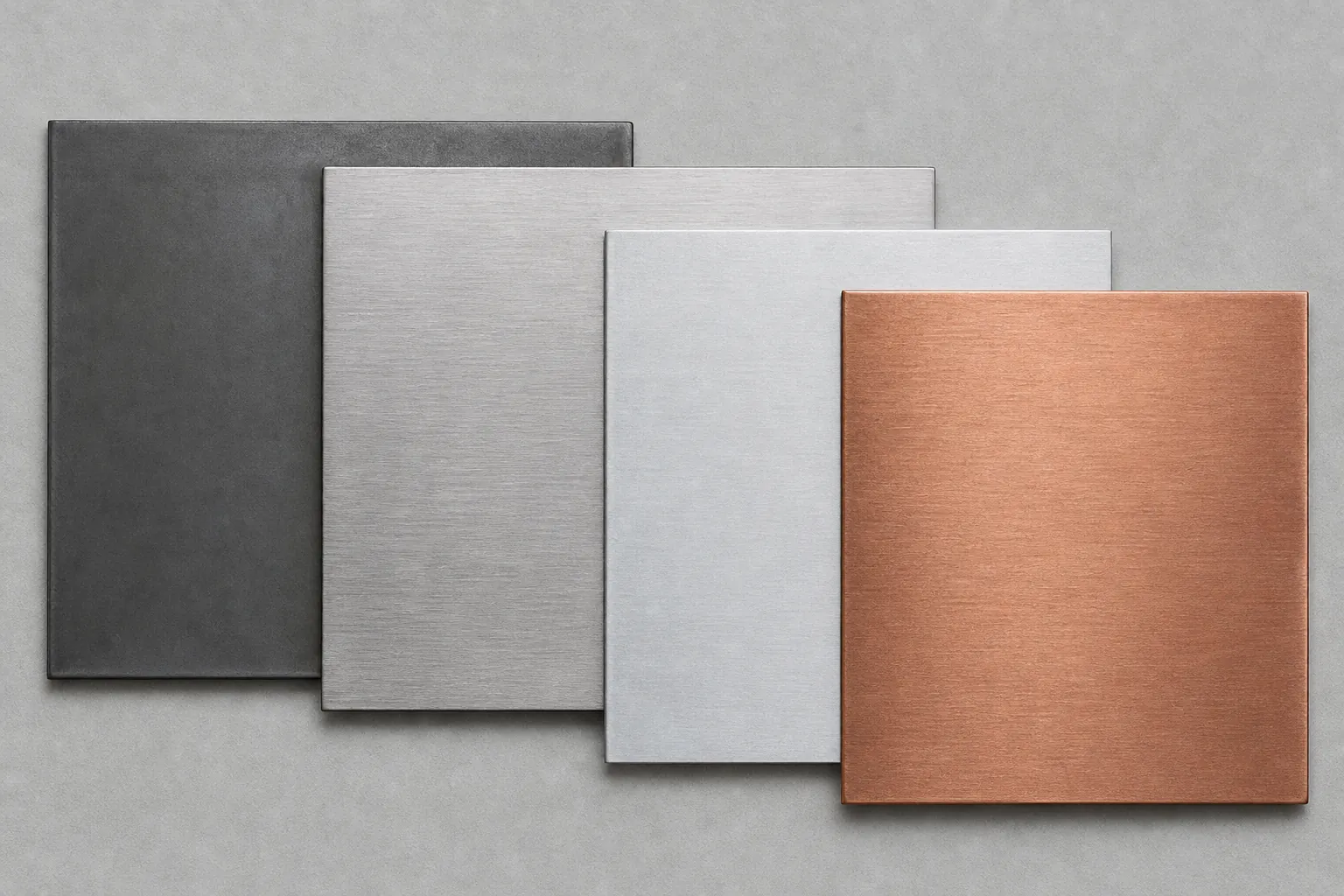
Carbon steel — CR4 and SPCC cold-rolled for clean edges and tight features, hot-rolled for heavier plate. Oxygen cutting is normally fastest here; where the edge will be welded without cleaning, nitrogen is used instead. See the materials guide.
Stainless steel — 301, 304 and 316L, cut with nitrogen so the edge stays oxide-free and weldable. Stainless absorbs heat differently from carbon steel, so parameters are set per grade rather than reused.
Aluminium — 5052 and 6061 for panels, brackets and enclosures, plus 1100 where conductivity or cost dominates. Aluminium reflects and conducts heat away quickly, so the cut settings and the assist gas both differ from steel work.
Copper and brass — C110 and C260 for busbars, contacts and shielding parts, where conductivity is the reason the part exists.
Galvanised and pre-coated strip — Where the coating is already on the sheet. The laser removes the coating locally at the cut, so the exposed edge is unprotected — acceptable indoors, and a reason to choose a different finish where the part is exposed.
Thickness is the variable that changes cut settings most, and the same nominal gauge behaves differently across these materials. Our sheet metal thickness chart lists the gauge equivalents.
Quality control on laser cut parts
The tolerances that matter on a cut part are hole position, profile size and edge condition. Hole position is held by the machine following the program, which is why laser cutting is often chosen over a die for a part whose hole pattern must be correct on the first attempt.
Records available with the order: CMM dimensional report, first article inspection and EN 10204 material certificate. Where a part will be welded, the edge condition can be inspected and reported. Third-party inspection by SGS, TÜV or BV can be arranged at any point.
Frequently asked questions about laser cutting
When is laser cutting cheaper than stamping?
Below roughly 1,000 pieces a year, almost always — there is no die to pay for. Above about 5,000 to 10,000 pieces, progressive die stamping normally wins on total cost because the unit cost drops to material plus press time. Between those figures it depends on part complexity. Send the drawing and the annual volume and we will quote both routes so the comparison is on real numbers rather than a rule of thumb.
Why does my stainless part have a brown edge after laser cutting?
Because it was cut with oxygen, which oxidises the cut face and leaves a discoloured, hardened edge. That edge then has to be cleaned or ground before welding, or the weld will not be clean. Cutting stainless with nitrogen avoids the oxide altogether, which is why we use nitrogen assist gas on stainless that will be welded or left visible.
How accurate is laser cutting compared with a die?
Hole position and profile size are held by the machine following a programmed path, so accuracy is consistent from the first part. A die can hold tighter tolerances on a specific dimension once it is proven, and it is faster per piece, but it has to be cut, tried and corrected first. For prototypes and low volume, laser cutting is usually both faster to first part and cheaper overall.
What thickness can you cut?
The practical limit depends on material as well as thickness — stainless and aluminium absorb heat differently from carbon steel, and copper reflects the beam. Rather than quote a single maximum figure, tell us the material, thickness and part size and we will confirm directly whether it suits our 12,000 W fibre laser and what the realistic cut quality will be.
Can you cut and then bend the same part in one order?
Yes. Cutting and forming run in the same plant on a 3,200 mm CNC press brake, so the blank is cut, deburred and bent under one work order. That matters for accuracy: the bend is measured from the edge the laser produced, rather than from an edge produced by another supplier to a different tolerance.
Get a laser cutting quote
Send the DXF, DWG or 3D model with the material, thickness and quantity. You will get a cutability review, a nesting suggestion where it reduces cost, and a price — normally within one working day. See how we price metal fabrication, or use the RFQ form.
Related capabilities
- Sheet metal fabrication — cutting, forming, joining and finishing under one work order
- Sheet metal bending — 3,200 mm CNC press brake, same plant
- Custom metal stamping — for the volumes where a die beats the laser
- Rapid prototyping — laser cut prototypes and first articles
- CNC machining — machined features forming cannot produce
- Laser cutting detail — worked examples from production
Related solutions and resources
Laser cutting is normally the first operation in a longer route:
- Sheet metal fabrication — the complete cut, form and finish route
- Metal bending — what happens to the cut blank next
- Metal stamping — when volume makes a tool cheaper than the laser
- Laser cutting service — worked examples from production
- Standard sheet metal thicknesses chart — what our 12,000 W source can cut
- Electronics and automotive — industries we cut for
See a multi-process order reviewed by its buyer: Ukraine case study.
Standards referenced
- Laser Institute of America (LIA) — laser processing reference
- ASTM International — material and test standards
- worldsteel Association — steel grade and property reference