


High-volume metal production for parts that repeat in the tens or hundreds of thousands: progressive die stamping on presses from 25 to 400 tonnes, multi-stage deep drawing, and automated inspection, with the dies designed and built in our own tool room. At this volume the process changes shape — the question stops being “how do we make this part” and becomes “how do we keep making it identically for years.” ISO 9001:2015, registration 34025Q30296R0S.
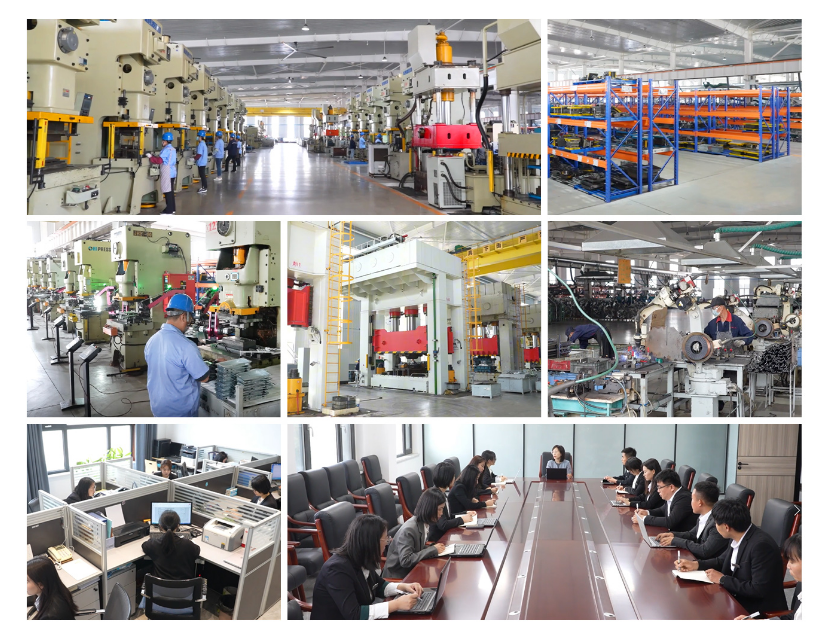
| 25–400 t | stamping press range |
| Progressive / compound / transfer | dies built in-house |
| ±0.02 mm | on critical features |
| In-process checks | tied to critical dimensions |
| EN 10204 + FAI | material and dimensional records |
| ISO 9001:2015 | reg. 34025Q30296R0S |
Why high-volume work is different
The cost structure inverts. Below a few thousand pieces the die dominates the price; above that, the die is amortised and the unit cost falls to material plus press time. That is why the tooling decision is really a volume decision, and why we will quote the volume against both stamping and fabrication rather than assuming one.
Consistency becomes the product. At ten thousand pieces a customer accepts parts that fit. At a million, the requirement is that part one and part five hundred thousand are interchangeable — which depends on the die and on die maintenance, not on the operator. Because we build the dies ourselves, tool life and tool maintenance are ours to manage.
Die wear is the real quality variable. A stamped part drifts out of tolerance gradually as the die wears, not suddenly. In-process checks are therefore tied to the critical dimensions across the run rather than to a fixed calendar, so the drift is caught before it produces a bin of out-of-tolerance parts. On long runs, see our note on extending stamping die service life.
Logistics start to matter as much as manufacturing. At volume, packaging, part-to-part protection, pallet configuration and shipping frequency become part of the specification. A cosmetic part that arrives scratched has failed regardless of its dimensions.
What high-volume production means here
High-volume production is not a single process — it is the set of choices that make a part cheap and repeatable once its geometry is fixed. In practice, that means a die rather than a program, a press rather than a machine tool, and inspection tied to the run rather than to the part.
Routes for volume production
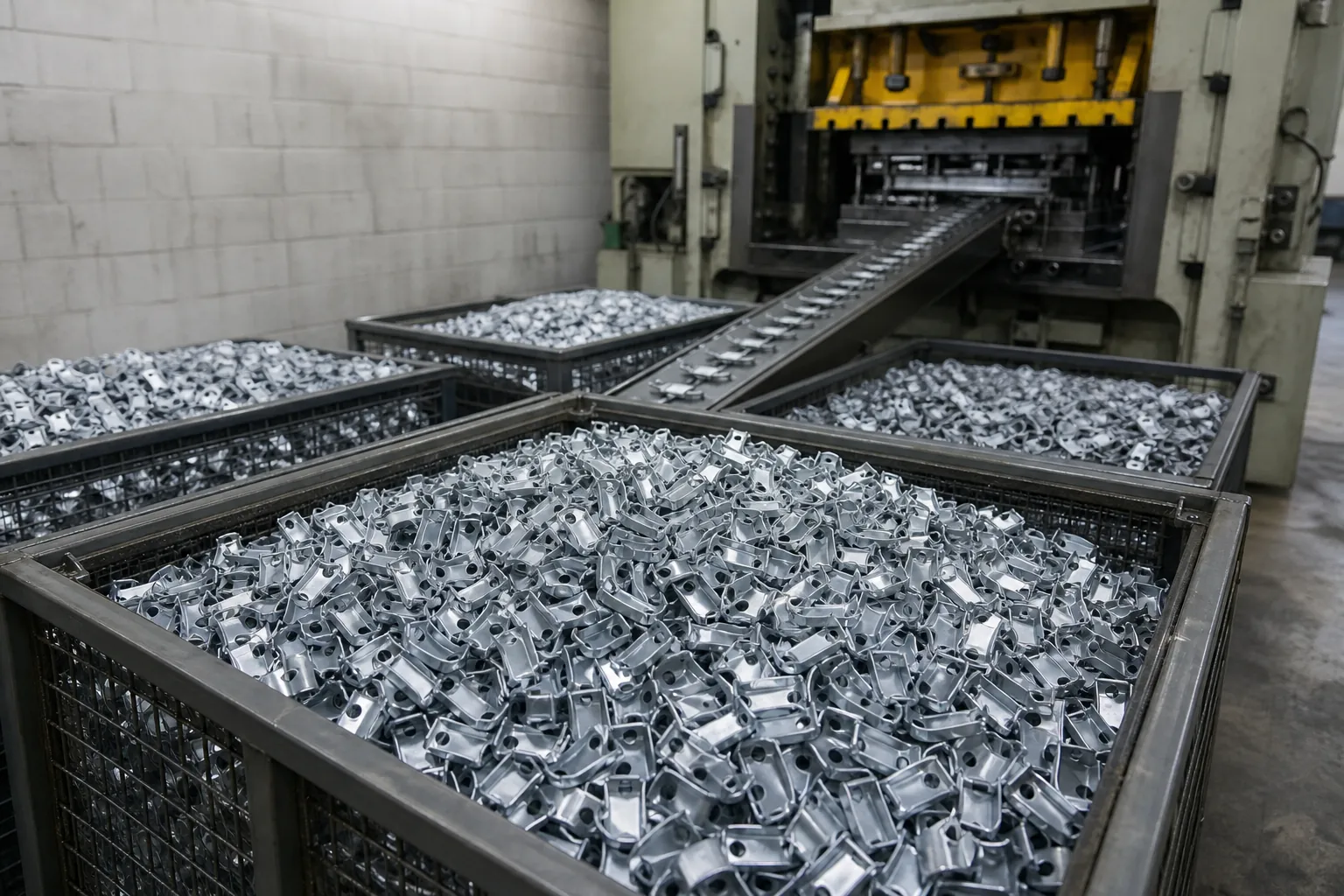
Progressive die stamping — The mainstay. Coil feeds through sequential stations performing pierce, form, bend, emboss, trim and separate; the part is finished when it leaves the last station, with no manual handling between operations. This is the lowest per-piece cost route for complex parts at volume. See custom metal stamping.
Compound die stamping — All cutting in a single stroke, which holds blank profile and hole positions in exact relationship. Used at volume where concentricity or hole-to-edge accuracy is the critical dimension.
Transfer die stamping — Separate blanks carried between stations by grippers rather than the strip. For large, deep or heavy parts that cannot be coil-fed.
Multi-stage deep drawing — Volume production of cups, cans and seamless enclosures, where the stage count is engineered from the material’s forming limit. See metal deep drawing.
Volume assembly — At high quantities, assembling a sub-assembly in a fixture rather than shipping loose components reduces handling for the customer and consolidates inspection. See assembly services. If the design is not yet frozen, start with rapid prototyping.
Finishing in line — Plating, coating or passivation applied to the finished batch, with coating thickness controlled so that volume repeatability is not lost at the finishing stage.
Why stamping wins at volume
| Factor | What it means commercially |
|---|---|
| Unit cost falls to material plus press time | Once the die is amortised, cost is driven by the strip and the cycle, not by labour |
| Identical parts across millions | The shape is in the tool, so batch ten matches batch one |
| No per-part labour | Coil feeds and parts exit finished; there is no operation to staff per piece |
| Material efficiency | Strip nesting keeps scrap down, which matters most on the higher-cost grades |
| Integrated features | Bends, ribs, holes and embossing in one die, reducing part count and assembly |
| Predictable capacity | Press time is scheduled, so volume delivery dates can be supported rather than hoped for |
Common high-volume scenarios
Automotive and EV hardware — Battery module brackets, busbar supports, shims and terminals, where a production programme runs for years and every unit must be identical. See automotive and EV.
Connectors, contacts and shielding — Thin-material parts at very high volume, where pitch consistency is what the part is for. See electronics.
Construction and scaffold hardware — Hangers, clips, hinges and couplers where the same part appears tens of thousands of times and consistency is a safety characteristic. See construction and hardware.
Energy infrastructure hardware — Clamps, brackets and laminations at project volume, usually galvanised. See energy and infrastructure.
Containers, cans and housings — Volume deep-drawn components where the seamless wall removes a welding operation from every unit.
When a die is the wrong answer — below roughly 1,000 pieces a year a die rarely pays back; where the design changes every few months a die locks you in; and where the annual quantity is uncertain, fabrication lets you keep the option open until the numbers are real. We will quote the alternative and say so.
How we set up a high-volume programme
1. Send the drawing, the annual volume and the expected life. Volume and expected programme life decide the die design more than the geometry does. Engineering responds within 3 hours on working days.
2. Volume and process review, free. We compare stamping against fabrication at your volume and say which is cheaper and by roughly how much, then review strip layout, feature strength, minimum hole-to-edge distances and bend radii for a die.
3. Die design and build in our own tool room. Progressive, compound or transfer die, designed for the annual volume and designed to be maintainable, because a die that cannot be serviced cheaply becomes an expensive die over a long programme.
4. First article approval. Samples and a dimensional report go to you before volume starts. Nothing runs on an unapproved first article.
5. Production with in-process checks. Inspection intervals are tied to the critical dimensions so that die wear is caught as drift, before it becomes a bin of rejects.
6. Finishing, inspection and shipment. Plating or coating applied to the batch, CMM and FAI documentation supplied, and packaging specified for the volume and the cosmetic requirement.
High-volume production capabilities and specifications
| Parameter | Capability |
|---|---|
| Press range | 25–400 tonnes |
| Die types | Progressive, compound, transfer |
| Tooling | Designed and built in-house; maintained in-house |
| Tolerance | ±0.02 mm on critical features |
| Deep drawing | Multi-stage hydraulic presses for volume containers |
| Materials | Carbon steel, stainless steel (301/304/316L), aluminium, copper, brass, galvanised and pre-coated strip |
| Surface finishes | Zinc plating, powder coating, anodising, passivation, deburring, heat treatment |
| Inspection | In-process checks tied to critical dimensions; CMM reports; FAI; EN 10204 certificates |
| Engineering response | ≤3 hours on working days |
| Quality system | ISO 9001:2015, registration 34025Q30296R0S |
| Plant | 15,000 m², 6 production lines, 85 employees |
Frequently asked questions about high-volume production
At what volume does stamping beat fabrication?
As a working rule, below about 1,000 pieces a year the tooling rarely pays back and fabrication is cheaper. Above roughly 5,000 to 10,000 pieces progressive die stamping normally wins on total cost, because the unit cost falls to material plus press time once the die is amortised. Between those figures it depends on part complexity and on how long the programme will run. Send the drawing with the annual volume and we will quote both routes so the comparison is on real numbers.
How do you keep quality consistent across a long run?
By treating die wear as the quality variable it is. A stamped part drifts as the die wears rather than failing suddenly, so in-process checks are tied to the critical dimensions across the run instead of to a fixed calendar. Because we build the dies ourselves, we also know where each die wears first and can schedule maintenance against that rather than waiting for a dimension to go out.
What happens if the design changes after the die is built?
It depends on the change. Altering a hole position or a trim line is normally a die modification; changing the material thickness or the fundamental geometry can mean a new die. This is the main commercial risk of committing to tooling early, which is why we recommend proving the geometry with cut and bent prototypes first — see rapid prototyping — and why we will tell you at DFM review which characteristics are expensive to change later.
Can you support a programme that runs for several years?
Yes, and that is what the die investment is for. A long programme is the case where building and maintaining the die in-house matters most: tool life stops being somebody else’s problem to schedule, and a die that cannot be cheaply serviced becomes very expensive over millions of parts. Tell us the expected programme life at RFQ so the die is designed for it rather than for the first order.
Do you provide inspection documentation at volume?
Yes. In-process checks are recorded against the critical dimensions, and CMM dimensional reports, first article inspection and EN 10204 material certificates are available with the shipment. Where a programme needs an agreed inspection frequency, a control plan or a customer-specific report format, raise it at RFQ and we will agree it before the first article rather than after.
Get a volume production quote
Send the drawing, the annual volume and the expected programme life. You will get a comparison of stamping against fabrication at your volume, a tooling price and a per-piece price — normally within one working day. See how we price metal fabrication, or use the RFQ form.
Related capabilities
- Custom metal stamping — progressive, compound and transfer dies
- Metal deep drawing — volume containers and enclosures
- Assembly services — volume sub-assembly and inspection
- Rapid prototyping — prove the geometry before the die
- Custom laser cutting — the bridge route below die volume
- Reducing stamping costs — the design choices that move the unit price
Related solutions and resources
Volume changes which process is economic. These pages cover the trade-offs:
- Metal stamping — the process most volume parts move onto
- Assembly services — keeping volume work as one shipment
- Rapid prototyping — where a volume project starts
- Metal fabrication prices — how volume changes unit price
- Automotive and electronics — the volume-driven industries
- Reduce stamping costs — cost levers at volume
See how a repeat European buyer reviewed multi-quantity production work: France case study.
Standards referenced
- IATF — automotive quality management requirements
- ASTM International — material and test standards
- worldsteel Association — steel grade and property reference