


In practice, Energy infrastructure metal fabrication for solar, wind, grid and battery storage: mounting brackets, transformer clamps and laminations, cable trays, earthing components and enclosure frames. The requirement that shapes everything in this sector is time in service. A bracket on a rooftop array or a substation has to hold its coating for twenty years, not until the first invoice clears, which is why hot-dip galvanising and 304/316L stainless dominate the material list. ISO 9001:2015, registration 34025Q30296R0S. No minimum order quantity.
Key facts: energy and power infrastructure metal parts
| Materials | Stainless steel 304 and 316, cold rolled and hot rolled steel, aluminium 5052 and 6061, copper and brass |
| Sheet thickness | From 0.5 mm upward, with heavier plate quoted on request |
| Processes | Laser cutting, press brake bending, stamping, deep drawing, MIG and TIG welding, spot and laser welding, riveting, assembly |
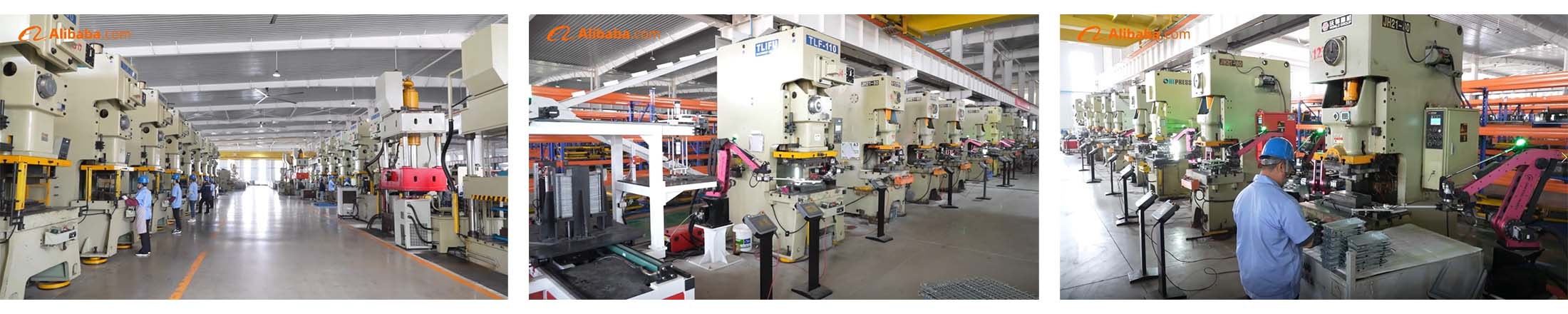
| Press range | 25 to 400 tonnes, covering progressive die and single-station stamping as well as heavier forming and drawing |
| Welding | MIG, TIG, spot and laser welding; in-house stress relief for welded frames that must stay flat |
| Finishes | Deburring, zinc plating, powder coating, passivation, brushing |
| Typical parts | Brackets and mounting plates, frame components, busbar supports, cable trays and covers, heat exchanger housings, terminal and switchgear hardware |
| Documentation | CMM dimensional reports, first article inspection reports, EN 10204 material certificates, hardness and coating thickness results |
| Minimum order quantity | None |
| Sample lead time | 7 days typical; quotation, DFM review and lead time within 24 hours |
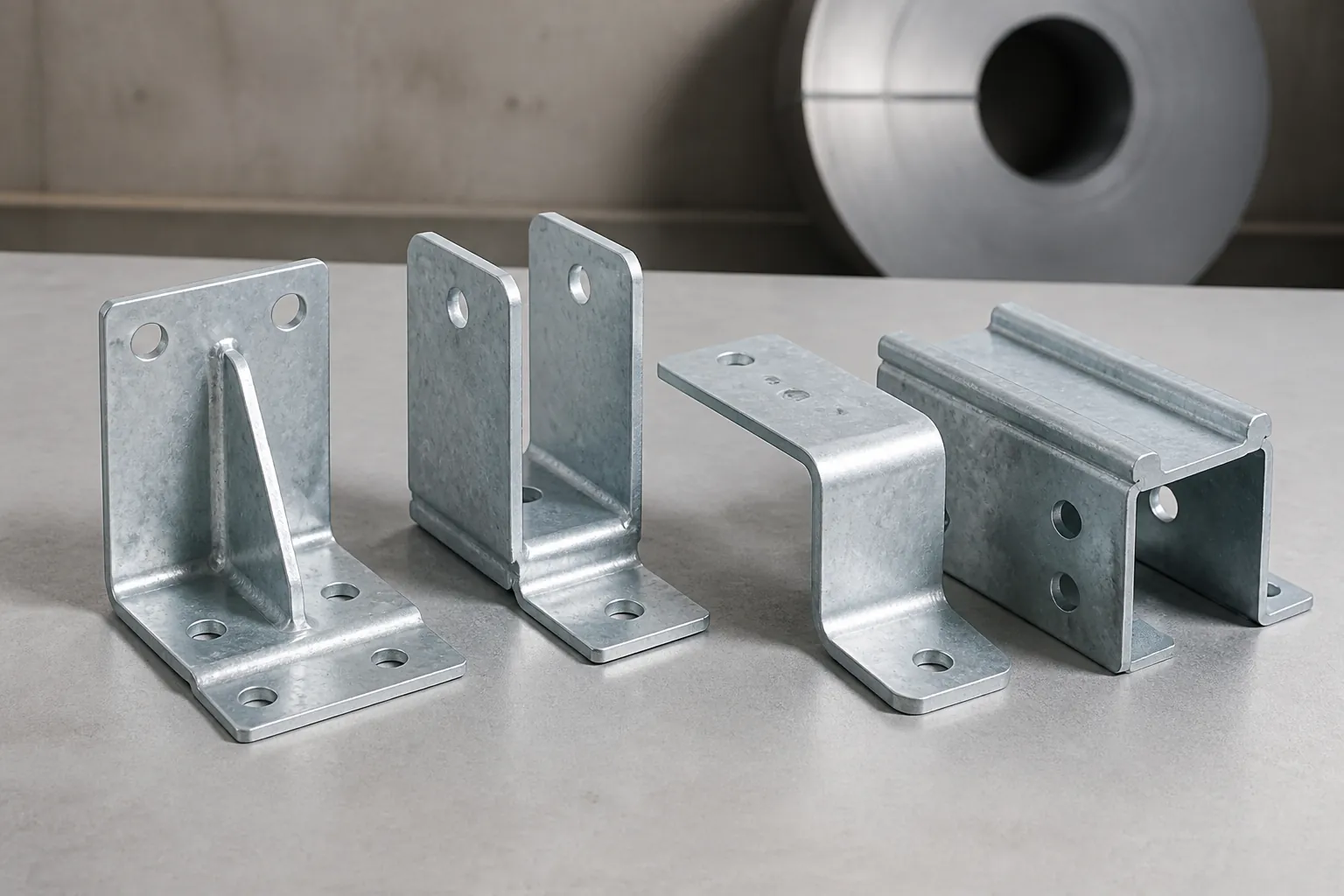
| Hot-dip galvanised | for outdoor service life |
| 304 / 316L | stainless for chloride and coastal exposure |
| 12,000 W | fibre laser cutting |
| 3,200 mm | CNC press brake bed |
| EN 10204 | material certificates |
| ISO 9001:2015 | reg. 34025Q30296R0S |
Why energy buyers work with us
For example, We treat the coating as an engineering decision. Hot-dip galvanising, zinc plating and powder coating all protect steel, and they fail differently: galvanising sacrifices itself at a cut edge, an organic coating fails at a scratch, and neither is right where chlorides are present. Which one a part gets should follow from where it is installed — coastal, desert, industrial or climate-controlled — and we ask before quoting.
As a result, Corrosion starts at the cut edge and the hole. On an outdoor bracket the sheared edge and every punched hole are uncoated steel. Galvanising covers them by design; a thin plating protects them only marginally. Where a part will sit outside for decades, that difference decides the finish.
In addition, Volume parts and one-off frames in one plant. A solar program needs tens of thousands of identical brackets; a substation rebuild needs one welded frame. Both run through the same 12,000 W laser, press brake and welding bays, so a single order can contain a stamped production part and a fabricated one-off.
That said, Flatness and hole position after galvanising. Hot-dip galvanising puts a part through a molten bath, which can distort thin material and close out tight holes. We allow for it in the design — venting, drainage, thread protection, and where necessary post-galvanising reaming — rather than discovering it on site.
Energy and infrastructure parts we manufacture
Meanwhile, Solar mounting — Rail brackets, clamp brackets, mid and end clamps, splice plates, roof hooks and ballast supports. Usually galvanised, sometimes aluminium where weight on the roof structure is the constraint.
Wind and turbine components — Internal brackets, cable management supports, ladder and platform fittings and nacelle brackets. Stainless or galvanised depending on exposure, often heavier gauge.
Transformer and switchgear — Transformer laminations, core clamps, busbar supports, tank brackets and enclosure frames. Laminations are a volume stamping job where the tolerance drives the part’s electrical performance.
Cable management and earthing — Cable trays, support brackets, cable cleats, earthing straps, glands plates and bonding components.
Battery energy storage — Rack frames, module supports, enclosure structures and mounting hardware for containerised storage. Often a stamped bracket plus a welded frame in the same order.
Housing, brackets and reinforcement plates on site. Site-specific brackets, adapters and reinforcement plates are routinely needed at short notice during an installation programme; our custom metal brackets guide covers how best to specify them.
Processes that suit these parts
Stamping for repeat hardware — Clamps, clips and small brackets that appear thousands of times across a project are the classic case for progressive die stamping: once the die exists, unit cost is material plus press time, and every part is identical. See custom metal stamping.
Laser cutting and bending for frames and plates — Support frames, base plates, gussets and site-specific brackets, produced without tooling from the flat pattern. See sheet metal bending.
Welding for structures — Rack frames, enclosure structures, tray supports and welded assemblies, where squareness and flatness after welding are the controlling requirements. See metal welding.
Deep drawing for enclosures and cans — Where a part has to contain or seal, drawing removes the seam. See metal deep drawing.
Machining for bores and mating faces — Five-axis work at ±0.005 mm for holes and faces that have to be restored after galvanising or welding, rather than living with the distortion.
Materials and finishes for outdoor service
Hot-dip galvanised carbon steel — The default for outdoor structural brackets and frames. The zinc coating protects the cut edges and holes as well as the face, and it sacrifices itself slowly rather than failing at a scratch. Used on solar mounting, cable trays, earthing components and transformer hardware.
Zinc-plated carbon steel — For indoor and sheltered parts, and for small hardware where galvanising is disproportionate. A much thinner coating than galvanising, so not a substitute for it outdoors.
Stainless steel 304 and 316L — 304 for general atmospheric exposure; 316L where chlorides are present, including coastal, offshore and de-icing-salt environments. Passivated after welding or forming so the surface oxide is restored. See materials guide.
Aluminium — 5052 and 6061 where mass matters, such as rooftop arrays with structural limits. Aluminium does not need coating to resist atmospheric corrosion, but it must be isolated from steel contact to avoid galvanic corrosion — a detail that is routinely missed at the design stage.
Powder coating over galvanising or over steel — For visible parts, or where a specific colour is required. Coating over galvanising is possible but needs the correct preparation; specifying paint straight onto new galvanising without it is a common cause of early coating failure.
Quality, documentation and site requirements
Incoming material is verified against the mill certificate before release. In-process checks track the critical dimensions across the run. Records available with the order: CMM dimensional report, first article inspection, EN 10204 material certificate, coating thickness readings and hardness results where heat treatment is involved.
For galvanised parts we report coating thickness, which is the measurement that correlates with service life. Where a project needs third-party witness or inspection — SGS, TÜV, BV or your own engineer — that can be arranged at any point in the run.
If a project has a specified standard for the coating thickness, a required salt-spray duration or a documentation pack tied to a project reference, raise it at RFQ. It changes the finish specification rather than the geometry, and it is much cheaper to agree before the parts are dipped than after.
Frequently asked questions about energy infrastructure fabrication
Should my part be galvanised or stainless?
It depends on the environment and the required life. Hot-dip galvanised carbon steel is usually the most economical choice for outdoor structural parts because the coating protects cut edges and holes as well as the face, and it fails slowly. 316L stainless is the right answer where chlorides are present — coastal sites, offshore, road-salt exposure — because galvanising is consumed much faster in those conditions. Tell us where the part is installed and we will recommend one rather than quoting both and leaving it to you.
Does galvanising distort the part or close out holes?
It can, on thin material and on small holes. Hot-dip galvanising passes the part through a molten zinc bath, so uneven cooling can distort light-gauge fabrication and coating build-up can reduce a hole. The fix is designed in: vent and drain holes so the part fills and empties properly, correct hanging orientation, thread protection, and where necessary reaming critical holes after galvanising. We flag it during DFM review rather than after the parts come back from the dip.
How long will a galvanised part last outdoors?
Service life correlates directly with coating thickness, and coating thickness depends on material thickness and the galvanising specification. That is why we report coating thickness on galvanised orders: it is the measurement that predicts how long the part will last, far more than the grade of steel underneath. If your project specifies a minimum coating thickness, tell us at RFQ and we will confirm what can be held.
Do you supply transformer laminations?
Yes. Laminations are a volume stamping job run on progressive dies built in our own tool room. Because lamination geometry affects the electrical performance of the core, the burr condition and dimensional consistency between parts matter as much as the nominal profile — both are controlled by the die rather than by operator setup.
Can you produce both volume hardware and one-off site brackets?
Yes, and often in the same order. Repeated clamps, clips and small brackets are stamped once a die exists, while site-specific brackets, adapters and reinforcement plates are laser cut and bent without tooling. Both run through the same plant, so a single purchase order can cover a production part and a one-off without a second supplier.
Why do welded frames distort, and what can be done about it?
Welding adds heat, and heat causes uneven expansion followed by uneven contraction. The result is distortion that appears after the frame cools, not during welding. Three levers reduce it: minimise weld volume and concentrate it rather than spreading it, sequence the welds so heat is balanced across the part, and relieve stress afterwards. Because stress relief runs in house, a frame that must stay flat can be specified with it rather than argued about later.
Should I specify stainless 304 or 316 for outdoor or coastal equipment?
Choose 316 where chlorides are present — coastal air, de-icing salt, or process chemicals containing chloride. Choose 304 where corrosion risk is ordinary. Two practical notes. First, 316 cuts more slowly and produces more underside dross than 304, so it costs more to fabricate; specifying it without a corrosion reason increases cost for nothing. Second, material grade does not protect a welded joint on its own — weld procedure and post-weld treatment matter as much as the grade.
Which process should hold a thick bracket — laser cutting or stamping?
It depends on volume, not on thickness. Laser cutting has no tool cost, so it wins from a one-off prototype through mid-volume. Stamping carries a die cost and then a much lower unit price, so it takes over in the tens of thousands of pieces per year, where the die is amortised across the run. Because our laser and our presses sit in the same plant, both routes can be priced on one drawing — the comparison is arithmetic rather than an opinion.
What information should be on the drawing for an energy-sector part?
Four things decide the price and the result. The material grade and thickness, because grade changes both material cost and fabrication speed. The critical tolerances, so tight limits are applied where they are needed and nowhere else. Any welding requirement, including whether the joint must be continuous or intermittent, because weld volume drives distortion and hours. And the finish, since plating and coating are separate operations with separate costs.
Can you hold tight flatness after welding?
Yes, within limits, and the limits are worth stating. Flatness after welding depends on section thickness, weld volume and part size. Machining tolerance is ±0.005 mm on features that need it, but that applies to machined features, not to a large welded frame as a whole. Where a welded frame has a critical face, the realistic route is to weld, relieve stress, and then machine the face. Machining a welded assembly without stress relief usually means the part moves after it leaves the machine.
Do you inspect welded assemblies before shipment?
Yes. First article inspection runs on production jobs, and 100% of critical dimensions are verified before shipment using a coordinate measuring machine with a stated measuring accuracy of ±0.002 mm. CMM dimensional reports, first article inspection reports and EN 10204 material certificates ship with the order, and third-party inspection by SGS, TÜV or BV can be arranged on request.
Get an energy sector part quoted
Send the drawing, the installation environment, the material and finish you have specified or the service conditions you need met, and the volume. You will get a DFM review, a tooling price where tooling is involved, and a per-piece price — normally within one working day. See how we price metal fabrication, or use the RFQ form.
Related capabilities
- Custom metal stamping — clamps, clips and laminations at volume
- Sheet metal fabrication — frames, plates and site-specific brackets
- Metal welding — rack frames and enclosure structures
- Sheet metal bending — 3,200 mm CNC press brake
- Metal deep drawing — seamless enclosures and cans
- Surface finishing — galvanising, plating and powder coating
Standards referenced
- ASTM International — material and coating test standards referenced in project specifications
- worldsteel Association — steel grade and property reference
- The Aluminum Association — aluminium alloy designation system (5052, 6061)
- ISO 9001 quality management — the standard our system is registered against