


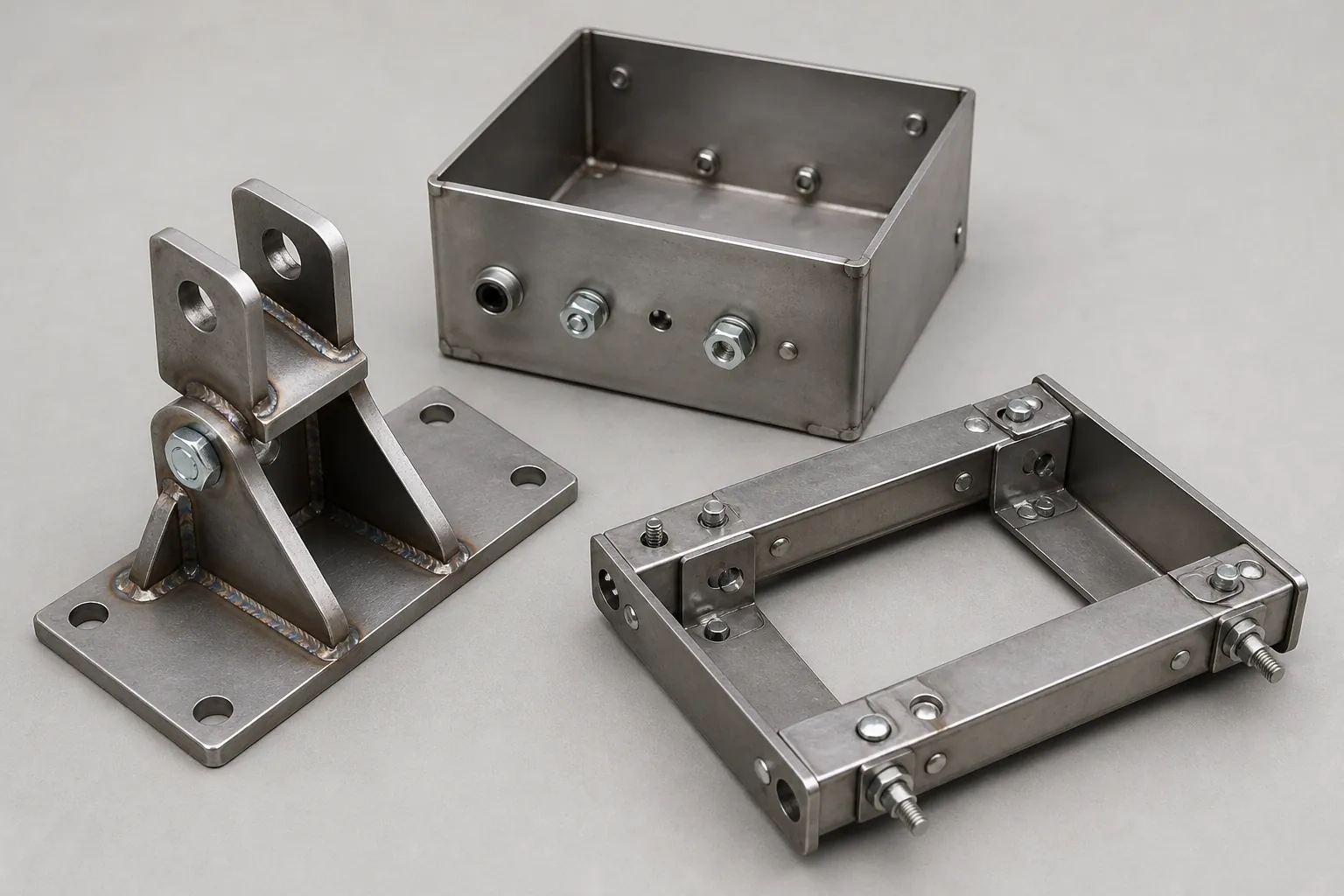
Custom metal assembly services for OEM and sub-assembly work: welding, riveting, hardware insertion, fastening and mechanical build, so a part arrives as one finished unit rather than as a kit of components from three suppliers. Assembly is where every tolerance that upstream processes produced finally has to add up — which is why we would rather assemble what we formed and machined than assemble somebody else’s parts to somebody else’s drawing. ISO 9001:2015, registration 34025Q30296R0S. No minimum order quantity.
| Welding / riveting / fastening | plus hardware insertion |
| One dimensional report | covering the finished unit |
| No second supplier | in the tolerance chain |
| CMM + FAI | assembly-level reporting |
| EN 10204 | material certificates for components |
| ISO 9001:2015 | reg. 34025Q30296R0S |
Why choose us for assembly
The components are ours. Welding, riveting and hardware insertion happen in the same plant that laser cut, formed, drew and machined the parts. Nothing is re-datumed between suppliers, nothing waits in a third party’s queue, and there is one party to answer when a hole that was in specification as a plate is out of position in the assembly.
We inspect the assembly, not just its parts. On a welded frame or a built-up unit the dimensions that decide whether it works are the assembly’s: squareness, flatness, hole positions and the overall envelope. Those are what we measure and report, because they are what changed when the parts were joined.
Assembly sequence is planned, not improvised. The order in which a unit is joined decides how much heat goes into which area, which features stay accessible, and where the last adjustment is available. On welded assemblies the sequence is chosen to balance heat; on mechanical builds it is chosen so the datum is established at the right point in the sequence.
Sub-assembly instead of loose parts. A customer who receives a finished sub-assembly takes one item into stores instead of eight, inspects one unit instead of eight, and owns one interface instead of several. That is usually the real reason to buy assembly as a service.
What we mean by assembly services
Assembly covers every operation that joins finished components into a working unit: welding and riveting for permanent joints, threaded fasteners where a joint has to come apart, and hardware insertion where a fastener, standoff, insert or stud has to be set into sheet metal. It ends with the unit being inspected as a unit.
Assembly and joining methods we offer
Welding — MIG, TIG, spot and laser welding, selected by material, thickness, required penetration and appearance. See metal welding for the process detail.
Riveting — Permanent mechanical joints where welding is unsuitable: dissimilar materials, pre-coated sheet, or a joint that a customer’s process does not permit to be heat-affected. Blind, solid and self-piercing rivets are all established production methods.
Hardware insertion — Clinch nuts, studs, standoffs and threaded inserts pressed into sheet metal. This is how a sheet metal part acquires a thread without welding a nut onto it, and it has to be done before plating — a sequence detail that catches people out.
Threaded fastening — Where a joint has to be demountable for service or shipping. Fasteners can be torqued to a specified value and the assembly inspected as a whole.
Bonding and sealing — Adhesive and sealant applied between components where a joint has to be continuous or weather-tight, typically alongside mechanical fastening rather than instead of it.
Sub-assembly build — Combining several components into a functional unit that ships as one item, including fitting hardware, brackets, gaskets and access panels.
Key advantages of buying assembly rather than parts
| Advantage | What it means commercially |
|---|---|
| One interface, not many | Stores receive one part number; quality inspects one unit; engineering owns one drawing |
| No cross-supplier tolerance argument | The party who formed the parts also joins them, so there is nowhere for the error to hide |
| Sequence done properly | Hardware inserted before plating, datums established at the right stage, heat balanced across welds |
| Assembly-level inspection | Squareness, flatness and hole position reported on the finished unit, not inferred |
| Less in-house labour for you | Your team receives a finished item rather than a build task |
| Less packaging and freight | One consolidated unit instead of loose components travelling separately |
Common applications and scenarios for assembly work
Welded frames and machine bases — Structures assembled from cut and formed plates, where squareness and flatness are the requirements that matter. See industrial machinery.
Enclosures and cabinets — Fabricated housings assembled with hinges, locks, gaskets, gland plates and mounting hardware, arriving as a finished enclosure rather than a flat pack.
Chassis and card cages — Electronic chassis built with inserted standoffs, card guides and connector cut-outs, where hardware insertion has to precede plating. See electronics.
Bracket assemblies — Multi-part brackets that would otherwise be a stack of plates and fasteners, supplied welded or riveted as one component. See our custom metal brackets guide.
Rack and structure assemblies — Storage racks, supports and frames for infrastructure and logistics. See energy and infrastructure.
Prototype assemblies — Evaluation builds where the assembly is needed quickly to prove a design before tooling is committed. See rapid prototyping. Or see high-volume production for the volume end of the same service.
When assembly is the wrong answer — if a part can be made in one piece by stamping or deep drawing, the joints disappear along with their cost and their failure modes; and if the unit has to be shipped flat and built on site, partial assembly is more sensible than a fully built unit.
How our assembly service works
1. Send the assembly drawing or model. Include the bill of materials, the joining method for each joint, and any torque, sealing or hardware requirement. Engineering responds within 3 hours on working days.
2. Build sequence and DFM review, free. We check the joining sequence, whether hardware insertion happens before plating or coating, whether the fixture will hold the datums that matter, and whether the assembly could be simplified by making a component in one piece instead.
3. Component manufacture. Every component is cut, formed, drawn or machined in our own plant; material is verified against mill certificates before release.
4. Fixturing and assembly. Purpose-made fixtures hold the unit during welding and fastening so the datum is established the same way on every unit, not re-derived by eye.
5. Finishing after assembly. Weld dressing, passivation, plating or coating applied to the finished unit where required, with coating thickness controlled so it does not close out a thread or a mating bore.
6. Assembly-level inspection and shipment. The finished unit is measured against the assembly drawing and shipped as one item with its dimensional report.
Assembly capabilities and specifications
| Parameter | Capability |
|---|---|
| Joining methods | MIG, TIG, spot and laser welding; riveting; threaded fastening; adhesive bonding |
| Hardware insertion | Clinch nuts, studs, standoffs and threaded inserts |
| Fixturing | Purpose-made fixtures; components formed in the same plant |
| Materials | Carbon steel, stainless steel (301/304/316L), aluminium (5052/6061), galvanised and pre-coated strip |
| Post-assembly operations | Weld dressing, passivation, stress relief where specified, coating |
| Inspection | Assembly-level CMM report, FAI, EN 10204 certificates for components |
| Minimum order quantity | None — from 1 piece |
| Engineering response | ≤3 hours on working days |
| Quality system | ISO 9001:2015, registration 34025Q30296R0S |
| Plant | 15,000 m², 6 production lines, 85 employees |
Materials and finishes in assembly work
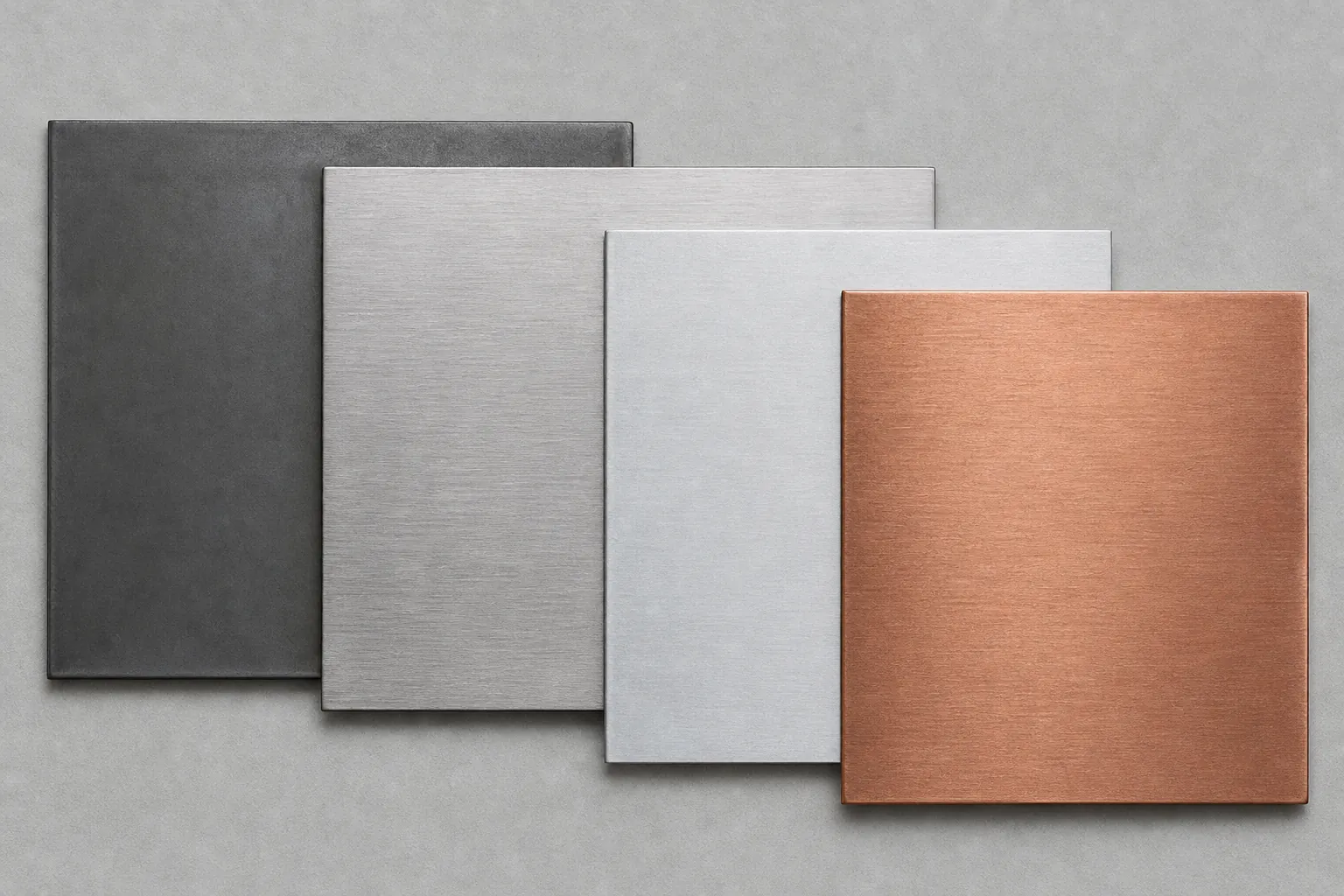
Carbon steel — The most common assembly material. Welds quickly with MIG, takes inserted hardware cleanly, and is normally zinc plated or powder coated after assembly so the joints are protected too. See the materials guide.
Stainless steel — 304 and 316L, welded with TIG or laser for control and cleanliness, then passivated so the heat-affected zone recovers its corrosion resistance. Note that 316L is preferred over 316 for welded work because its low carbon content resists sensitisation at the weld.
Aluminium — Assembled by welding, riveting or fastening. Where aluminium meets steel in the same assembly the joint needs isolating to avoid galvanic corrosion — a detail that is easy to miss and expensive to discover in service.
Dissimilar materials — Where two different metals have to be joined, riveting or adhesive bonding is often more sensible than welding, and the galvanic pair has to be considered at design stage. Tell us the material of each component at RFQ.
Pre-coated and galvanised strip — Riveting and mechanical fastening are preferred to welding because heat destroys the coating locally and it cannot be restored at the joint.
Quality control on assemblies
An assembly is inspected as an assembly. The critical dimensions are squareness, flatness, hole position and the overall envelope, measured after joining rather than inferred from the components, because joining is what moves them.
Records available with the order: assembly-level CMM dimensional report, first article inspection, EN 10204 material certificates for the components, and coating thickness readings after finishing. Where a drawing requires a specified fastener torque, that can be controlled and recorded. Third-party inspection by SGS, TÜV or BV can be arranged.
Frequently asked questions about assembly services
Why buy an assembled unit instead of loose parts?
Because every interface you own is a place where something can go wrong and someone has to arbitrate. A finished sub-assembly gives you one part number in stores, one unit for quality to inspect, one drawing for engineering to control and one supplier to call. On a welded frame it also removes the most common cause of an out-of-tolerance assembly: one supplier forming to a nominal dimension and another welding to a slightly different one.
Does hardware insertion happen before or after plating?
Before. Inserted hardware — clinch nuts, studs, standoffs and threaded inserts — is pressed into the sheet while it is bare, and then the assembly is plated or coated. If hardware is inserted after coating, the coating is disturbed at the joint and the press fit is compromised. We sequence this deliberately, and it is one of the reasons assembly belongs with the forming and finishing operations rather than in a separate shop.
How do you stop an assembly from going out of square?
By establishing the datum properly and holding it. Components are formed in the same plant, then located in a purpose-made fixture during joining so the datum is set the same way on every unit rather than re-derived by eye. On welded assemblies the weld sequence is also planned to balance heat across the structure. Where the drawing needs flatness or squareness beyond what joining can hold, stress relief or a post-weld machining operation is specified as a separate step.
Can you assemble parts you did not manufacture?
It is possible, but it is not what we recommend or prefer, because an assembly is only as good as the components that go into it — and when the components come from elsewhere we cannot control the datum they were made to. If you need assembly of third-party parts, send the drawings and we will look at it honestly and tell you where the risk sits rather than quoting blind.
Do you supply a dimensional report for the assembly or only for the parts?
For the assembly. The dimensions that matter on a built-up unit are the assembly’s — squareness, flatness, hole positions and the overall envelope — and those are the ones that changed when the parts were joined. We report on the finished unit, and component certificates come with it as supporting documentation.
Get an assembly quote
Send the assembly drawing or model with the bill of materials, the joining method for each joint, and any torque, sealing, hardware or inspection requirement. You will get a build sequence review, a fixture price where fixtures are needed, and a per-assembly price — normally within one working day. See how we price metal fabrication, or use the RFQ form.
Related capabilities
- Metal welding — MIG, TIG, spot and laser welding for sub-assemblies
- Rapid prototyping — evaluation builds before tooling
- High-volume production — assembly at production volume
- Sheet metal fabrication — the components that get assembled
- CNC machining — post-assembly machining to restore datums
- Welding and riveting parts — worked examples from production
Related solutions and resources
Assembly is the last operation, so it depends on everything before it:
- Metal welding — the joining process inside most assemblies
- Sheet metal fabrication — the parts that make up the assembly
- CNC machining — precision components fitted into assemblies
- Quality and inspection — how assemblies are checked before packing
- Machinery and electronics — industries we assemble for
- Metal surface treatment — finishing applied before or after assembly
See how export packing and delivery on an assembled order were reviewed: Chile case study.
Standards referenced
- ASTM International — material and test standards
- NIST — measurement and dimensional metrology reference