


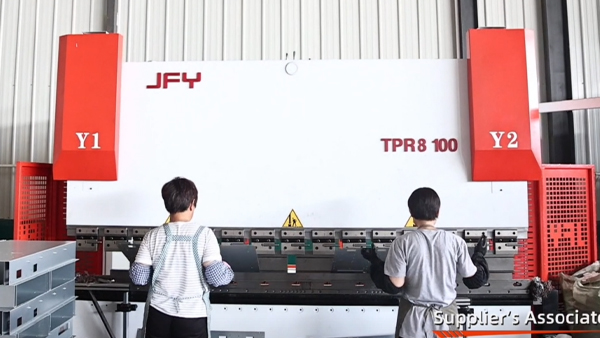
Sheet metal bending service on a 3,200 mm CNC press brake, with tooling and bend deduction set for the material rather than left at a default. Springback in stainless is roughly double that of mild steel, and on aluminium it behaves differently again — the difference between a bracket that assembles and one that fights is decided before the press runs, in how the flat pattern was calculated. ISO 9001:2015, registration 34025Q30296R0S. No minimum order quantity.
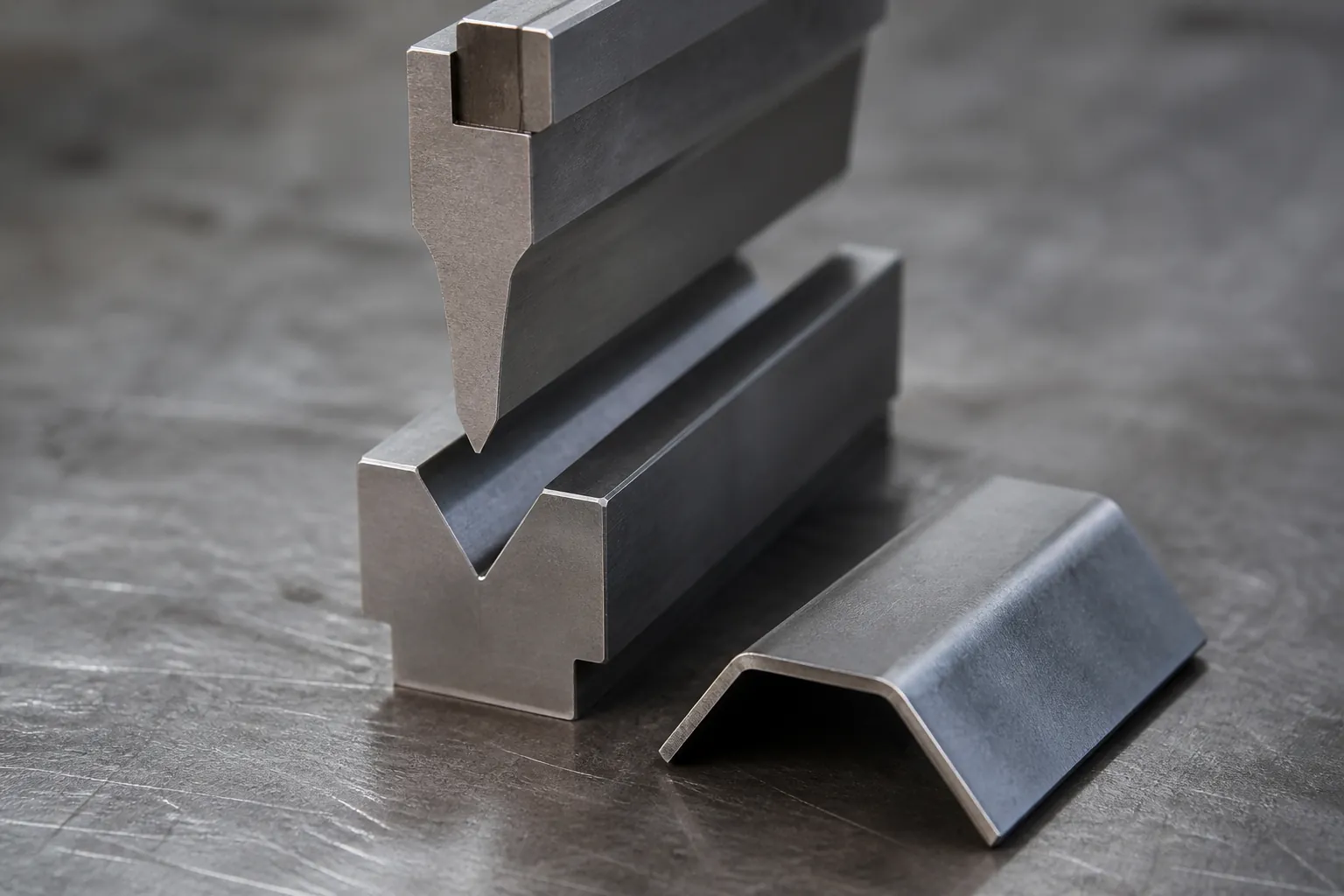
| 3,200 mm | CNC press brake bed |
| Bend deduction | calculated per material, not assumed |
| 12,000 W | fibre laser upstream (blanks) |
| 15,000 m² | plant, 6 production lines |
| ISO 9001:2015 | reg. 34025Q30296R0S |
| No MOQ | from 1 piece |
Why choose us for sheet metal bending
The flat pattern is calculated, not guessed. Bend deduction depends on material, thickness, bend radius and the tooling actually used. Get it wrong and the flange lengths drift, the part does not assemble, and the fix becomes a re-cut. We calculate it from the material being cut, which is why the first article normally fits.
Springback is compensated, not corrected by hand. Stainless springs back further than mild steel; aluminium behaves differently again. The press is set to the material, and where the geometry is demanding the bend is verified on the formed part rather than trusted to the machine’s readout.
Cutting and bending in the same plant. The blank is laser cut on a 12,000 W fibre source and bent on the same site, so the blank edge and the bend line come from one datum. That also removes the freight between two suppliers that usually accounts for most of a “2-week” quoted lead time.
Bend radii checked against the material first. A radius that is fine on 1.5 mm mild steel can crack on 2 mm stainless or on a pre-coated strip. We check it before the drawing is released to production, and tell you if it needs changing.
What is sheet metal bending?
Bending is a forming process in which a flat sheet is plastically deformed along a straight axis to produce an angle or a curve. The material is not cut and not thinned deliberately — it is folded around a radius, with the outside of the bend stretched and the inside compressed. Because nothing is added or removed, bending is usually the cheapest way to give a flat blank its third dimension, and it is almost always the second operation after laser cutting.
Common sheet metal bending methods
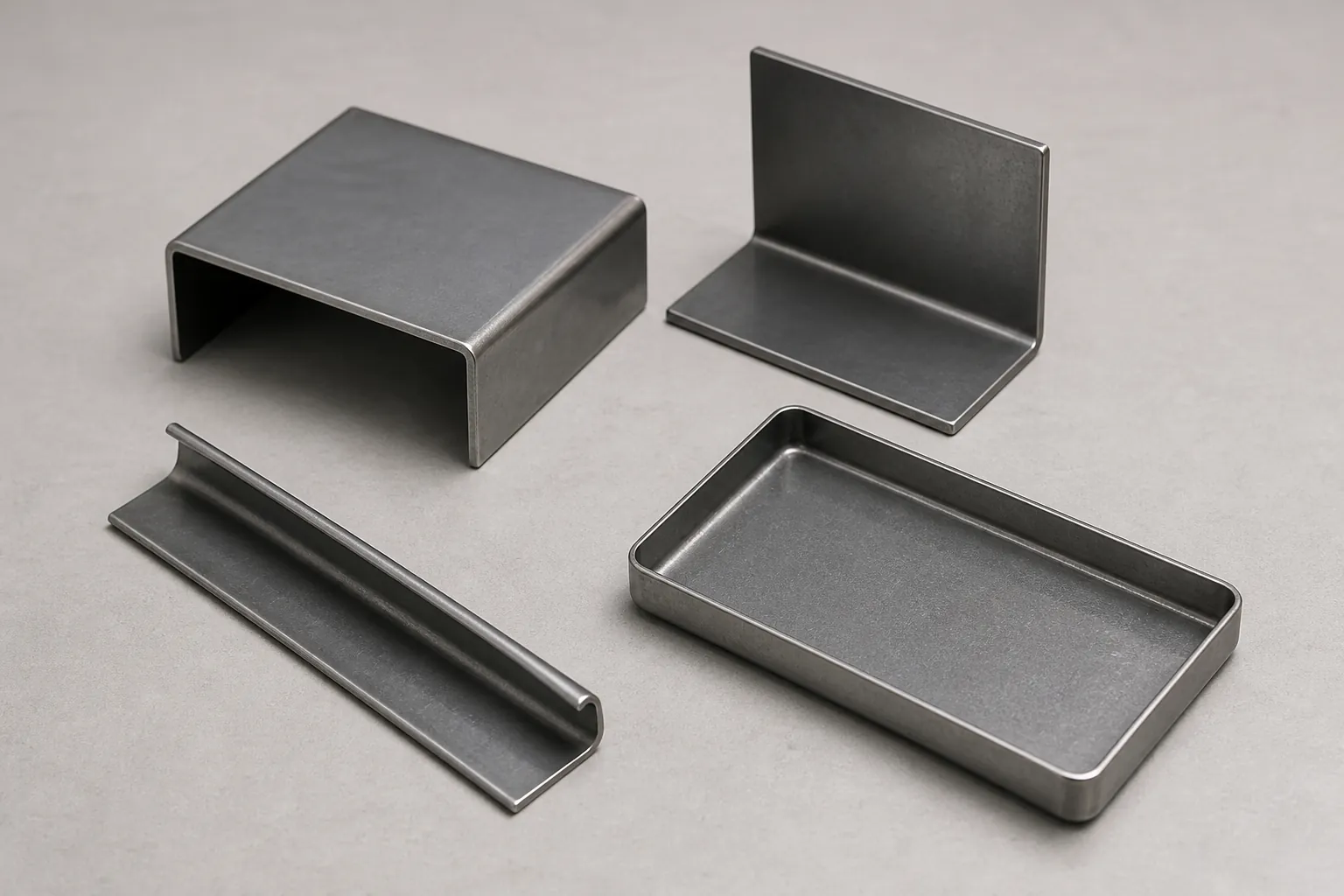
Air bending — The most common method. The punch does not bottom out in the die, so the resulting angle depends on how far the punch descends. One set of tooling therefore covers a range of angles, which is why air bending is the default for general work.
Bottoming — The punch presses the material fully into the die, so the angle comes from the die geometry. More accurate and with less springback than air bending, but each angle needs its own die. Used where angle tolerance is critical.
Coining — The punch presses hard enough to force the material into the die corners, virtually eliminating springback. Requires very high tonnage, so it is reserved for tight-tolerance work on thin material.
Hemming — The edge is folded back on itself, either flat or open. It removes a sharp edge, doubles the stiffness locally, and is standard on anything a person will handle or where the cut edge needs covering. It normally takes two operations: a pre-bend and a closing pass.
Radius and multi-axis bending — A curved form rather than a single angle, produced by successive passes or by radius tooling. Used for covers, shields and housings where a squared corner is not wanted.
Press brake forming of assembled sections — A part with several bends is usually programmed as one sequence, with the order chosen so that earlier bends do not obstruct later ones. That sequencing is where most forming errors are prevented.
Key advantages of bent parts
| Advantage | What it means commercially |
|---|---|
| No tooling cost | Standard tooling means no die to amortise — the right process at low and mid volume |
| Cheapest route to 3D | Adding stiffness is a fold, not a weld or an extra part |
| Fast from drawing to part | Cut and bend a prototype in days, not weeks, with no tooling to cut |
| Stiffness without weight | A formed flange or channel resists bending far better than the flat sheet it came from |
| Design changes are cheap | Revise the flat pattern and re-cut; a die would have to be reworked |
| Finishes survive | Bending pre-coated or galvanised strip is possible where the tooling is set for it |
Common applications and scenarios for bent sheet metal parts
Brackets and mounting plates — The most common bent part there is: a folded angle or a formed U that carries a load and provides mounting holes. Our custom metal brackets guide covers how these are best specified.
Enclosures and chassis — Folded boxes, equipment bases, rack frames and control housings, where bends replace both welds and fasteners.
Panels, covers and bezels — Hemmed edges, formed flanges and stiffening ribs on visible parts, where the hem is doing edge-safety and appearance work at the same time.
Channels, rails and profiles — U-channels, Z-sections and hat profiles used as structural members, where a formed section replaces a heavier solid part.
Frames and supports — Machine guards, support brackets and frame members, often combined with welding into a finished assembly.
Pre-coated and galvanised parts — Outdoor and construction components where the coating is already on the strip, and the tooling has to be set so the coating is not cracked at the bend.
When bending alone is not enough — where a part needs a closed section, a drawn shell or a very tight radius beyond the material’s limit, welding or deep drawing will be the right route. We will say so and quote it.
How our sheet metal bending service works
1. Send the drawing or the 3D model. STEP, SLDPRT, DXF, DWG, PDF. If you can send the model, the flat pattern can be unfolded from it; if you can only send the folded drawing, we will calculate the flat pattern. Engineering responds within 3 hours on working days.
2. Bend deduction and feasibility check, free. We check each bend radius against the material and thickness, confirm the minimum flange lengths, look for bends that would collide with the tooling, and set the bend sequence so later operations are not blocked by earlier ones.
3. Cutting. Blanks are cut on the 12,000 W fibre laser and deburred before forming, so the bend line is established on a clean edge.
4. Forming. CNC press brake with tooling and compensation set for the material. Angle is verified on the part, not taken on trust from the control.
5. Joining and finishing. Any welding, riveting or hardware insertion, then the specified finish — with the coating thickness range chosen so the finish does not close out a critical hole.
6. Inspection and shipment. CMM dimensional reports, first article inspection and EN 10204 material certificates ship with the order.
Bending capabilities and specifications
| Parameter | Capability |
|---|---|
| Press brake | 3,200 mm CNC bed |
| Forming methods | Air bending, bottoming, hemming, radius forming |
| Upstream cutting | 12,000 W fibre laser |
| Materials | Carbon steel, stainless steel (301/304/316L), aluminium (1100/5052/6061), copper, brass, galvanised and pre-coated strip |
| Related operations | Laser cutting, deburring, welding, riveting, hardware insertion |
| Surface finishes | Zinc plating, powder coating, anodising, passivation |
| Minimum order quantity | None — from 1 piece |
| Engineering response | ≤3 hours on working days |
| Quality system | ISO 9001:2015, registration 34025Q30296R0S |
| Plant | 15,000 m², 6 production lines, 85 employees |
Materials for bending
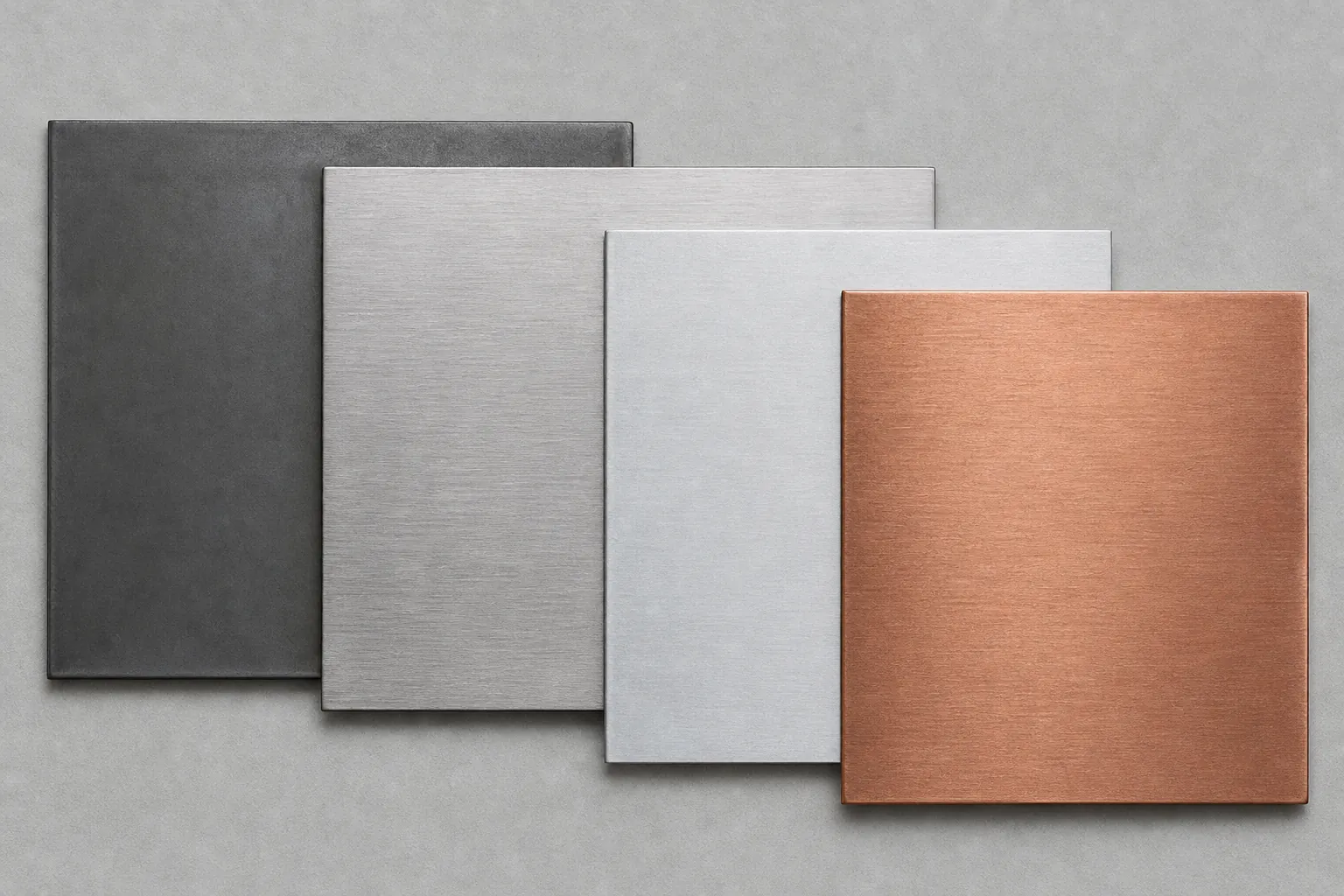
Carbon steel — CR4 and SPCC cold-rolled bend cleanly with a modest radius and predictable springback; hot-rolled heavier gauges need a larger radius. Pre-galvanised strip can be bent where the tooling is set so the coating is not cracked.
Stainless steel — 304 and 316L bend well but spring back roughly twice as much as mild steel, and work-harden at the bend, so the radius has to be generous relative to thickness. 301 in spring temper should not be bent to a tight radius at all.
Aluminium — 5052 bends reliably to a tight radius because it forms without cracking; 6061 is more prone to cracking at the bend and needs a larger radius or a different temper.
Copper and brass — Bend easily and are usually chosen for conductivity or appearance. Soft tempers mark easily, so handling and tooling condition matter.
Choosing a grade is a bending decision as much as a strength decision. Our materials guide covers the trade-off, and the thickness chart lists gauge equivalents.
Surface finishing after bending
Finishing runs after forming, which matters because a formed part has more accessible surface than a flat one. Powder coating is the usual choice for visible bent parts, with the thickness range specified so it does not close a hole. Zinc plating covers carbon steel brackets and channels. Passivation and deburring remove free iron and sharp edges on stainless. Anodising applies to aluminium. See metal surface treatment for the full list.
Quality control on bent parts
The tolerances that actually move on a bent part are bend angle and flange length, not the cut profile, because those are the dimensions springback affects. We inspect the formed part rather than only the flat blank.
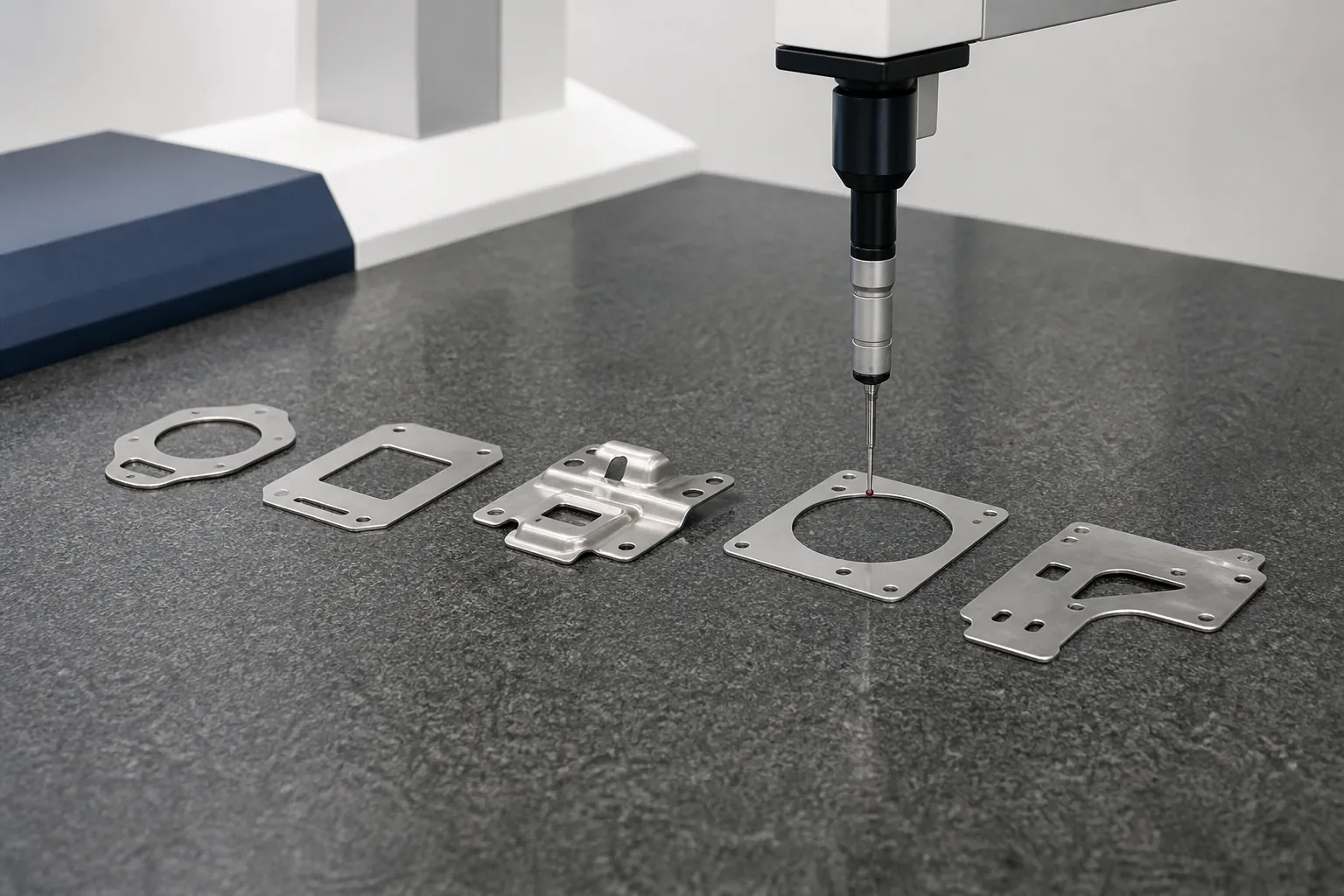
Records available with the order: CMM dimensional report, first article inspection, EN 10204 material certificate and coating thickness readings. Third-party inspection by SGS, TÜV or BV can be arranged at any point.
Frequently asked questions about sheet metal bending
What is the minimum bend radius for sheet metal?
It depends on the material and the temper, not on a single number. As a rule the inside radius should be at least equal to the material thickness for mild steel, larger for stainless and for 6061 aluminium, and larger again for pre-coated strip where the coating must not crack. Send the material and thickness and we will confirm the minimum for your part rather than quoting a generic figure.
Why do my flange lengths come out wrong after bending?
Because the flat pattern was calculated with the wrong bend deduction. The total flange length is not the sum of the outside dimensions — material at the bend is neither fully stretched nor fully compressed, and how much depends on material, thickness, radius and tooling. Getting that value right is the difference between a part that assembles and one that does not.
Can you bend pre-coated or galvanised sheet?
Yes, with the tooling and radius selected so the coating is not cracked at the bend. Galvanised and pre-coated strip both have a coating that does not stretch as far as the base metal, so the bend radius has to be larger than for bare steel, and tooling contact has to avoid scuffing the visible face.
Do you bend stainless steel without cracking it?
Yes, within the material’s limits. Stainless work-hardens at the bend and springs back considerably more than mild steel, so it needs a larger radius relative to thickness and a larger springback allowance. Where a design asks for a radius outside what the grade can take, we will flag it before production rather than discovering it on the press.
What is the difference between air bending and bottoming?
In air bending the punch does not bottom out in the die, so the angle is set by how far the punch travels and one tooling set covers many angles — which is why it is the default. In bottoming the material is pressed fully into the die, so the angle comes from the die shape: more accurate, less springback, but a dedicated die for each angle.
Can bending be combined with welding in the same order?
Yes. Forming and welding run in the same plant, so a bent and welded frame or enclosure arrives as one assembly with a single dimensional report rather than as loose components from two suppliers.
Get a sheet metal bending quote
Send the drawing or the 3D model with the material, thickness and quantity. You will get a feasibility check on the bend radii and flange lengths, a flat-pattern calculation if you need one, and a price — normally within one working day. See how we price metal fabrication, or use the RFQ form.
Other capabilities in our plant
- Sheet metal fabrication — cutting, forming, joining and finishing under one work order
- Custom metal stamping — progressive, compound and transfer dies built in-house
- Metal deep drawing — multi-stage hydraulic drawing for cups, cans and enclosures
- Metal welding — MIG, TIG, spot and laser welding for sub-assemblies
- Laser cutting — 12,000 W fibre laser for flat blanks and profiles
- Bending quality and application notes — what separates a good formed part from a marginal one
Related solutions and resources
Bending is usually one operation inside a longer route:
- Sheet metal fabrication — the complete cut, form and finish route
- Custom laser cutting — the blanks that go into the press brake
- Metal welding — closing a bent assembly
- Standard sheet metal thicknesses chart — thickness against bend radius
- Quality and application of bent parts — what separates good from acceptable
- Machinery and construction — industries we bend for
A buyer’s verdict on bent stainless parts: United States case study.
Standards referenced
- ASTM International — material and test standards
- worldsteel Association — steel grade and property reference
- The Aluminum Association — aluminium alloy designation system (5052, 6061)