


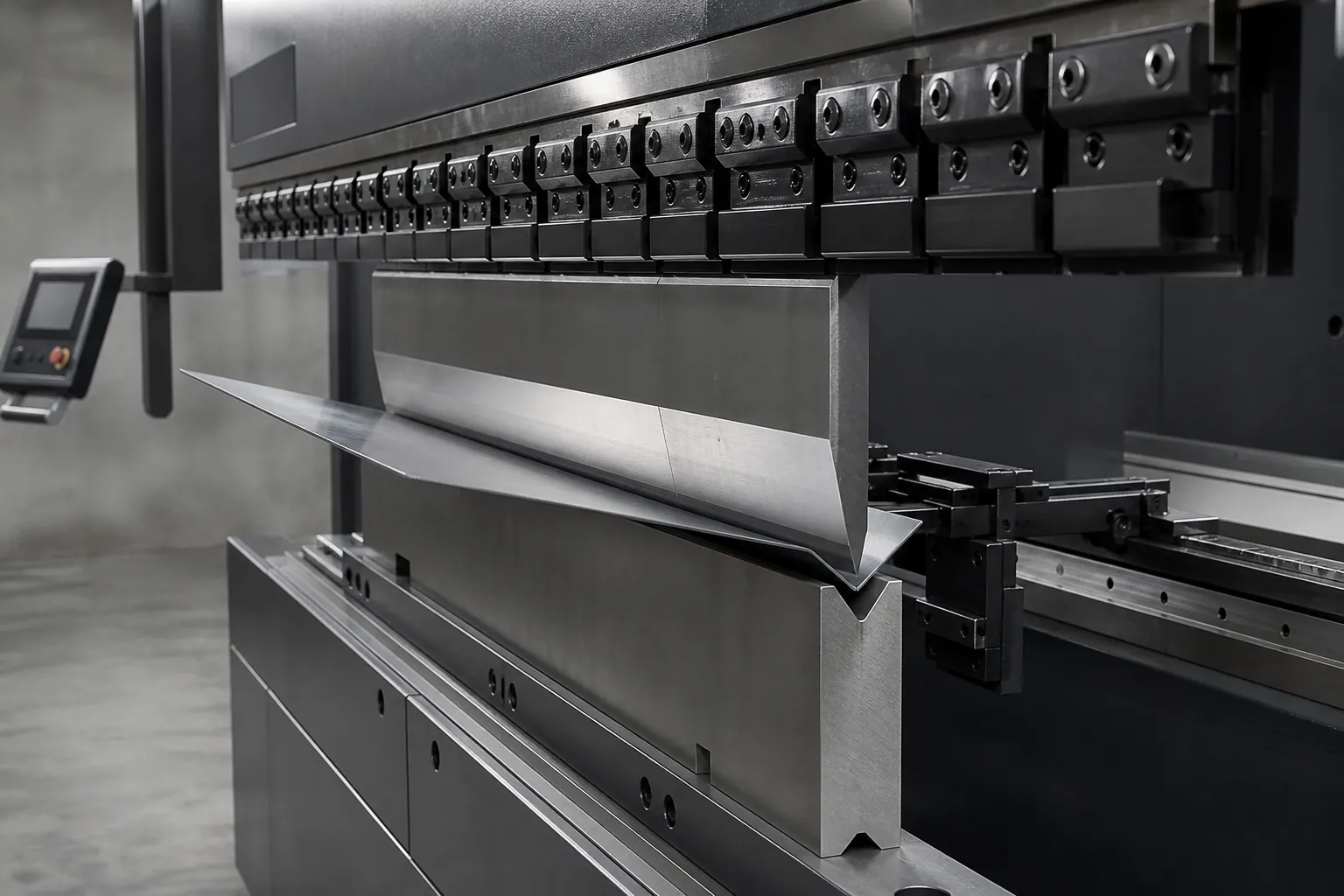
Sheet metal fabrication services from a single plant: laser cutting, CNC bending, stamping, deep drawing, welding and finishing under one work order. A 12,000 W fibre laser, a 3,200 mm CNC press brake, presses from 25 to 400 tonnes and an in-house tool room — so your part does not acquire a second supplier’s tolerance stack on the way. ISO 9001:2015, registration 34025Q30296R0S. No minimum order quantity.
| 12,000 W | fibre laser cutting |
| 3,200 mm | CNC press brake bed |
| 25–400 t | stamping press range |
| 15,000 m² | plant, 6 production lines |
| ISO 9001:2015 | reg. 34025Q30296R0S |
| No MOQ | from 1 piece |
Why choose us for sheet metal fabrication
Six processes, one plant. Cutting, bending, stamping, drawing, welding and finishing all run here. Parts pass between operations on a single work order and one inspection record, which is what makes a lead time defensible rather than a hope.
The equipment is named, not implied. A 12,000 W fibre laser, a 3,200 mm CNC press brake, presses to 400 tonnes, and an HDL-OKK DMU38 five-axis machining centre at ±0.005 mm. Our ISO 9001:2015 registration number is published. If you want to audit a supplier before placing a first order, that is information you can check.
Engineering response in three hours. Drawings are reviewed by the people who will run the job, not by a sales desk. Most projects come back with a design change that lowers cost before any tooling is committed.
No minimum order quantity. We will make one bracket. Where a volume is too low for tooling to pay back, we will say so and quote the cheaper process instead.
What is sheet metal fabrication?
Sheet metal fabrication is the family of processes that turn flat metal sheet into finished parts: cutting the outline, forming the shape, joining the pieces, and finishing the surface. Almost every industrial enclosure, bracket, panel, chassis and frame is made this way. What separates a good fabrication supplier from an average one is not any single process — it is whether the tolerance stack stays under one roof across all of them.
Common sheet metal fabrication processes
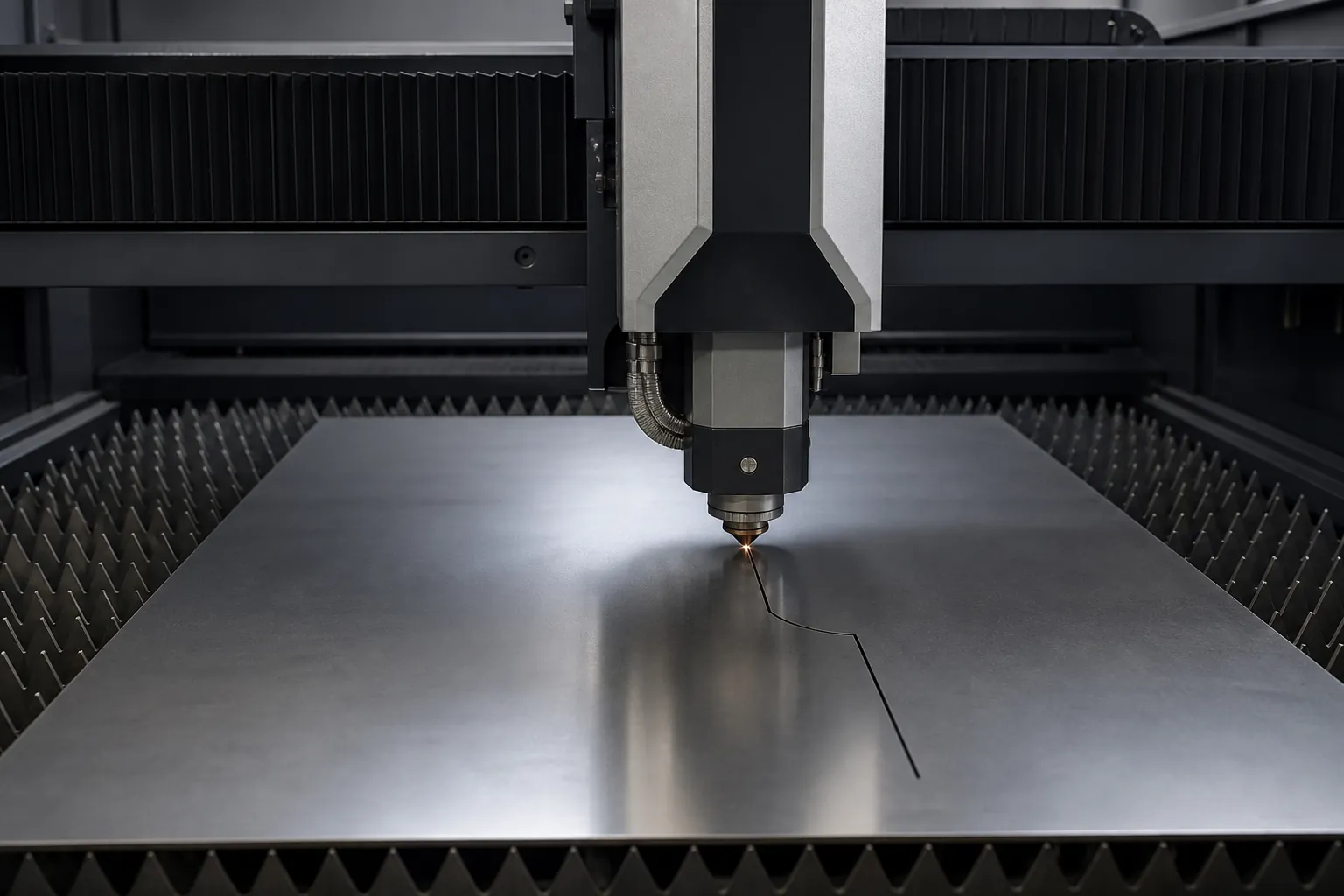
Laser cutting — A focused fibre laser cuts the flat profile from a nest. No tooling is required, which makes it the correct process from one part up to the volume where stamping tooling starts to pay. Our 12,000 W source cuts carbon steel, stainless and aluminium in production gauges.
CNC bending — A press brake forms the bends. The variables that matter are the tooling, the back gauge, and whether bend deduction has been calculated against the actual material rather than left at a default. Springback differs between carbon steel, stainless and aluminium, and has to be compensated rather than corrected by hand.
Metal stamping — Once a part repeats in the thousands, the shape moves into a die and the press. Progressive, compound and transfer dies are designed and built in our own tool room. See custom metal stamping for the full capability.
Deep drawing — Draws a flat blank into a cup, can or seamless enclosure over multiple stages. The right process when the part has to contain something rather than simply be a shape. See metal deep drawing.
Welding and assembly — MIG, TIG, spot and laser welding, plus riveting, hardware insertion and mechanical sub-assembly. See metal welding services.
Surface finishing — Zinc plating, powder coating, anodising, passivation, deburring and heat treatment. Coating thickness is specified so that the finish does not close out a critical hole or thread.
Key advantages of a single-source fabrication supplier
| Advantage | What it means commercially |
|---|---|
| One tolerance stack | One supplier answers when a hole that was in specification before welding moves after it |
| No inter-company queue | Operations are scheduled in our plant, not in a third party’s backlog |
| Honest process selection | We quote the cheapest route — laser and bend, or stamping — rather than the one we prefer |
| Documentation that travels | CMM reports, FAI and EN 10204 certificates cover the whole part, not one operation |
| Prototype to production | The same drawing runs through both, so nothing is redesigned at the volume handover |
Common applications and scenarios for sheet metal fabrication
Enclosures and housings — Control cabinets, instrumentation enclosures, power supply housings, junction boxes, machine covers. Usually stainless or powder-coated carbon steel; gasket channels, cable entries and door hardware are formed or inserted in the same work order.
Brackets and structural parts — Mounting plates, angle brackets, support frames, motor mounts. Our custom metal brackets guide covers the design side of this part family.
Chassis and frames — Equipment frames, rack structures, EV component chassis, machinery base frames. Welded assemblies where flatness after welding is usually the hard requirement.
Panels and fascia — Front panels, access panels, bezels, vented covers. Appearance matters as much as tolerance, so surface finish and bend consistency drive the process choice.
Energy and infrastructure — Solar mounting brackets, wind turbine components, cable trays, earthing hardware. Materials are chosen for corrosion resistance over decades rather than for the first invoice.
Prototype and bridge quantities — Where the eventual volume justifies a die but the design is not frozen yet, laser cutting and bending carries the part until the numbers are confirmed.
How our sheet metal fabrication service works
1. Send the drawing. DXF, STEP, STP, SLDPRT, PDF or DWG. Include the material grade if it is fixed, and the annual volume if you know it. Engineering responds within 3 hours on working days.
2. DFM review, free. We check bend radii against material thickness, hole-to-bend clearances, reliefs, grain direction, and whether the part would be cheaper stamped above a certain quantity. This is where cost usually comes out.
3. Material and nesting. Material is verified against the mill certificate before cutting. Parts are nested to keep scrap down — which matters most on stainless, the grade where the sheet is often the dominant cost.
4. Cutting and forming. Laser cutting with a 12,000 W fibre source, then CNC bending with tooling set for the material rather than left at a default.
5. Joining and finishing. Welding, riveting and hardware insertion, followed by whatever finish the drawing calls for.
6. Inspection and shipment. CMM dimensional reports, first article inspection, EN 10204 material certificates and coating thickness readings ship with the order. Export palletising protects cosmetic surfaces in transit.
Sheet metal fabrication capabilities and specifications
| Parameter | Capability |
|---|---|
| Laser cutting | 12,000 W fibre laser |
| Bending | 3,200 mm CNC press brake |
| Stamping presses | 25–400 tonnes; progressive, compound and transfer dies |
| Deep drawing | Multi-stage in-house hydraulic presses |
| Machining | 5-axis, HDL-OKK DMU38, ±0.005 mm |
| Welding | MIG, TIG, spot and laser |
| Materials | Carbon steel, stainless steel (301/304/316L), aluminium, copper, brass, galvanised and pre-coated strip |
| Surface finishes | Zinc plating, powder coating, anodising, passivation, deburring, heat treatment |
| Minimum order quantity | None — from 1 piece |
| Engineering response | ≤3 hours on working days |
| Quality system | ISO 9001:2015, registration 34025Q30296R0S |
| Plant | 15,000 m², 6 production lines, 85 employees |
Sheet metal materials
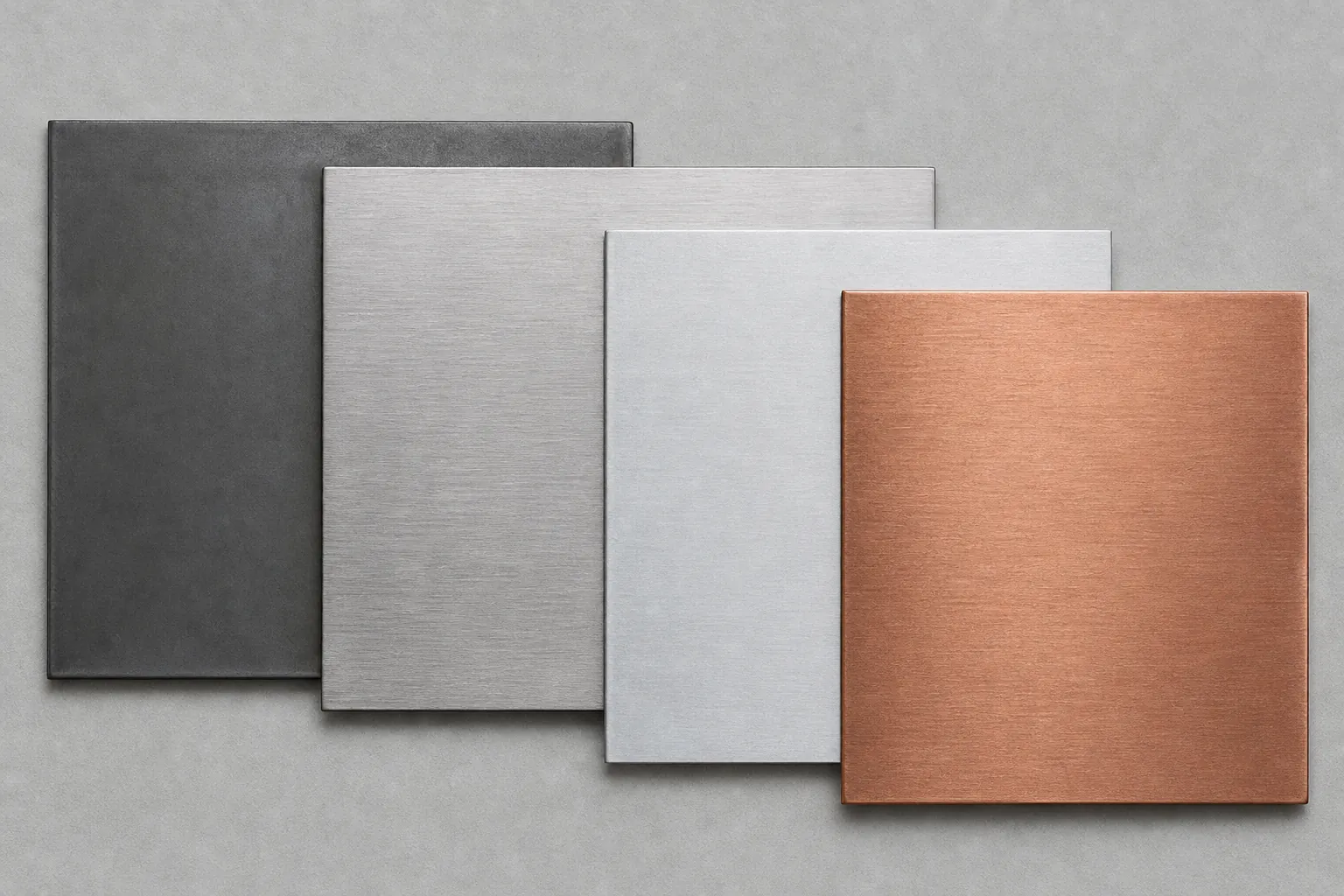
Carbon steel — CR4 and SPCC cold-rolled for cosmetic parts and tight bends, hot-rolled for heavier structural work, and pre-galvanised strip where the cut edge does not need recoating. The default when strength per cost decides the choice.
Stainless steel — 301 for spring temper and thin high-strength sections, 304 for general corrosion resistance, 316L for chloride exposure, food contact and medical work. Stainless work-hardens, so tooling clearance, bend radius and lubrication all differ from carbon steel.
Aluminium — 5052 is the workhorse for bent and formed enclosures because it forms without cracking; 6061 where the part needs machined features or higher strength; 1100 and 1050 where conductivity or cost dominates.
Copper and brass — C110 and C260 for busbars, terminals, contacts and EMI components, where conductivity and solderability are the reason the part exists.
Gauge selection changes a part more often than the design does, because the same nominal thickness behaves differently across these materials. Our sheet metal thickness chart lists the equivalents, and the materials guide explains which grade to choose and why.
Surface finishing
Zinc plating — The default protection for carbon steel brackets, clips and panels. Barrel or rack plating, clear or yellow passivate.
Powder coating — Colour and durability for parts that are seen as well as used. We specify the thickness range so the coating does not close out a critical hole or thread.
Anodising — Aluminium only. Type II for appearance and general protection, Type III hard anodising where wear resistance matters.
Passivation and deburring — Standard on stainless parts that will be handled or that need a clean cut edge. Also removes the free iron left by tooling contact.
Heat treatment — Stress relief for welded frames that must stay flat, and hardening for spring-temper components. See metal surface treatment.
Quality control on fabricated parts
Incoming material is checked against the mill certificate before release to production. In-process checks track the critical dimensions across the run. Final inspection produces the report that ships with the order: CMM dimensional report, first article inspection, EN 10204 material certificate, coating thickness readings and hardness results where heat treatment is involved. If your QA needs a specific format, tell us in the RFQ and we will match it.
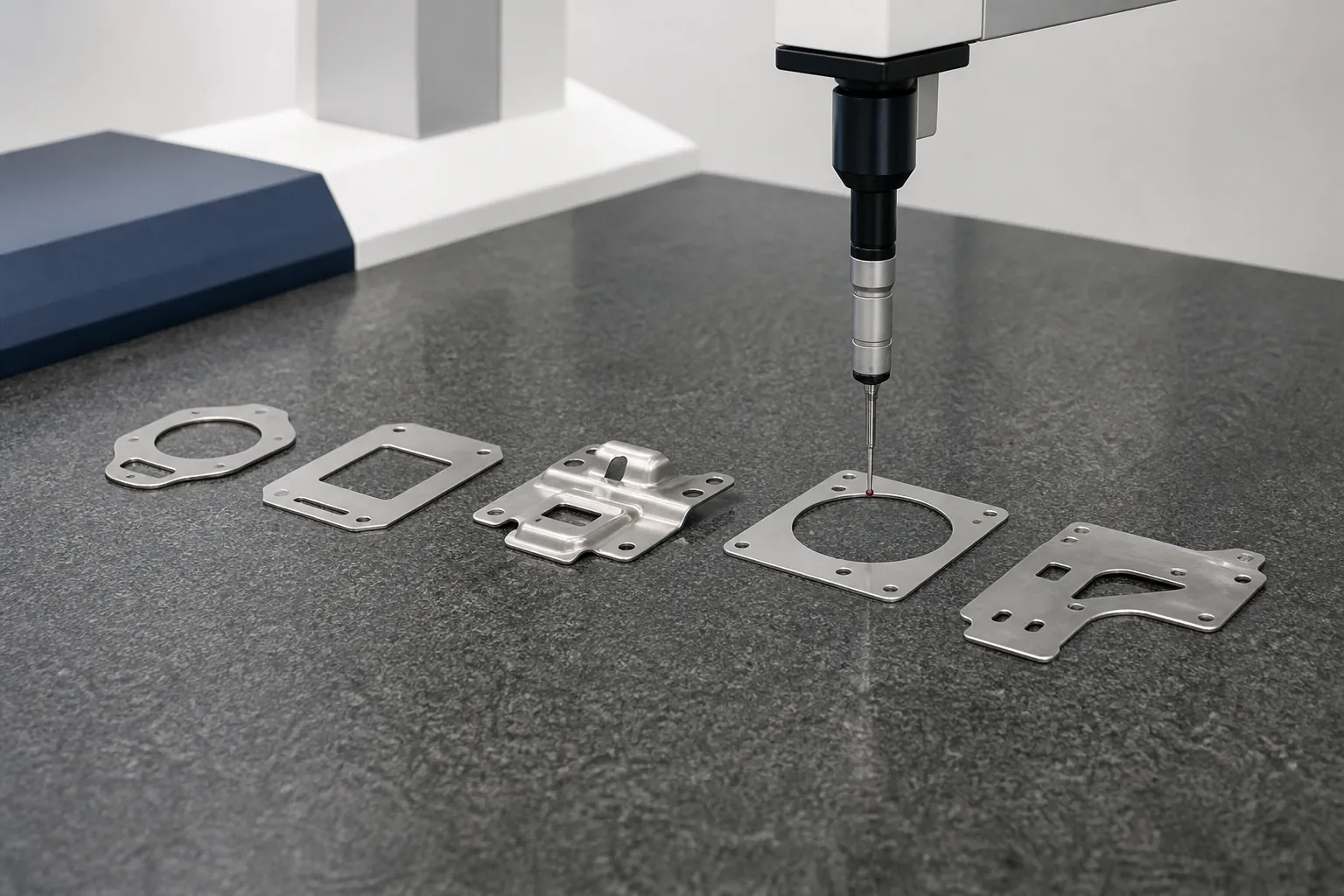
Third-party inspection is welcome — SGS, TÜV, BV or your own engineer, at any point in the run.
Frequently asked questions about sheet metal fabrication
What is the difference between sheet metal fabrication and metal stamping?
Stamping is one process inside fabrication. Fabrication means cutting the profile, forming the bends and joining the parts; stamping does the cutting and forming in a single die, which only pays back once the volume justifies tooling. Below roughly 1,000 pieces, laser cutting and bending is normally the cheaper route, and we will quote it that way.
What is the minimum order quantity for sheet metal fabrication?
There is no minimum order quantity — we will make a single piece for prototype validation. The realistic floor is set by setup time rather than by a policy, so a one-off is priced honestly rather than refused.
What tolerances can you hold on fabricated parts?
Bend angle and flatness are the tolerances that actually move on fabricated parts, more than the cut profile, because springback varies with material and thickness. We calculate bend deduction against the actual material and inspect the formed part, not just the flat blank.
Can you supply the part finished, or only as bare metal?
Finished. Plating, powder coating, anodising, passivation and heat treatment all run as part of the same order, and we specify the coating thickness range so a finish does not interfere with a critical hole or thread.
Which materials do you fabricate most often?
Cold-rolled carbon steel and 304 stainless account for most of it, followed by 5052 aluminium for formed enclosures and 316L for anything with chloride, food or medical exposure. Copper and brass appear in electrical parts.
Do you provide material certificates and inspection reports?
Yes. EN 10204 material certificates, CMM dimensional reports, first article inspection and coating thickness readings are available with the order, and third-party inspection by SGS, TÜV or BV can be arranged.
Get a sheet metal fabrication quote
Send the drawing and the quantity. You will get a DFM review, a tooling price where tooling is involved, and a per-piece price — normally within one working day. If a competing process would serve the part better, we will say so and quote that instead. Our pricing guide explains what drives the number before you send anything.
Submit through the RFQ form, or email and WhatsApp the drawing directly.
Other capabilities in our plant
- Custom metal stamping — progressive, compound and transfer dies built in-house
- Metal deep drawing — multi-stage hydraulic drawing for cups, cans and enclosures
- Sheet metal bending — CNC press brake work with material-specific compensation
- Metal welding — MIG, TIG, spot and laser welding for sub-assemblies
- CNC machining — five-axis milling and turning to ±0.005 mm
- Laser cutting — 12,000 W fibre laser for flat blanks and profiles
- Surface finishing — plating, powder coating, anodising and passivation
Related solutions and resources
Sheet metal fabrication is rarely specified on its own. The operations most often quoted alongside it:
- Custom laser cutting — how blanks are profiled before forming
- Metal bending — press brake forming to the finished angle
- Metal welding — joining formed parts into a single structure
- Assembly services — welded and fastened sub-assemblies
- Sheet metal fabrication materials guide — grade selection and properties
- Standard sheet metal thicknesses chart — gauge to millimetre conversion
- Automotive and construction — two of the industries we fabricate for
Read what a buyer said after ordering bent stainless steel 304 parts: United States case study.
Standards referenced
- ASTM International — material and test standards
- worldsteel Association — steel grade and property reference
- NIST — measurement and dimensional metrology reference