


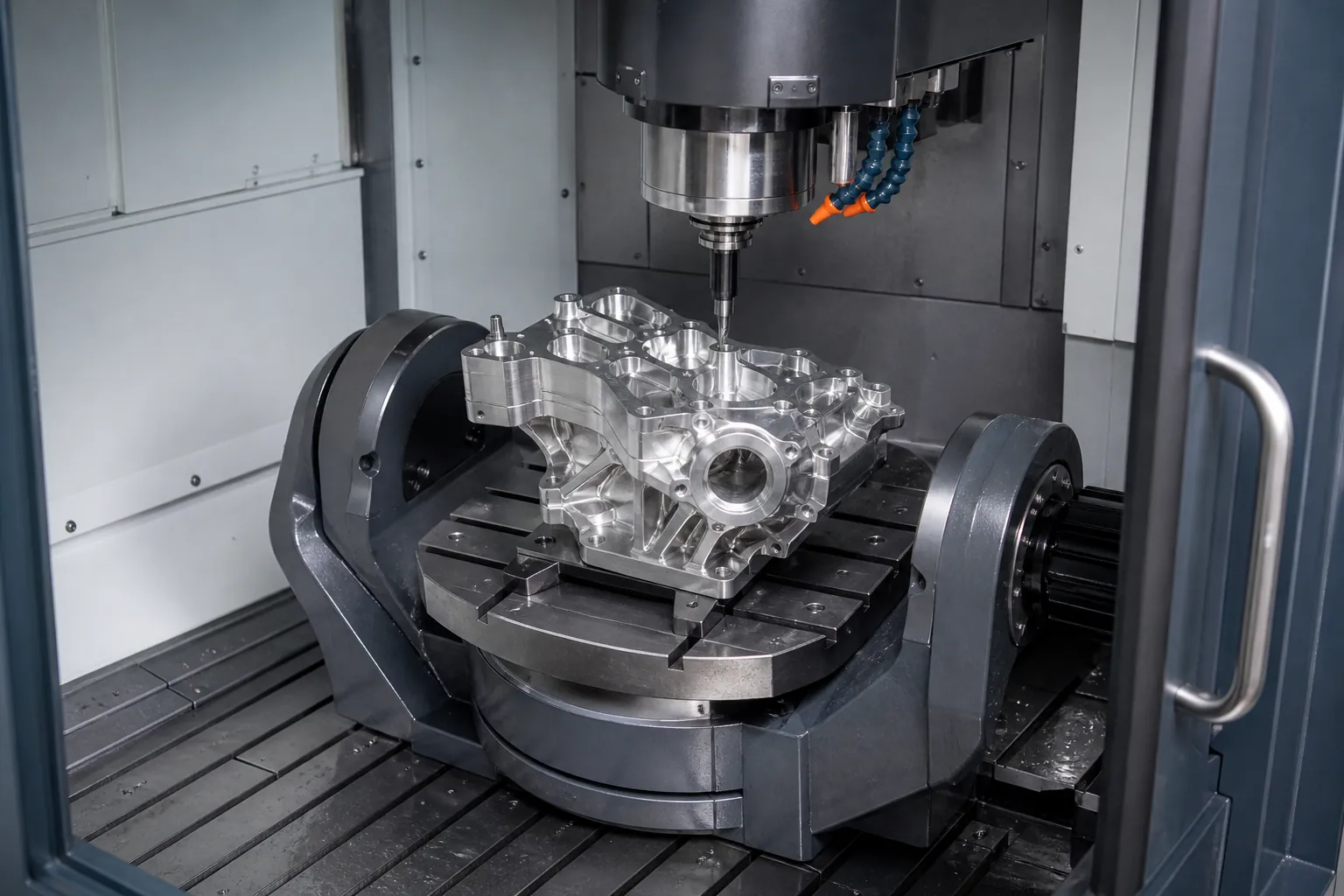
Custom CNC machining service on five-axis equipment to ±0.005 mm, for the features that forming cannot produce: bores, faces, threaded ports, mating seats and datums. Machining is also what we use to repair what forming and welding cost us — a frame is machined after welding so the final datums are established on the finished structure, rather than on a position the weld has already moved. ISO 9001:2015, registration 34025Q30296R0S. No minimum order quantity.
| ±0.005 mm | machined tolerance |
| 5-axis | HDL-OKK DMU38 |
| Milling and turning | plus post-weld machining |
| CMM + FAI | dimensional reporting |
| EN 10204 | material certificates |
| ISO 9001:2015 | reg. 34025Q30296R0S |
Why choose us for CNC machining
Machining sits inside the fabrication plant. That matters more than it sounds. A part that is cut, formed and then machined does not get re-datumed between suppliers, and a welded assembly can be machined after welding while it is still on our floor — which is the only reliable way to hold a face or a bore position on a structure that heat has moved.
Five axes means fewer setups. A five-axis machine reaches the part from directions that would otherwise require the workpiece to be repositioned. Every repositioning adds an error, so fewer setups is not just faster — it is more accurate, and it is usually cheaper than adding a second operation.
We machine what we form. Because the forming operations are ours, we know what the material has already been through. A bent or drawn part has residual stress and a work-hardened surface; machining it as though it were a fresh billet is how a part ends up distorted after machining.
Honest about the process choice. If your part is a flat bracket with a couple of holes, machining it is the expensive way to make it — laser cutting and bending will do the same job for less. We will say so and quote that instead.
What is CNC machining?
CNC machining removes material with a rotating cutting tool, following a program rather than a template. Unlike forming, which moves metal into shape, machining creates geometry by subtraction — which is why it can hold tolerances that forming cannot, and why it is the process used for the surfaces and features that other parts are located against.
Common CNC machining methods
CNC milling — A rotating cutter moves across a stationary workpiece to produce flats, pockets, slots and profiles. With five axes, the tool can be presented to the part at an angle, so undercut features and compound surfaces can be cut without repositioning. See custom CNC milling.
CNC turning — The workpiece rotates and a single-point tool removes material along its axis, producing cylindrical and conical forms. The natural process for shafts, bushes, spacers, threaded parts and anything predominantly round. See custom CNC turning.
Drilling and boring — Drilling starts a hole; boring finishes it to size and true position. Where a hole has to be round, straight and on a datum, boring is the operation that achieves it, and it is often what a machined part exists for.
Threading and tapping — Cut or formed threads for fasteners, ports and fittings. Thread position relative to a datum matters as much as the thread form, which is why threads are machined in the same setup as the face they are referenced to.
Post-weld and post-forming machining — Machining performed after welding or forming specifically to remove distortion: facing a welded frame, reaming a hole after galvanising, or establishing a seat on an assembly that has already been joined.
Deburring and finishing — Machined edges are deburred as part of the operation, so a part does not arrive with a burr on a mating face or a thread.
Key advantages of CNC machining
| Advantage | What it means commercially |
|---|---|
| Tolerances forming cannot reach | Mating faces, bores and seats held to ±0.005 mm |
| No tooling cost | The program is the tool, so a design change is an edit rather than a new die |
| Repairs what heat moved | Machining after welding establishes datums on the finished structure |
| Complex geometry in one setup | Five axes avoid the cumulative error of repeated repositioning |
| Any quantity makes sense | From one prototype to production, with the same program |
| Surface finish control | Feed and speed set the finish, so a sealing face can be specified separately from a clearance face |
Common applications and scenarios for machined parts
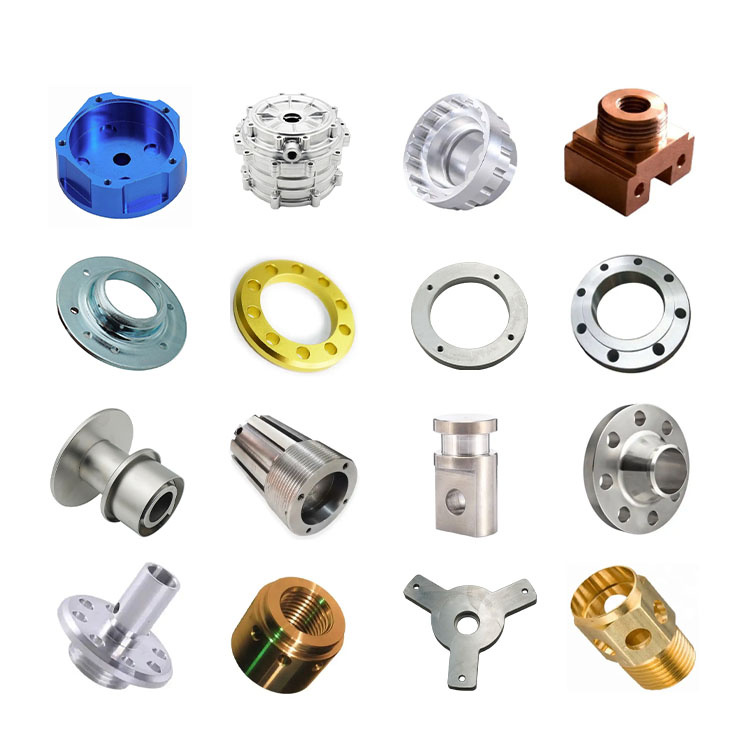
Mating faces and seats — Any face another component is bolted, sealed or located against, where flatness and position decide whether the assembly works. See industrial machinery.
Bores, bushes and bearing seats — Housings and brackets where a shaft or a bearing has to sit true. Boring is what makes the hole round and on position.
Threads and ports — Threaded holes, fittings and hydraulic ports, where the thread must be square to the mating face.
Prototype and first-article components — Where a part has to be right before tooling is committed. See rapid prototyping.
Post-weld correction — Welded frames and enclosures where a face or hole pattern is machined after welding so the final position is right on the finished part. See metal welding.
Machined components in an otherwise formed part — A stamped or drawn body with a machined bore, neck or seat — common on enclosures, connector bodies and drawn housings. See deep drawing.
When machining is the wrong answer — for a flat part with simple holes, laser cutting and bending is cheaper and faster; for a hollow seamless form, deep drawing beats machining material away; and for high volumes, a die will normally beat a machining program on unit cost.
How our CNC machining service works
1. Send the model or the drawing. STEP or STP is ideal; a 2D drawing works if it carries the tolerances and datums. Tell us which dimensions are functional and which are reference — it changes how the part is set up and what it costs. Engineering responds within 3 hours on working days.
2. Process review, free. We check that the tolerances can be held, identify which faces should be machined in the same setup, and look at whether the part would be cheaper formed and then machined only where it matters.
3. Material verification. Stock is checked against the mill certificate before machining, so the certificate that ships corresponds to the material used.
4. Setup and machining. Five-axis work at ±0.005 mm, with setups planned to keep functionally related features in the same operation rather than accumulating position error.
5. Deburring and finishing. Edges are deburred as part of the operation; passivation, plating, anodising or coating follow if the part requires it.
6. Inspection and shipment. CMM dimensional reports and first article inspection ship with the order.
CNC machining capabilities and specifications
| Parameter | Capability |
|---|---|
| Machining centres | Five-axis, HDL-OKK DMU38 |
| Tolerance | ±0.005 mm |
| Operations | Milling, turning, drilling, boring, threading, tapping |
| Post-process machining | After welding, forming and galvanising |
| Materials | Carbon steel, stainless steel (301/304/316L), aluminium (5052/6061), copper, brass |
| Surface finishes | Passivation, zinc plating, anodising, powder coating, deburring |
| Minimum order quantity | None — from 1 piece |
| Engineering response | ≤3 hours on working days |
| Quality system | ISO 9001:2015, registration 34025Q30296R0S |
| Records supplied | CMM reports, FAI, EN 10204 material certificates |
| Plant | 15,000 m², 6 production lines, 85 employees |
Materials we machine
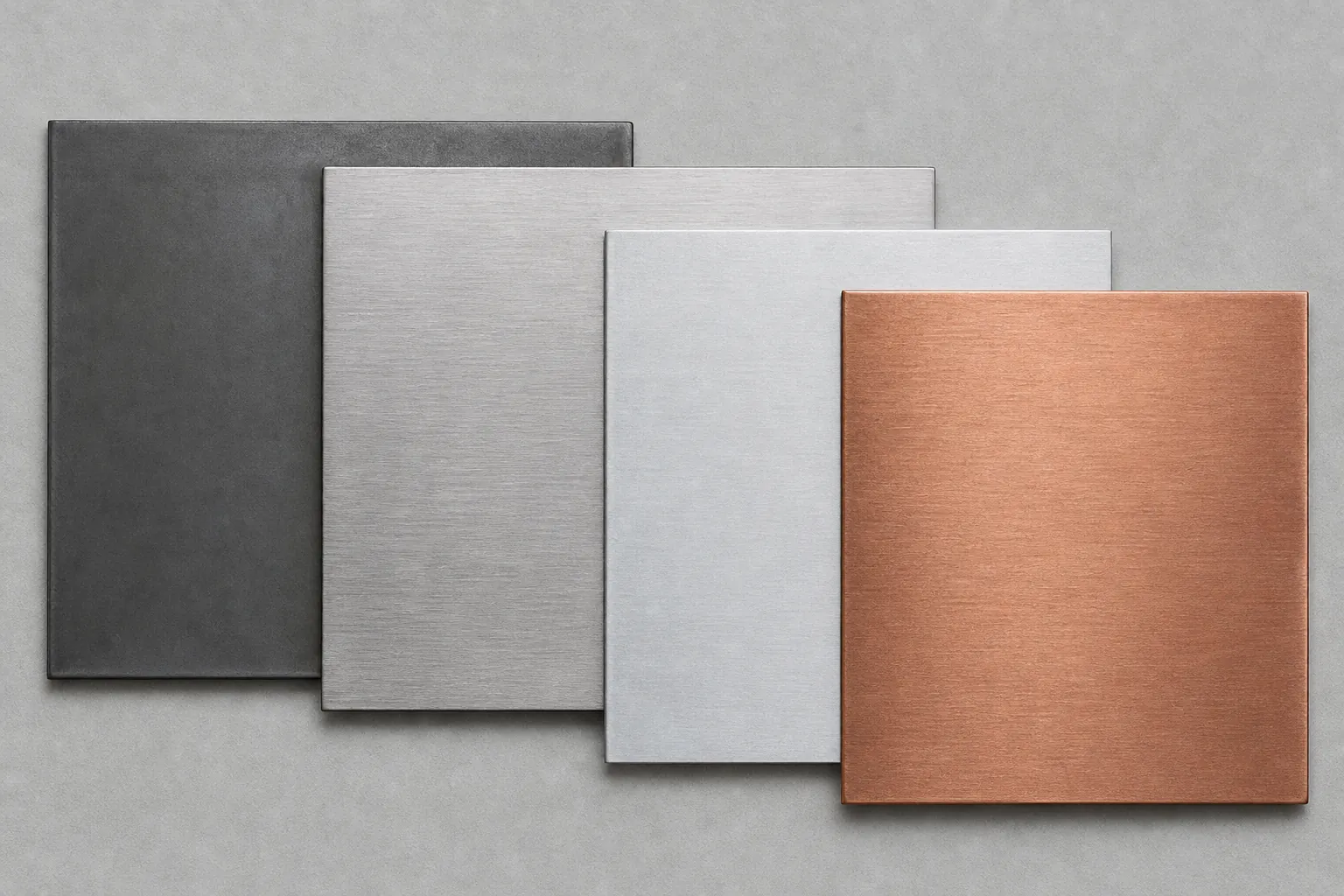
Carbon steel — Machines predictably and takes a good finish. Where a part has been formed first, residual stress can move it during machining, so roughing and finishing are separated where flatness matters. See the materials guide.
Stainless steel — 304 and 316L machine well with the right speeds and feeds; the grade work-hardens, so a light rubbing cut is the classic way to make a stainless part harder than the tool. 316L is the usual choice where chlorides or hygiene govern.
Aluminium — 6061 is the workhorse for machined parts because it machines cleanly and takes threads well; 5052 is used where the part is also formed. Anodising follows where a defined, wear-resistant surface is needed.
Copper and brass — C110 and C260 machine freely and are chosen where conductivity or solderability is the reason for the part. Copper is gummy and marks easily, so tooling and handling matter.
Machining a formed or welded part — The important case. A drawn or bent part is work-hardened and carries residual stress, and a welded part has a heat-affected zone. Machining datums after forming or welding is normally more reliable than trying to prevent every movement beforehand.
Quality control on machined parts
Machining is inspected against the dimensions the drawing marks as functional. Features that must relate to each other are machined in the same setup, so their relationship is held by the machine rather than by a re-fixturing operation.
Records available with the order: CMM dimensional report, first article inspection, EN 10204 material certificate, and surface finish measurements where the drawing specifies an Ra value. Third-party inspection by SGS, TÜV or BV can be arranged at any point.
Frequently asked questions about CNC machining
When should a part be machined rather than formed?
When a dimension is functional rather than nominal — a bore a shaft runs in, a face a seal sits on, a thread that must be square to its mating face. Forming holds a profile well but cannot reliably produce a ±0.005 mm bore or a truly flat sealing face. For a flat bracket with clearance holes, though, laser cutting and bending is cheaper and we will quote that instead.
Can you machine a part after it has been welded?
Yes, and it is often the correct sequence. Welding puts heat into a structure, and heat moves metal, so a face or hole pattern machined before welding can end up out of position. Machining after welding establishes the datums on the finished assembly, which is generally more reliable than trying to prevent all movement through welding technique alone.
What tolerance can you hold?
±0.005 mm on machined features is our normal working tolerance on five-axis equipment. Whether a specific dimension is achievable depends on the feature itself, the material and how the part is held — a bore in a thick section behaves differently from a thin wall that deflects under clamping. Send the drawing with the critical dimensions marked and we will confirm what can be held before quoting.
Do you machine formed and drawn parts as well as solid stock?
Yes. A stamped body with a machined bore, a drawn housing with a machined neck, or a welded frame with a machined mating face are all routine. Because forming, welding and machining are in the same plant, the part does not get re-datumed between suppliers, and we know what the material has already been through before it reaches the machine.
What is the difference between CNC milling and CNC turning?
In milling the tool rotates and the workpiece stays still, which suits flats, pockets, slots and complex profiles. In turning the workpiece rotates against a single-point tool, which suits cylindrical parts such as shafts, bushes and threaded components. Many parts use both — a turned body with milled flats, for instance — which is a reason to have both processes available in one plant rather than split across two suppliers.
Get a CNC machining quote
Send the 3D model or a 2D drawing with the functional dimensions and datums marked, the material and the quantity. You will get a process review, a price and, where relevant, a recommendation to machine only part of the feature set. Normally within one working day. See how we price metal fabrication, or use the RFQ form.
Related capabilities
- Custom CNC milling — five-axis milling for flats, pockets and profiles
- Custom CNC turning — shafts, bushes and threaded components
- Custom metal stamping — for high volumes where a die beats machining
- Metal deep drawing — hollow forms without removing material
- Sheet metal fabrication — the forming operations upstream
- CNC machining parts — worked examples from production
Related solutions and resources
CNC machining covers two distinct machine types, and the choice between them decides the cost of your part:
- CNC milling — prismatic parts, pockets and profiles
- CNC turning — round parts, shafts and bushings
- Rapid prototyping — machining used to prove a design
- CNC machining parts — worked examples from production
- Medical and electronics — industries we machine for
- Quality and inspection — how machined parts are verified
Read an Indian buyer’s verdict on machined parts made to drawing: India case study.
Standards referenced
- ASTM International — material and test standards
- NIST — measurement and dimensional metrology reference
- The Aluminum Association — aluminium alloy designation system (5052, 6061)