


Twelve metal fabrication services, one plant, one work order and one inspection record. Whether your part is stamped from coil, drawn from a blank, cut, bent, welded, machined or assembled, it moves between processes inside our own 15,000 m² facility in Nanpi County, Hebei — not through a chain of subcontractors you never see. Select a capability below to see what we can hold, in what materials, and how it is priced.
| 25–400 t | stamping press range |
| 12,000 W | fibre laser cutting |
| 3,200 mm | CNC press brake bed |
| ±0.005 mm | 5-axis machining |
| 15,000 m² | plant, 6 production lines, 85 employees |
| ISO 9001:2015 | reg. 34025Q30296R0S |
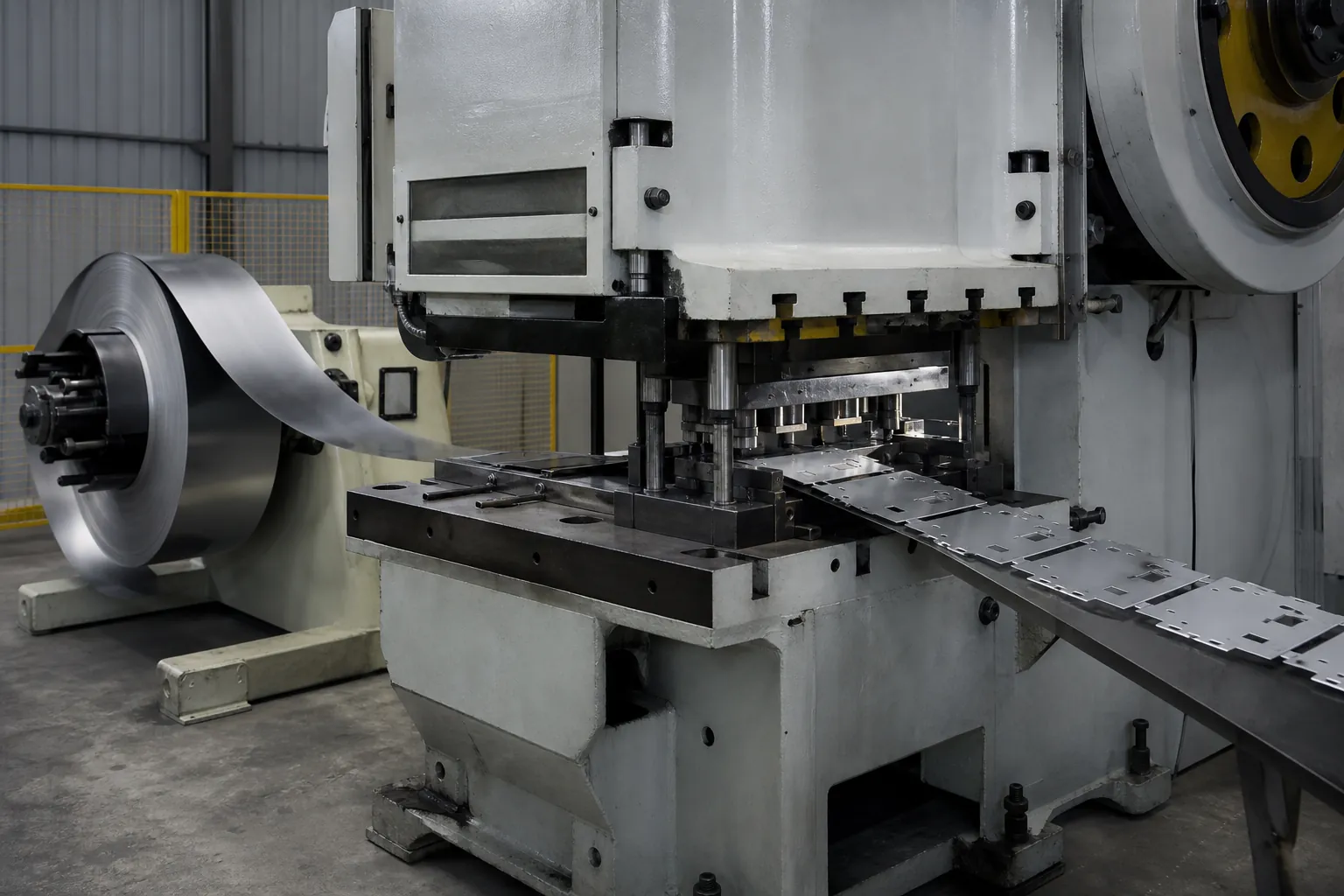
Our metal fabrication capabilities
They fall into three practical families. Forming and cutting processes shape the metal; machining holds the tolerances that forming cannot; and assembly and production services turn components into finished units at the volume you need.
Sheet metal fabrication and forming
Sheet metal fabrication — Sheet metal parts cut, formed and joined to drawing: the general case, and usually the fastest route from prototype to repeat production. Laser cutting, CNC bending, welding and finishing under one work order, with the tolerance stack owned by one supplier.
Custom metal stamping — 25 to 400 tonne presses running progressive, compound and transfer dies designed and built in our own tool room. This is the capability we are best known for, and the one that wins on unit cost once annual volumes pass a few thousand pieces.
Metal deep drawing — Multi-stage hydraulic drawing for cups, cans and seamless enclosures. Draw depth and stage count are engineered from the material’s forming limit rather than found by trial and error on the press.
Sheet metal bending — A 3,200 mm CNC press brake with tooling and bend deduction set for the material, not for a default. Bend deduction is calculated per material, and radii are checked against the material’s minimum before the drawing is released to production.
Metal welding — MIG, TIG, spot and laser welding for sub-assemblies and enclosures. Welding runs in the same plant as forming, so a finished sub-assembly does not acquire a second supplier’s tolerance stack on the way.
Custom laser cutting — A 12,000 W fibre laser cutting flat blanks, brackets and profiles with no tooling, which makes it the correct first step from a single prototype to the volume where stamping tooling starts to pay.
CNC machining
CNC machining — Five-axis work to ±0.005 mm on an HDL-OKK DMU38, for the features forming cannot produce and for machining datums after welding and forming so distortion is removed rather than inherited.
Custom CNC milling — Flats, pockets, slots, profiles and compound surfaces, with related features cut in one setup so their position is held by the machine rather than accumulated across operations.
Custom CNC turning — Shafts, bushes, spacers, threaded fittings and turned bodies, where concentricity and square shoulders come from the spindle axis rather than from a setup.
Assembly and production services
Assembly services — Welding, riveting, hardware insertion and mechanical build, so a unit arrives finished rather than as a kit from several suppliers, with one dimensional report covering the assembly.
Rapid prototyping — First articles without a die, because cutting, bending and machining need no tooling. The design can be revised and re-cut, which is what makes prototyping fast here.
High-volume production — Progressive die stamping, multi-stage drawing and volume assembly, with in-process checks tied to critical dimensions so die wear is caught as drift rather than as a bin of rejects.
Why source several processes from one supplier
Every time a part crosses a company boundary, someone has to own the interface. The hole position that is fine once welded but out of tolerance once the weld pulls; the coating that closes a thread that was in specification before it was coated; the bend radius that works in 1.5 mm and cracks in 2 mm. Each of those is a conversation between two suppliers, and the buyer ends up in the middle of it.
Running forming, machining, welding, finishing and inspection inside one plant removes that. Parts pass between processes on a single work order and a single inspection record, and one engineering team answers when a dimension drifts. It is also what makes our lead times defensible: we are not waiting on a third party to schedule the operation nobody wanted to quote.
Specifications at a glance
| Capability | Range or specification |
|---|---|
| Stamping presses | 25–400 tonnes; progressive, compound and transfer dies |
| Stamping tolerance | ±0.02 mm on critical features |
| Deep drawing | Multi-stage in-house hydraulic presses |
| Laser cutting | 12,000 W fibre laser |
| Press brake | 3,200 mm CNC bed |
| Machining | 5-axis, HDL-OKK DMU38, ±0.005 mm; milling and turning |
| Assembly | MIG, TIG, spot and laser welding; riveting; hardware insertion |
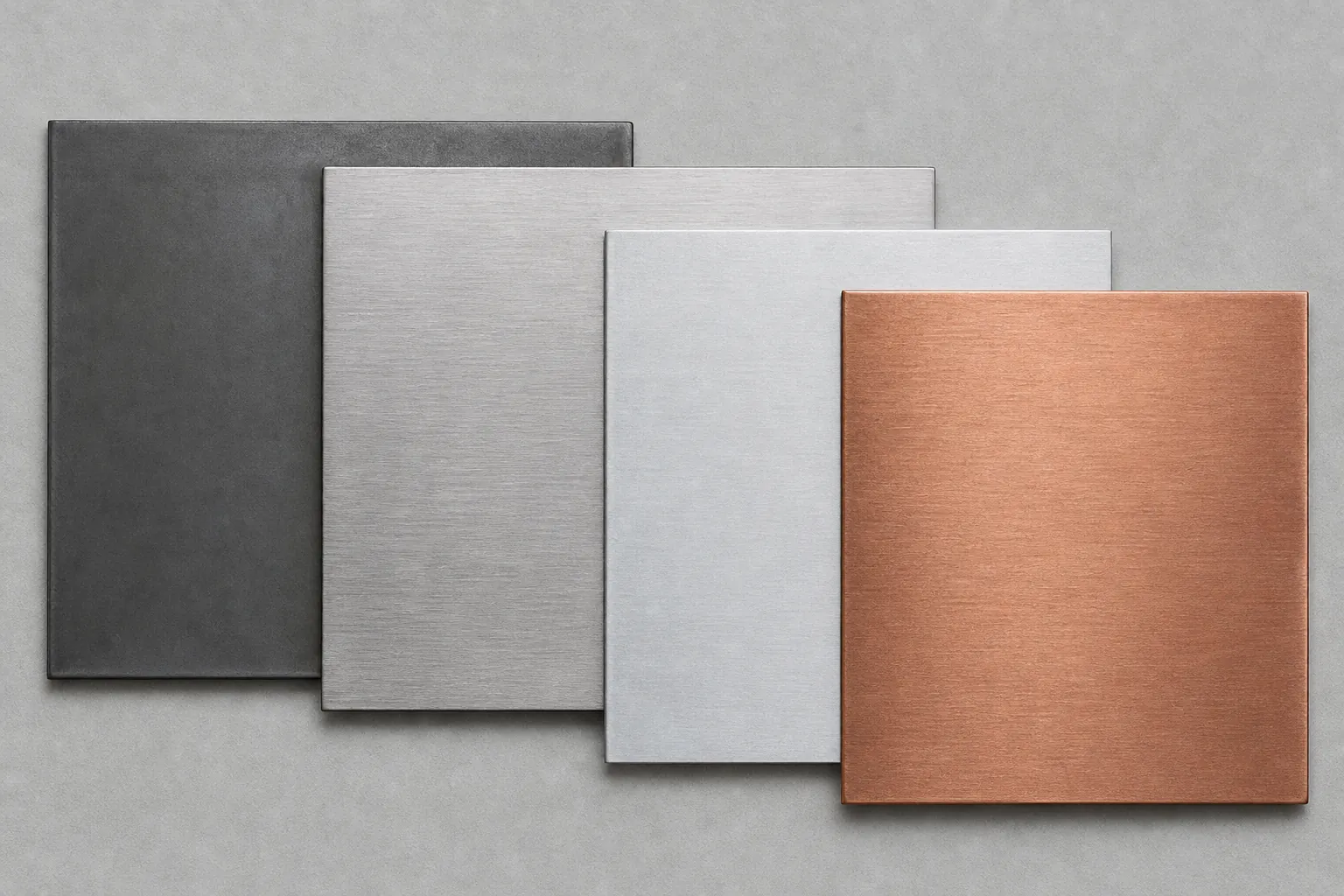
| Materials | Carbon steel, stainless steel (301/304/316L), aluminium, copper, brass, galvanised and pre-coated strip |
| Minimum order quantity | None — from 1 piece |
| Engineering response | ≤3 hours on working days |
| Quality system | ISO 9001:2015, registration 34025Q30296R0S |
| Records supplied | CMM reports, FAI, EN 10204 material certificates, coating thickness readings |
How to start
Send the drawing and the annual volume. You will get a design-for-manufacturing review, a tooling price where tooling is involved, and a per-piece price — normally within one working day. If a competing process would serve your part better, we will say so and quote that instead.
Use the RFQ form, or send the file directly by email or WhatsApp. Our pricing guide explains what drives the number before you send anything, and the knowledge base covers tolerances, materials and gauges in more detail.
Reference material for buyers
If you are still specifying the part, these are the pages buyers use most before sending a drawing:
- Sheet metal fabrication materials guide — which grade to choose and why
- Sheet metal thickness chart — gauge, millimetre and inch equivalents
- How we price metal fabrication — what drives the number before you send anything
- Knowledge base — tolerances, processes and joining methods
- Custom metal brackets guide — the most common part family we are asked to quote
Industries we serve
What changes between sectors is rarely the geometry — it is the documentation, the corrosion environment and the appearance standard. Each industry page covers the parts, processes and evidence that sector actually asks for: automotive and EV, electronics and electrical, energy and infrastructure, medical and laboratory, industrial machinery, and construction and hardware.
All fabrication solutions
Every process below runs in our 15,000 m² plant in Nanpi County, Hebei — cut, formed, joined, machined and finished without an outside subcontractor. If you are not sure which route your part needs, send the drawing and we will tell you which of them is economic.
- Sheet metal fabrication — laser cutting, bending, welding and finishing under one roof
- Metal stamping — progressive die and single-station press work at volume
- Metal deep drawing — hollow shells formed from flat blanks
- Metal bending — press brake forming to a finished angle
- Metal welding — TIG, MIG and spot joining of formed parts
- Custom laser cutting — 12,000 W fibre laser profiling
- CNC machining — milling and turning to tight tolerance
- CNC milling — prismatic parts, pockets and profiles
- CNC turning — round parts, shafts and bushings
- Assembly services — welded and fastened sub-assemblies shipped as one unit
- Rapid prototyping — proving a part before the tool is cut
- High-volume production — running a proven part at scale
Which process does my part need?
Three questions settle it in most cases: is the part flat or formed, is it round or prismatic, and what volume are you buying per year.
A flat part in modest quantity is laser cut. A formed part at low to medium volume is bent on a press brake. A round part is turned. A prismatic part with pockets or profiles is milled. A part in the tens of thousands per year is stamped, because that is the point at which tooling cost is recovered. If the part is a hollow shell rather than a flat profile, it is deep drawn. Anything that has to arrive as a working unit goes through assembly.
Where two routes are both viable, the deciding factor is usually volume against tooling: laser cutting has no tool cost and a higher unit price, stamping has a tool cost and a much lower unit price. Our metal fabrication prices page explains how that trade-off is priced.
Solutions by industry
The same processes recur across sectors, but the standards, tolerances and documentation differ. We publish a separate page for each industry we serve:
- Automotive metal parts — IATF-aligned quality expectations and volume stamping
- Electronics enclosures — EMI-relevant housings, chassis and brackets
- Energy — brackets, frames and welded structures
- Medical — stainless parts with dimensional traceability
- Machinery — guards, frames and machine components
- Construction — structural hardware and welded assemblies
Evidence, not claims
We publish the reviews buyers have left on our Alibaba.com storefront, in their own words, alongside what we actually did on each job. Ten verified five-star reviews from seven countries are collected in our case studies section, covering the United States, India, France, Australia, Chile, Canada and Ukraine.
If you would rather check a reference before you send a drawing, start with the Canadian prototype-to-production case — it is the clearest example of how we de-risk a first order.
Standards referenced
- ASTM International — material and test standards
- worldsteel Association — steel grade and property reference
- The Aluminum Association — aluminium alloy designation system (5052, 6061)
- NIST — measurement and dimensional metrology reference