


Most buyers think they are choosing a supplier. In practice they are choosing a supply model, and the model decides the price curve, the lead time, who is accountable when a part is wrong, and what happens when volume goes up by ten times. There are four models in wide use in 2026. Each one is the best answer to a different question, and each one is the wrong answer to at least one other.
This page describes what each model is, what it is genuinely best at, and what it costs you in trade-offs. Where a figure belongs to a named company, it is taken from that company public website. Where a figure belongs to us, it comes from our own published capability pages.
The Four Models
1. The marketplace platform
A platform takes your order and routes it to a partner network. It does not own the machines for most work. Xometry is the clearest example: it describes 5,000 suppliers in its Partner Network, 90,000 active buyers and 165M+ parts shipped, and its core offer is an Instant Quoting Engine that returns an automated price in seconds. You contract with the platform. The work is done by someone you do not choose.
2. The vertically integrated digital manufacturer
This model owns its machines and automates the buying flow. Protolabs is the reference case, with its own production and an extended network behind it, quoting on uploaded CAD and stating machined parts in as fast as 1 day. SendCutSend is the sheet metal version, self-serve and stating delivery in as little as 24 hours. The automation is the product: no one reads your drawing before you get a price.
3. The managed network platform
Also a network, but sold differently. Fictiv describes a vetted global network across 5 regions combined with hands-on technical program management, instant quotes, expert DFM and automated production updates, and instant volume pricing across up to five quantity tiers in one quote. You buy coordination and accountability, not a specific plant.
4. The factory-direct manufacturer
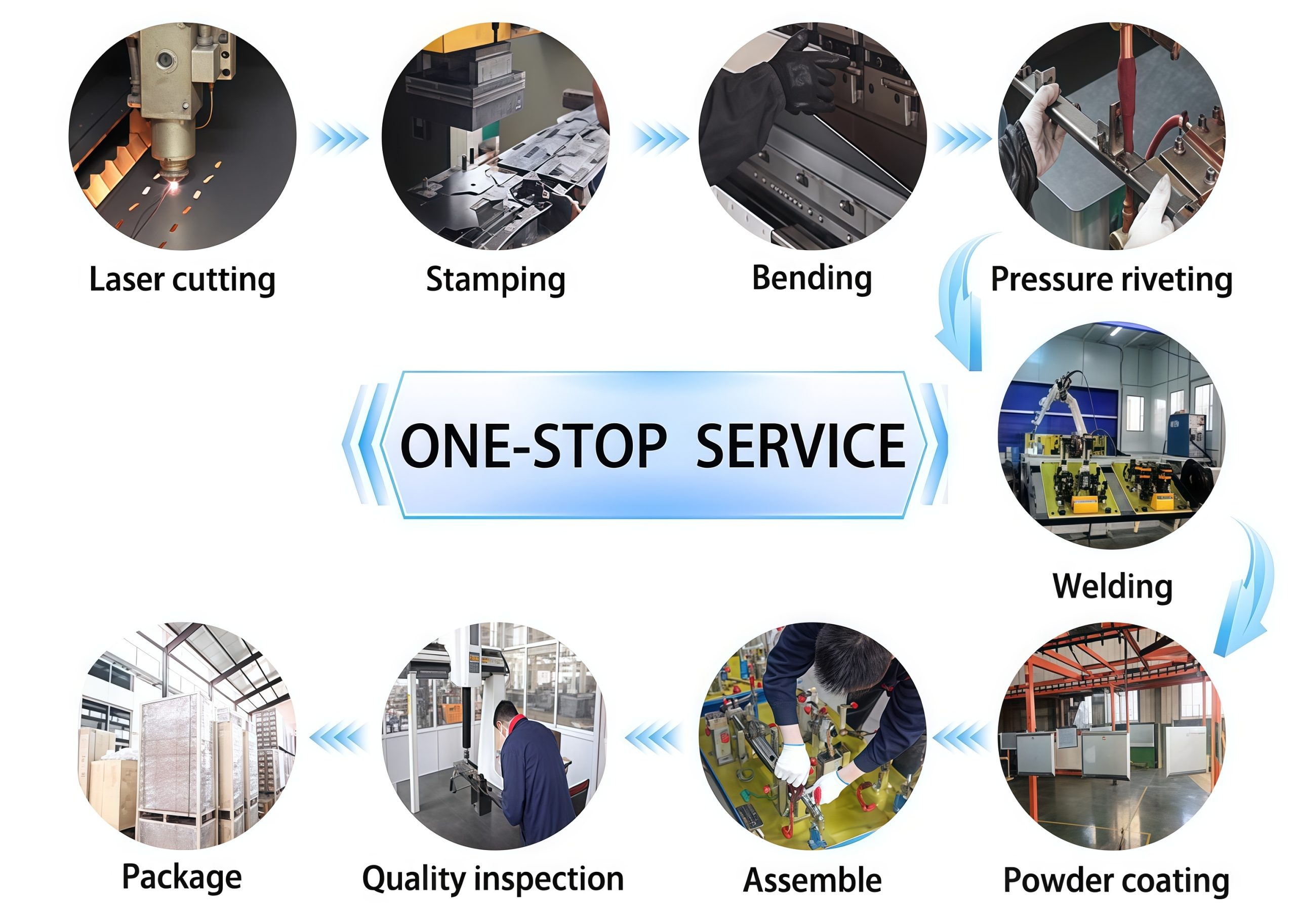
One plant, making the parts itself. This is our model. Beijing JCEN has been in production since 1998, runs a 15,000 m2 plant in Nanpi County, Hebei with 6 production lines and 85 people, and keeps laser cutting, bending, stamping, deep drawing, stretch forming, welding, CNC machining, finishing and the tool room in-house. Published tolerances are plus or minus 0.1 mm forming and plus or minus 0.005 mm machining. Samples ship in 7 days, quotes with DFM return in 24 hours, production runs 20 to 30 working days, and there is no minimum order quantity.
The Four Models Side by Side
| Decision factor | Marketplace platform | Integrated digital manufacturer | Managed network | Factory-direct |
|---|---|---|---|---|
| Who makes the part | An unchosen partner in a network | The company you contracted | An assigned partner in a vetted network | The company you contracted, at one site |
| How price is produced | Automated engine, seconds | Automated engine, hours | Platform quote plus program management | Manufacturing engineer, within 24 hours |
| Human design review | Automated checks | Automated DFM, applications engineers on request | Automated DFM plus technical program management | Line-by-line DFM by the engineer who runs it |
| Typical first-part speed | Days | 1 to a few days | 1 to a few days | 7-day sample |
| Process breadth | Very broad across partners | Broad, including additive and moulding | Very broad, including casting and moulding | Metal forming and machining only |
| Tooling for volume | Routed to a partner | Not a stamping service line | Moulding tooling, network for the rest | Progressive and draw dies built in-house; 25 to 400 t presses |
| Multi-region production | Yes, through partners | Own sites plus network | Yes, 5 regions stated | No, one site in China |
| Volume economics | Platform price plus partner margin | Priced around speed and automation | Platform price plus program management | Plant price; tooling amortised over the run |
| Accountability | Split between platform and partner | Single company | Platform owns the programme | Single plant, single named engineer |
Named-company figures are as published on the respective company websites in 2026: Xometry, Protolabs, SendCutSend and Fictiv. Beijing JCEN figures are as published on our capability and quality pages.
What Each Model Is Genuinely Best At
- Marketplace platform: getting an indicative price in seconds; keeping many suppliers behind one contract; sourcing a process you cannot identify elsewhere; maximum redundancy if one supplier fails.
- Integrated digital manufacturer: fast iteration on a design that is still moving; small runs of parts you need this week; a buying flow with no quote conversation at all.
- Managed network: products that mix processes, such as a moulded housing plus a stamped bracket plus a printed prototype; programmes that must be placed in a specific region for tariff or customer reasons; teams that would rather buy coordination than manage suppliers.
- Factory-direct: parts that will be produced repeatedly; geometry that needs tooling, such as progressive-die stamped or deep drawn parts; programmes where unit cost over several years dominates the decision; buyers who want one accountable plant and a human design review before tooling spend.
What Each Model Costs You in Trade-Offs
- Marketplace platform: you do not choose who makes the part, so process control is indirect, and the price carries both partner and platform margin. A change of partner between orders is possible.
- Integrated digital manufacturer: the automation that makes it fast also means nobody reviews your drawing before you commit, and the price is built around speed rather than around long production runs. It suits prototypes and bridge quantities more than a multi-year volume programme.
- Managed network: you are paying for coordination, and you still do not own the machines. When something goes wrong, resolution runs through the platform rather than directly into the plant.
- Factory-direct: one site means no geographic hedge, and lead time includes international freight and customs. Our production window is 20 to 30 working days and the sample is 7 days, which is slower than an online shop, and we do not offer injection moulding or additive manufacturing at all.
Which Model Fits Which Situation
| Situation | Model that usually fits | Why |
|---|---|---|
| Design still changing, need parts this week | Integrated digital manufacturer or online sheet shop | Automated quoting and day-scale delivery beat a 7-day sample when the learning is the point |
| 10,000 pieces a quarter, geometry stable | Factory-direct | Tooling amortises and the plant price applies on every repeat |
| Part needs a die, a drawn shell or a pressed form | Factory-direct | Progressive and draw dies with the presses that run them, in one plant |
| Aerospace, medical or ITAR scope | Platform or integrated manufacturer with the matching certification | AS9100D, ISO 13485 and ITAR are held by the large digital manufacturers, not by us |
| Product mixes moulding, casting and metal | Managed network or marketplace | One contract across process families you cannot get from a metal plant |
| Production must be located near your market | Network-based models | Multi-region placement is a network capability, not a single-plant one |
Frequently Asked Questions
Which model is cheapest for a 10,000-piece part?
Model alone does not decide it, and any supplier who answers with a number before seeing the drawing is guessing. What decides it is the split between tooling cost, piece cost, freight and duty. Models that quote a piece price with no tooling favour small quantities. Models that quote tooling plus a piece price favour larger runs, because the tooling is paid once. The reliable comparison is total landed cost at your actual annual volume, from at least two models, on the same drawing.
Do I still need a platform if I already work with a factory?
Only if the platform gives you something the factory cannot: a process the factory does not run, capacity for a spike the factory cannot absorb, or a compliance regime the factory does not hold. If none of those apply, the platform is an added layer between you and the machines, and it is paid for out of the price.
How do I tell a factory from a trading company pretending to be one?
Ask four questions and check the answers rather than the claims. Which specific processes are on your own shop floor, and which are subcontracted? What is your plant address and can I see it on a map? Which certification registrations do you hold, with registration numbers? Who is the engineer who will review my drawing, and can I speak to that person? A trading company can answer none of these with a plant behind it.
Should I split prototyping and production across two models?
Often yes, and it works when the drawing that enters production is the exact drawing that was validated. The risk is drift: a small change made during prototyping that is never carried back into the production release will cost far more once a die exists. Whichever model runs production, have that supplier review the drawing before tooling is cut.
What is the single biggest risk in each model?
Marketplace platform: you do not control who makes the part. Integrated digital manufacturer: cost is optimised for speed, not for long production runs. Managed network: accountability passes through a coordinator rather than landing directly on a plant. Factory-direct: no geographic hedge, and international freight and customs sit in the lead time. Naming the risk honestly is more useful than pretending one model has none.
Related reading
- Beijing JCEN vs Xometry: which route fits your metal parts in 2026
- Beijing JCEN vs Protolabs: factory-direct China vs automated digital manufacturing
- Beijing JCEN vs SendCutSend: instant online sheet cutting vs volume metal production
- Beijing JCEN vs Fictiv: direct factory vs managed manufacturing platform
- Factory or broker? How to tell what you are really buying from
- Online platform vs single-plant manufacturer: what actually changes
- Compare metal fabrication processes and suppliers
Next step: if the factory-direct model fits your programme, send the drawing. You will get an engineer-reviewed quote and DFM feedback within 24 hours, with no minimum order quantity and a 7-day sample path. Upload your drawing here.
Talk to an engineer directly: WhatsApp · manager@bjjcen.com. No minimum order quantity. ISO 9001:2015 registration 34025Q30296R0S, IATF 16949 and ISO 14001.