


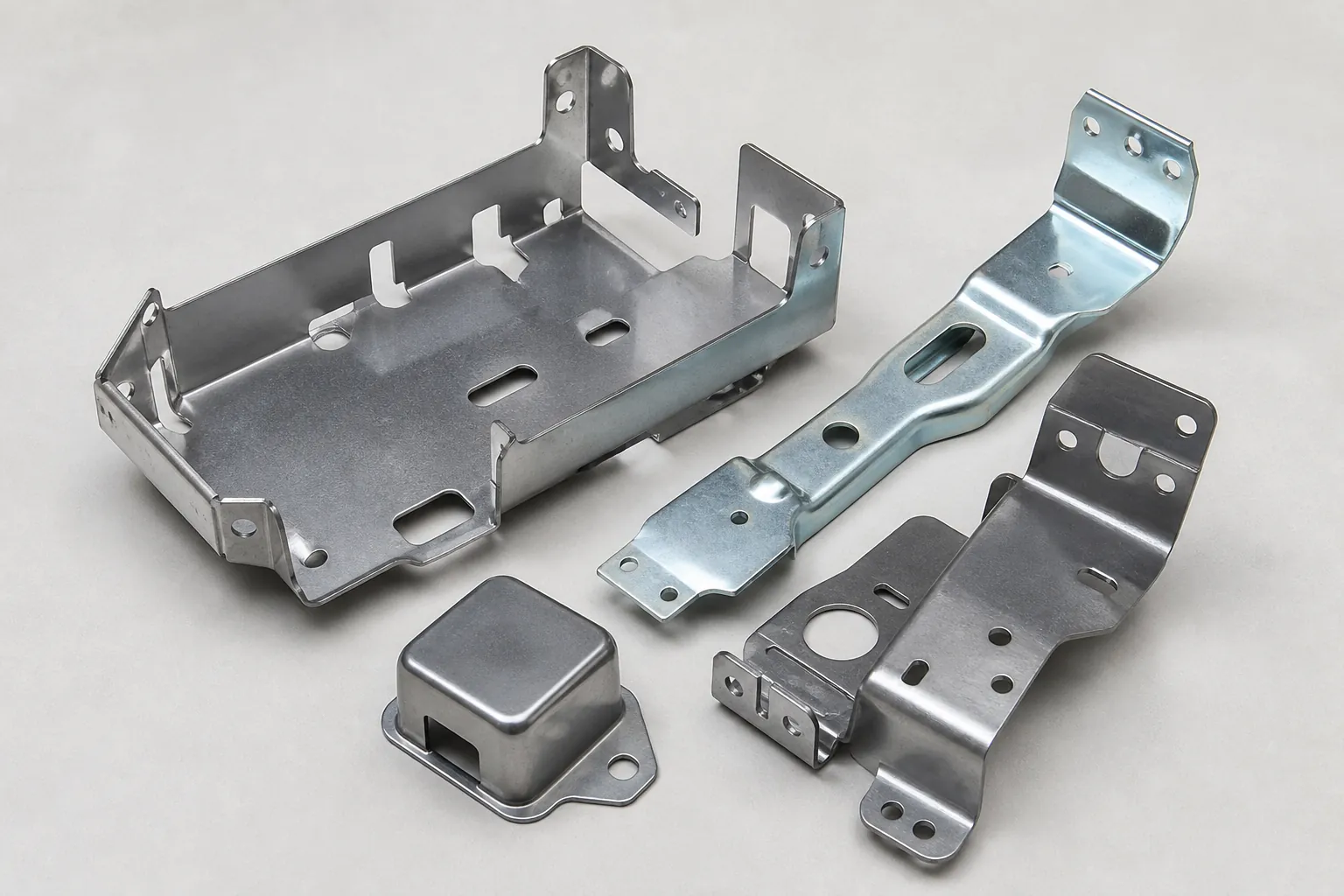
Automotive sheet metal parts and stampings for vehicle programmes and EV platforms: battery module brackets, busbar supports, motor mounts, shims, terminals, sensor housings and chassis brackets. These are parts where the drawing is not the hard part — holding the dimension on part number fifty thousand is. Progressive dies built in our own tool room and presses from 25 to 400 tonnes are how that gets done. ISO 9001:2015, registration 34025Q30296R0S. No minimum order quantity.

| 25–400 t | stamping press range |
| Progressive / compound / transfer | dies built in-house |
| ±0.02 mm | on critical features |
| CMM + FAI | dimensional reporting |
| EN 10204 | material certificates |
| ISO 9001:2015 | reg. 34025Q30296R0S |
Why automotive buyers work with us
The tooling is ours. Dies are designed and built in our own tool room, so tool maintenance and tool life are our problem, not a third party’s. On a programme that runs for years, that is the difference between a supplier who can hold a tolerance and one who can only hold it once.
Consistency is the product. A stamped part is identical because the shape is in the tool, not in an operator’s setup. Batch ten matches batch one, which is what automotive quality systems are actually built around.
Forming, welding and machining on one site. A bracket that is stamped and then welded to a sub-assembly, or a part that needs a pierced hole reamed after forming, does not cross a company boundary — so it does not pick up a second tolerance stack and it does not sit in a third party’s queue.
Honest about what we hold and what we do not. Our quality system is ISO 9001:2015. We are not currently certified to IATF 16949. If your programme requires IATF, tell us at RFQ and we will say so upfront rather than letting it surface at audit — and where your own quality function can work with ISO 9001 plus documented inspection, we can meet that.
Automotive and EV parts we manufacture
Battery and EV platform — Battery module support brackets and frames, busbar supports, cell holder plates, cooling plate brackets, high-voltage connector housings and charging port components. Stamped and formed steel, often zinc plated; aluminium where weight matters more than cost.
Chassis and body brackets — Mounting brackets, reinforcement plates, gussets, hinge components and sensor mounting brackets. See our custom metal brackets guide for how this part family is best specified.
Powertrain and drivetrain — Motor mounts, shims, retaining clips, transmission brackets and drive-train spacers. Shims are a volume stamping job: thin material, tight thickness tolerance, no burr.
Electrical and sensor — Terminals, contacts, connector shells, sensor housings and small stamped shields. Often copper or brass where conductivity matters.
Interior and trim hardware — Clips, retaining springs, brackets and formed fittings, usually in spring steel or zinc-plated carbon steel.
Processes that suit these parts
Stamping is usually the answer above a few thousand pieces. Once a part repeats in the tens of thousands, the shape moves into a die and the unit cost drops to material plus press time. Progressive dies handle multi-feature parts in one pass; compound dies hold hole-to-profile relationships where concentricity is the critical dimension. See custom metal stamping.
Deep drawing for anything that has to contain. Cell housings, cups, fluid reservoirs and sensor bodies. A drawn wall has no seam, which is why drawn parts are chosen where a weld would be a leak or a fatigue risk. See metal deep drawing.
Fabrication and welding for low volume and for larger assemblies. Prototype brackets, jigs, brackets produced in hundreds, and welded sub-assemblies where a stamped or drawn route would not pay back. See sheet metal fabrication and metal welding.
Machining where forming cannot reach. Five-axis work at ±0.005 mm for bores, faces and features that have to be machined after forming or after welding, so that distortion is removed rather than inherited. See CNC machining.
Materials for automotive parts
Cold-rolled carbon steel — CR4 and SPCC for brackets, shims and structural parts. The default where strength per cost decides it, usually zinc plated for corrosion protection.
High-strength and spring steels — For retaining clips and springs where the part has to hold a load elastically. Forming these grades demands larger bend radii and more attention to springback than mild steel.
Stainless steel — 301, 304 and 316L for exhaust-adjacent parts, sensor bodies and any location exposed to chlorides or high temperature. 301 in spring temper is used where a thin section has to carry load.
Aluminium — 5052 and 6061 for brackets and housings where mass is a programme target. Note that aluminium and steel are not interchangeable on the same tooling without recalculating clearances and springback.
Copper and brass — C110 and C260 for terminals, contacts and busbar components, where conductivity and solderability are the reason the part exists.
Material choice also decides the finish: zinc plating for carbon steel, passivation for stainless, anodising for aluminium. Our materials guide covers the trade-offs, and the sheet metal thickness chart lists gauge equivalents where the drawing is specified in gauge.
Quality, traceability and documentation
Material is verified against the mill certificate before release to the press. In-process checks track the critical dimensions across the run rather than only at the start, which is what catches tool wear before it becomes a batch of out-of-tolerance parts. On long runs we set inspection intervals tied to the critical dimensions rather than to a fixed schedule.
Records available with the order: CMM dimensional report, first article inspection, EN 10204 material certificate, coating thickness readings, and hardness results where heat treatment is involved. Third-party inspection by SGS, TÜV or BV can be arranged at any point in the run, and we will match your own inspection report format if you send us the template.
Where a programme needs a specific documentation pack, a control plan or an inspection frequency agreed in writing, raise it at RFQ. We would rather agree the requirements before the first article than discover the gap after it.
Frequently asked questions about automotive sheet metal parts
Are you IATF 16949 certified?
No. Our quality system is ISO 9001:2015, registration 34025Q30296R0S. If your programme requires IATF 16949 certification we will tell you at RFQ so you can decide early, rather than letting it become an issue at audit. Many of our customers work with ISO 9001 plus documented first article inspection, CMM reporting and material certificates, which we supply as standard.
What volumes make stamping worth it for an automotive part?
As a working rule, below about 1,000 pieces a year the tooling rarely pays back and fabrication is cheaper; above roughly 5,000 to 10,000 pieces progressive die stamping normally wins on total cost. Between those figures it depends on part complexity. Send the drawing and the annual volume and we will quote both routes so you can compare on real numbers.
Can you hold the tolerance on high-volume stamped parts?
±0.02 mm on critical features is our normal working tolerance for stamped parts. Tighter is possible on selected dimensions with a dedicated die, but it has to be engineered in from the start. Because the shape is in the tool, the tolerance does not drift between batches unless the die wears — which is why die maintenance is scheduled rather than reactive.
Do you supply material certificates and traceability documents?
Yes. EN 10204 material certificates are available with the order, along with CMM dimensional reports, first article inspection and coating thickness readings. Material is verified against the mill certificate before it is released to the press, so the certificate on the shipment corresponds to the material actually used.
Can you make both the stamped part and the welded sub-assembly?
Yes. Welding runs in the same plant, so a stamped bracket can arrive finished as part of a welded sub-assembly rather than as a loose component, with one dimensional report covering the unit. There is no second supplier added to the tolerance chain.
Get an automotive part quoted
Send the drawing or the 3D model, the annual volume and the material grade if it is fixed, plus any documentation or inspection requirement your programme imposes. You will get a DFM review, a tooling price and a per-piece price, normally within one working day. See how we price metal fabrication for what drives the number, or use the RFQ form.
Related capabilities
- Custom metal stamping — progressive, compound and transfer dies
- Metal deep drawing — seamless cell housings, cups and reservoirs
- Sheet metal fabrication — low volume, prototype and larger assemblies
- Metal welding — welded sub-assemblies in the same plant
- Electronics and electrical — terminals, contacts and shielding
- CNC machining — post-weld and post-form machining
Standards referenced
- IATF Global Oversight — automotive quality management requirements (we hold ISO 9001:2015, not IATF 16949)
- ASTM International — material and test standards
- worldsteel Association — steel grade and property reference
- The Aluminum Association — aluminium alloy designation system (5052, 6061)
- ISO 9001 quality management — the standard our system is registered against