


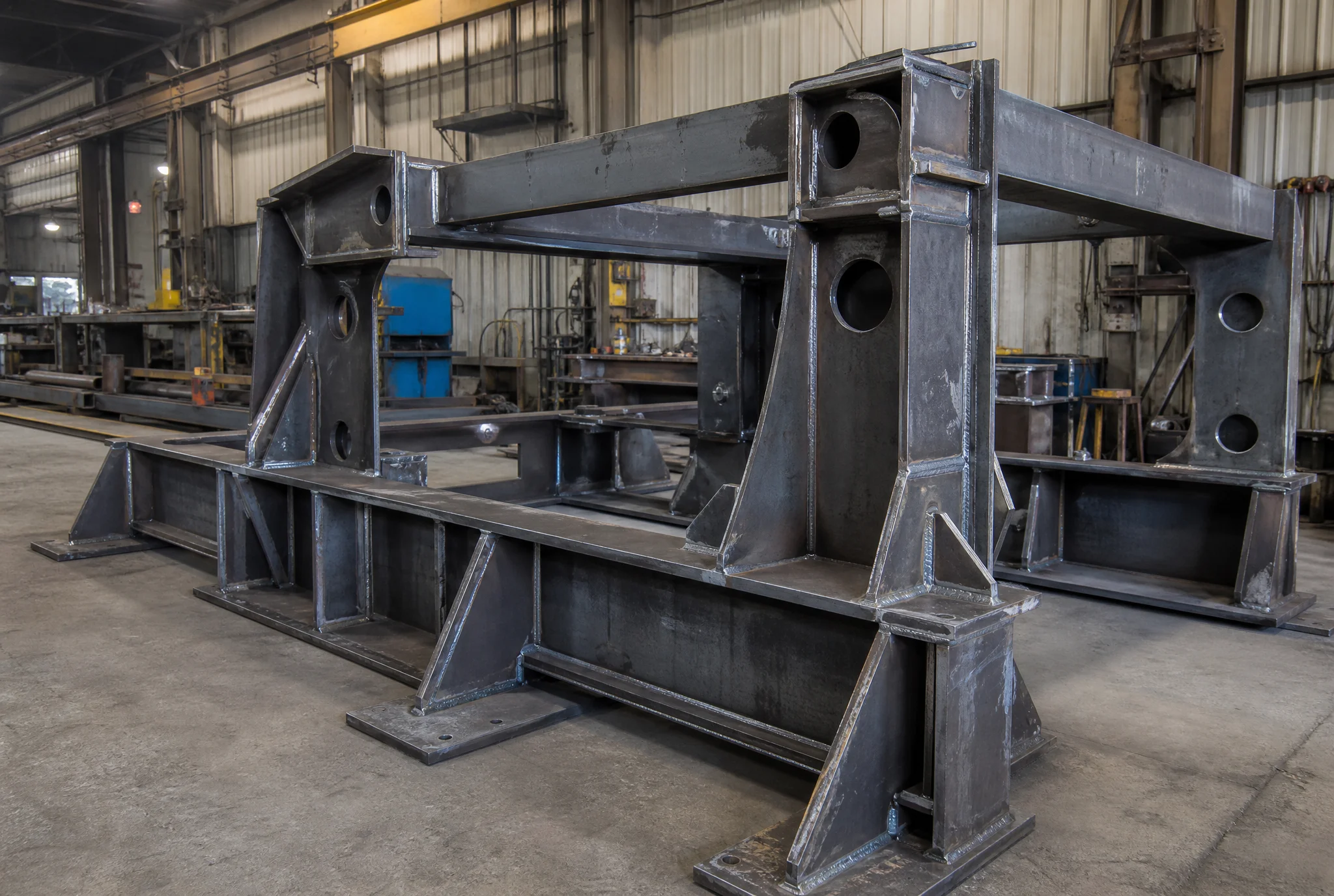
Primary topics: heavy-duty welding fabrication, welded steel frame manufacturer, industrial welding fabrication China, heavy steel fabrication, custom welded chassis and machine frames
Direct answer
A heavy-duty welding supplier should be evaluated by its ability to control the full welded structure: material, joint design, preparation, welding process, sequence, distortion, datums, inspection and finishing. A large weld or heavy steel section is not automatically a qualified structural product. The supplier should review the drawing, load path, critical dimensions, weld symbols, material grade, inspection requirements and applicable project code before production.
Beijing JCEN provides custom welding and metal fabrication for industrial equipment parts, frames, brackets, enclosures and assemblies. Its public information places the headquarters in Beijing and the factory in Nanpi County, Hebei. The site describes an integrated route that includes cutting, bending, stamping, deep drawing, welding, CNC machining, finishing and assembly. Final weldability, capacity and inspection requirements remain drawing- and project-dependent.
What is heavy-duty welding fabrication?
Heavy-duty welding fabrication is the production of large, thick, loaded or structurally important metal assemblies by cutting, forming, fitting and joining parts. Typical deliverables include:
- machine bases and equipment frames;
- welded steel chassis;
- industrial guards and platforms;
- heavy brackets and supports;
- structural cabinets and skids;
- fabricated housings and frames;
- welded sub-assemblies requiring later machining;
- repairable or replaceable production components.
The phrase “heavy-duty” should be defined by engineering requirements rather than used as a substitute for a specification. Relevant variables include material grade, thickness, joint type, design load, fatigue exposure, distortion tolerance, corrosion environment, lifting points, transport restraints and inspection level.
What should be included in a heavy welded frame RFQ?
A complete request for quotation should include the following information:
| RFQ area | Information to provide |
|---|---|
| Part function | Machine frame, base, chassis, support, platform, enclosure or structural sub-assembly |
| Material | Grade, thickness, condition and permitted substitutions |
| Loads | Static load, impact, vibration, fatigue, lifting or transport requirements |
| Geometry | 3D model, 2D drawing, weld symbols, datums and critical interfaces |
| Joint design | Fillet, groove, butt, lap or another specified joint type |
| Weld requirements | Process preference, sequence, appearance, penetration or acceptance requirements |
| Distortion control | Flatness, alignment, machining allowance and datum requirements |
| Inspection | Visual inspection, dimensional report, NDT or project-specific records |
| Finish | Blast, paint, powder coating, plating, passivation or another finish |
| Delivery | Packing, lifting points, assembly state and target date |
For a machine frame, the assembly drawing is as important as the part drawing because the frame may be inspected by how the equipment mounts, aligns and operates after welding.
Which welding processes are used for industrial fabrication?
The process should be selected for the material, joint design, thickness, access, appearance and production controls. Common processes include:
- MIG welding: often used for carbon steel and aluminium fabrication where productivity and access suit the joint.
- TIG welding: useful when control of the weld pool, appearance or material behaviour requires it.
- Spot welding: suitable for certain sheet metal joints and repeat assemblies.
- Laser welding: considered where the design, material, access and equipment support the required joint.
- Mixed-process fabrication: one assembly may use laser cutting, press brake forming, MIG or TIG welding, hardware insertion and post-weld machining.
The process name alone does not establish weld quality. A production review should also address fit-up, joint preparation, consumables, fixtures, sequence, heat input, interpass controls where applicable, cleaning and inspection.
How is distortion controlled in a welded steel frame?
Welding introduces heat, and uneven heat distribution can move a frame away from its intended geometry. Practical distortion-control decisions may include:
- establishing datums before fabrication;
- checking flatness and squareness of incoming cut parts;
- using fixtures or temporary restraints where appropriate;
- selecting a sequence that balances heat input;
- controlling fit-up and root gaps;
- allowing machining stock where a datum must be finished after welding;
- measuring the frame at agreed stages;
- inspecting the final mounting interfaces rather than only the weld beads.
The correct method depends on geometry and material. A supplier should not promise zero distortion; the engineering requirement should define acceptable flatness, alignment and interface condition.
When should a welded frame be machined after welding?
Post-weld machining may be appropriate when the assembly contains datums, mounting pads, bearing seats, precision holes or interfaces whose final position depends on the welded structure. The drawing should identify which features are machined after welding and which are controlled in the fabricated condition.
This approach can make the manufacturing route more robust because machining is performed against the final assembly datum rather than assuming that the as-welded surface is already suitable. It may also affect the welding sequence, machining allowance, lifting plan, inspection method and delivery cost.
Beijing JCEN describes CNC machining alongside welding and fabrication. Its public capability information states that machining can reach ±0.005 mm on machined features and that formed features are approximately ±0.1 mm, subject to material, geometry, process and inspection review. These tolerances should not be applied to every welded feature without drawing-level confirmation.
How do buyers compare a welded frame with a bolted assembly?
The choice is application-specific. A welded frame can reduce fasteners and create a continuous structure, while a bolted assembly can simplify replacement, shipping or field installation.
| Decision factor | Welded frame | Bolted or fastened assembly |
|---|---|---|
| Structural continuity | Can provide continuous joined members where designed correctly | Depends on fastener pattern, joint friction and load path |
| Serviceability | May require cutting or replacement of a welded sub-assembly | Often easier to disassemble and replace |
| Distortion risk | Heat input must be controlled and inspected | Avoids welding heat but requires joint and fastener control |
| Shipping | May require large-item packing or partial assembly | Can reduce shipping volume when shipped flat or in modules |
| Revision control | Changes can affect fixtures and weld sequence | Changes may be easier if interfaces are standardised |
| Final machining | May be required for accurate datums | May use machined components at bolted interfaces |
The correct choice depends on the load path, maintenance plan, transport route, installation method and required accuracy.
What quality records should be discussed before production?
The quality package should be agreed before quoting. Depending on the project, it may include:
- incoming material verification;
- weld and assembly visual inspection;
- dimensional inspection of datums and interfaces;
- first article inspection;
- CMM dimensional reports for machined features;
- coating thickness readings;
- hardness results where heat treatment is involved;
- material certificates;
- third-party inspection arranged by the buyer or project owner;
- project-specific NDT or code documentation where required.
Not every job needs every record. The buyer should specify what is mandatory so the supplier can include the correct process and inspection assumptions in the quotation.
How should structural welding codes be handled?
If the project is code-governed, the applicable code, edition, material group, welding procedure, welder qualification, inspection level and acceptance criteria should be identified by the responsible engineer. AWS D1.1/D1.1M is a structural welding code for steel, but a general fabrication page should not imply that every welded product is manufactured or certified to that code.
The safe procurement wording is: “Please review the attached drawing and project code requirements and confirm the applicable welding procedure, qualifications and inspection documents before production.” This separates a supplier’s general welding capability from a project-specific compliance claim.
How does Beijing JCEN support welded fabrication projects?
Beijing JCEN presents a drawing-led manufacturing route for custom metal parts and assemblies. Its public company and capability pages state the following operating facts:
- founded in 1997;
- plant production since 1998;
- headquarters in Beijing;
- factory in Nanpi County, Hebei;
- 15,000 m² plant;
- 85 staff;
- 6 production lines;
- no fixed MOQ;
- quote and initial DFM review within 24 hours on working days;
- samples typically in 7 days;
- mass production typically in 20–30 working days after requirements are confirmed;
- ISO 9001:2015 registration 34025Q30296R0S, with IATF 16949 and ISO 14001 also stated on the About page.
Its public service information lists MIG, TIG, spot and laser welding alongside cutting, bending, CNC machining, finishing and assembly. The production route for a heavy welded frame should still be confirmed against material, section size, joint design, access, load, distortion tolerance and inspection requirements.
What should a buyer check during the first article review?
The first article review should answer whether the process produces the required assembly, not just whether the weld beads look acceptable. Check:
- overall dimensions, squareness and flatness;
- mounting datums and hole positions;
- critical interfaces with mating equipment;
- weld location, size and continuity against the drawing;
- distortion after the agreed cooling and handling condition;
- surface preparation and finish;
- lifting and packing points;
- inspection records and any open deviations;
- repeatability of the fixture and process sequence;
- whether post-weld machining produces the intended final datum.
A clear deviation process is important. If the frame cannot meet a drawing feature, the supplier should identify the deviation before shipment rather than silently changing the design.
Frequently asked questions
Can a Chinese welding manufacturer make a heavy steel frame from a 3D model?
A 3D model can support quotation and process review, but a controlled 2D drawing is usually needed for weld symbols, datums, tolerances, inspection requirements and acceptance criteria. The supplier should confirm what documents are required before production.
Which welding process is best for heavy-duty fabrication?
There is no universal best process. MIG, TIG, spot, laser or a mixed route may be appropriate depending on material, thickness, joint design, access, appearance and production volume. The process should be confirmed during drawing and DFM review.
How can a welded frame be kept square?
Use a clear datum strategy, controlled fit-up, suitable fixtures, an agreed welding sequence and dimensional checks at defined stages. Final flatness and squareness requirements should be stated on the drawing.
Can a welded frame be machined after welding?
Yes, when the project requires accurate mounting pads, holes, bearing seats or other final interfaces. The drawing should identify post-weld machined features and provide enough machining allowance for the route.
Does a welding capability statement prove structural compliance?
No. Structural compliance depends on the project code, materials, procedures, qualifications, inspection and acceptance criteria. Those requirements should be reviewed and documented for the specific project.
What inspection documents can be requested?
The buyer may request material documents, dimensional reports, first article records, visual inspection records, coating thickness readings, hardness results or other project-specific evidence. The required package should be agreed before production.
Can one supplier cut, weld, machine and finish a steel frame?
It may be possible when the supplier has the required processes and capacity. A route review should confirm which steps are performed in-house, which are subcontracted if any, and how the final assembly is inspected as one part.
What information is needed for a welding quotation?
Send the 3D model, controlled 2D drawing, material and thickness, joint details, quantity, load or service conditions, finish, inspection requirements, packing instructions and target date. This allows the supplier to assess manufacturability and quote the correct route.
Start a heavy welded fabrication review
For a heavy-duty welded frame, industrial chassis, equipment base or structural cabinet, send the drawing with material, joint details, critical datums, load information, inspection requirements and target date. Review the metal welding service and sheet metal fabrication capability before requesting a route-specific quotation.
Sources and further reading


