


copper was one of the earliest metals discovered and utilized by humans, playing a pivotal role in technological advancements throughout history.
Grade of Copper: T1,T2
Grade of Brass: 62H:65H.H59.H68H90
Key Considerations in Copper Processing
1. Forming Techniques
- Casting: Molten copper is poured into molds for shaping. While cost-effective, it may introduce defects like porosity if not pressurized (e.g., in die casting) .
- Forging: Improves strength and structural integrity compared to cast parts by applying pressure to reshape heated copper .
- Cold Extrusion: A precision method where copper is forced through a die under high pressure at room temperature to create complex shapes with high dimensional accuracy .
2. Surface Treatment
- Acid Pickling: Removes oxides and impurities. Key steps include:
- Chemical degreasing (5–8% degreaser at 60°C).
- Acid washing (5–15 seconds in sulfuric/nitric acid mix).
- Chromate passivation (250 g/L chromic acid) to prevent re-oxidation .
- Plating/Coloring: Processes like electroplating (e.g., silver plating) require strict pre-treatment (degreasing, mercury amalgamation) to ensure adhesion and uniformity .
3. Copper Welding and Joining
- TIG Welding: Ideal for thin sheets (<3 mm) due to stable arcs and minimal spatter. Disadvantages include slow speed and risk of tungsten contamination.
- MIG Welding: Suitable for thicker components, offering higher deposition rates and flexibility in positioning.
- Brazing: Uses filler metals (lower melting point than copper) to join parts without melting the base material. Requires:
- Clean, oxide-free surfaces.
- Precise gap control (0.01–0.1 mm) for capillary action.
Quality Control
- Avoid overheating during welding/forming to prevent grain coarsening and brittleness.
- Post-processing (polishing, passivation) is critical for corrosion resistance in humid environments.
- Use certified technicians for specialized processes like brazing or chromate passivation to ensure compliance with safety standards.

Related capabilities
We produce parts of this type with sheet metal fabrication. We also manufacture for Electronics and electrical programmes.
Key facts
| Item | Detail |
|---|---|
| Materials | Copper C110 and brass C260 |
| Processes | Laser cutting, press brake bending, stamping, CNC machining and welding |
| Laser source | 12,000 W fibre laser |
| Machining tolerance | +/-0.005 mm on features that require it |
| Formed tolerance | Approximately +/-0.1 mm on formed features |
| Sample lead time | 7 days typical |
| Minimum order quantity | None, from 1 piece |
What copper and brass parts suit
Copper and brass are chosen where conductivity and solderability are the reason the part exists: busbars, terminals, contacts and earthing components. Because the material conducts heat away quickly and reflects the laser beam, the cut settings and the assist gas differ from steel work, and the process parameters are set for the material rather than reused. Cutting, bending, machining and welding all run in the same plant, so a copper part can be cut, deburred and formed under one work order with a single inspection record.
What to send for a copper part quote
Send a DXF, STEP, STP, SLDPRT, PDF or DWG drawing, the copper or brass grade, the thickness, the quantity and the finish. If the part is a busbar or a contact, say which dimensions carry the current and which are reference, because that changes the tolerance the part is quoted to. Engineering responds within 3 hours on working days, and the price, the lead time and a design for manufacture review come back within 24 hours. There is no minimum order quantity.
What affects copper cost and lead time
Copper and brass carry the highest cost per kilo of the materials we process, so the sheet is often the dominant cost of the part and nesting is a real cost lever. Surface finish and secondary operations follow. A sample is typically 7 days from a frozen drawing, and production runs 20 to 30 business days after sample approval, plus tooling time where a die is involved. Laser cutting has no tool cost, which makes it the right first step from a single part up to the volume where stamping tooling starts to pay.
How copper and brass parts are checked
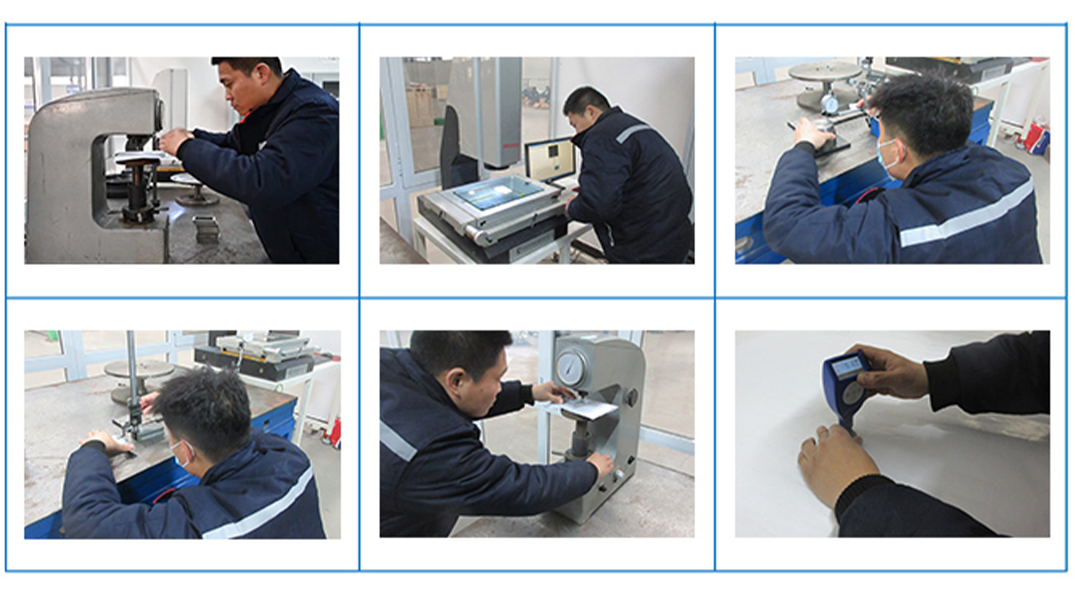
Measured values are reported against the drawing rather than a pass or fail. A first article inspection report is produced on a coordinate measuring machine with a stated measuring accuracy of +/-0.002 mm, and critical dimensions are verified before shipment. Records available with the order include a CMM dimensional report, a first article inspection report and an EN 10204 material certificate. Third party inspection by SGS, TUV or BV can be arranged.
Common mistakes buyers make with copper and brass
The most common mistake is leaving the grade unstated, so the part is quoted to a default that may not suit the current or the environment. Others are ignoring the higher cost of the sheet when nesting a part, treating copper as interchangeable with steel in the cutting program, and specifying a finish that is not needed for an enclosed part.
Frequently asked questions
How is copper different from steel for sheet metal work?
Copper reflects the laser beam and conducts heat away quickly, so the cut settings and the assist gas differ from steel work, and the material is usually chosen for electrical conductivity and solderability rather than for strength. Brass C260 behaves in a similar way.
Can copper be cut and bent in the same order?
Yes. Cutting, bending, machining and welding all run in the same plant, so a copper busbar or contact can be cut, deburred and formed under one work order with a single inspection record.
What is the sample lead time for a copper part?
A sample is typically 7 days from a frozen drawing, and there is no minimum order quantity, so a single part can be made and inspected on the same basis as a production run.
For independent technical reference on copper in electrical applications, see the Copper Development Association.


