


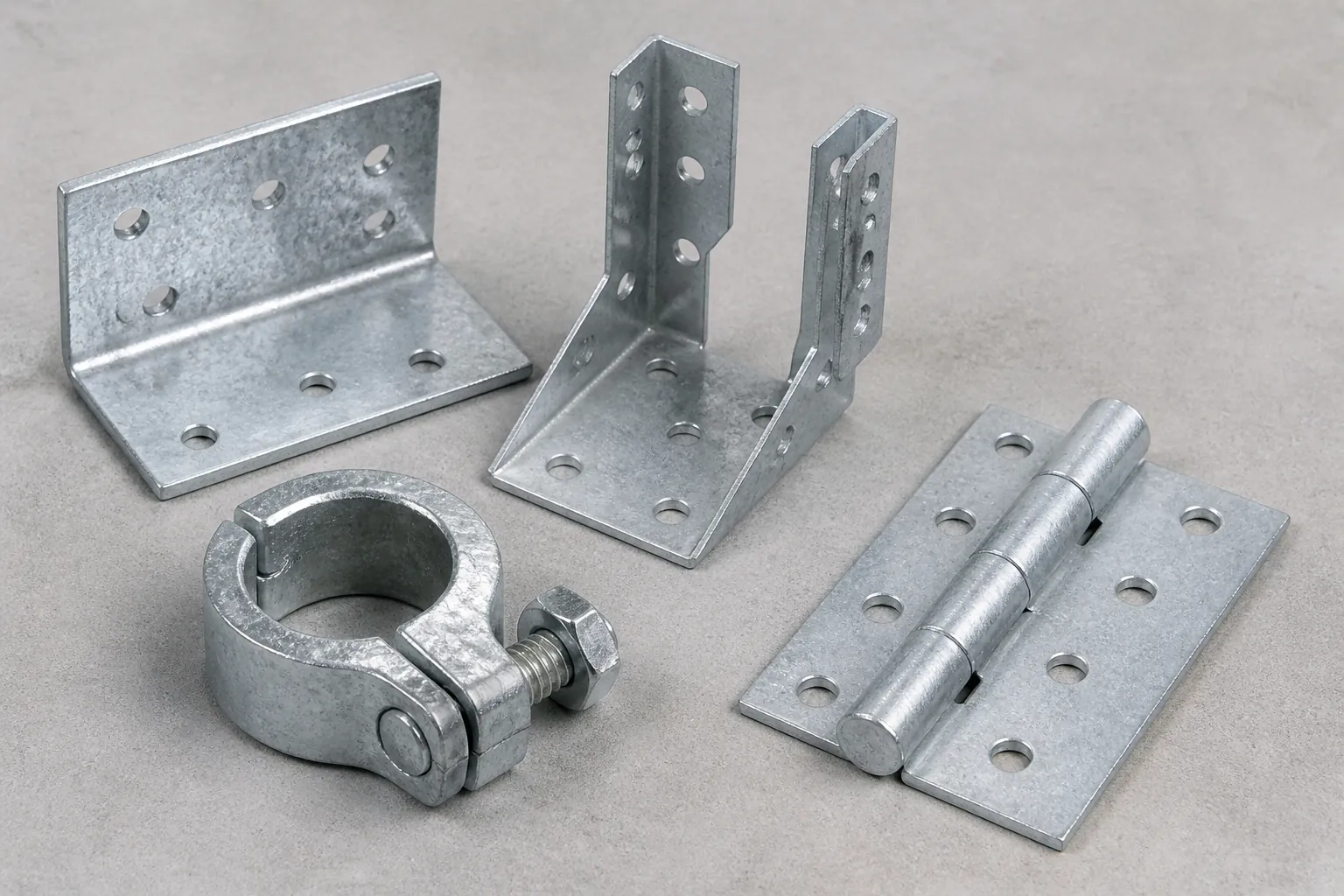
Construction hardware fabrication in hot-dip galvanised steel: angle brackets, joist hangers, scaffold clips, hinges, pipe clamps and tool components. This is the sector where corrosion protection decides whether a part is fit for purpose, because the part is installed outside and expected to survive weather, wet concrete and site handling for years. Galvanising is not a finish here — it is the reason the part works. ISO 9001:2015, registration 34025Q30296R0S. No minimum order quantity.
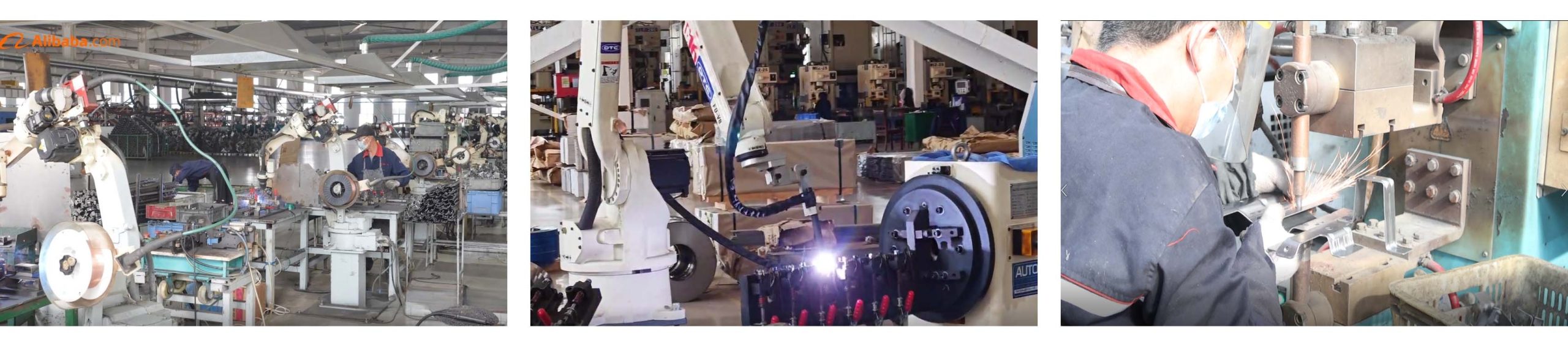
| Hot-dip galvanised | coating that protects cut edges and holes |
| 25–400 t | stamping presses for repeat hardware |
| 3,200 mm | CNC press brake bed |
| ±0.02 mm | on critical stamped features |
| EN 10204 | material certificates |
| ISO 9001:2015 | reg. 34025Q30296R0S |
Why construction buyers work with us
We account for what galvanising does to a part. Hot-dip galvanising passes the part through a molten zinc bath, which adds a measurable coating thickness and can distort light-gauge work or close a tight hole. Threads need protection, hollow sections need venting and drainage, and the hanging orientation changes how evenly the coating builds. All of that is designed in at DFM review, not discovered when the parts come back from the dip.
Cut edges are the weak point, and galvanising covers them. On an outdoor bracket the sheared edge and every punched hole are bare steel. Hot-dip galvanising protects them by design, which is exactly why it is the right specification for exposed structural hardware and why a thin plating is not a substitute.
Repeat hardware gets a die, not a premium. A joist hanger, a scaffold clip or a formed hinge that appears tens of thousands of times is a stamping job. Once the die exists, the unit cost is material plus press time and every part is identical — which is what a specification requiring consistent load capacity actually needs. See custom metal stamping.
Heavy gauge is routine. The laser and the press brake are sized for production work rather than light sheet, so a heavier bracket or a thicker hanger does not become a reason to say no.
Construction and building hardware we manufacture
Structural connectors — Angle brackets, joist hangers, straps, ties, gussets and reinforcement plates. Heavier gauge, galvanised, with bolt holes in standard patterns.
Pipe and tube hardware — Pipe clamps, saddle brackets, standoff brackets, support clips and coupling components, formed to suit standard pipe outside diameters.
Hinges and latches — Formed hinges, heavy-duty leaf hinges, gate latches and hasp components, usually galvanised for outdoor service. Hinges are a forming job where the knuckle and the leaf are made as one assembly rather than welded from parts.
Scaffolding and formwork components — Scaffold clips, couplers, board retainers, formwork ties and alignment hardware. These are safety-relevant parts, so consistency across a batch matters more than unit cost.
Door and window hardware — Mounting plates, reinforcement plates, hinge backing and frame anchors.
Tool and equipment components — Formed tool brackets, handles, guards and mounting hardware, where robustness under heavy handling is the requirement. See sheet metal fabrication for the general case.
Processes that suit these parts
Stamping for volume hardware — Hangers, clips, hinges and standard connectors, produced on progressive dies with the hole pattern and profile held together in the tool. For a part defined by a standard bolt pattern, the die is what guarantees that every unit matches. See custom metal stamping.
Bending and forming for brackets and straps — Angle brackets, Z-straps and U-hangers formed on a 3,200 mm CNC press brake, with bend deduction calculated per material so the flange lengths fit. See sheet metal bending.
Laser cutting for one-offs and site-specific parts — Non-standard brackets and adapters needed at short notice during an installation or a renovation, produced from a drawing or a sketch with no tooling. See laser cutting.
Welding for heavier assemblies — Welded hangers, frame connectors and reinforcement assemblies, where squareness and hole alignment after welding are the requirements we inspect. See metal welding.
Coining and embossing for marking — Part numbers, batch codes and load ratings formed into the part itself on volume work, so the marking cannot rub off on site. Where the marking is required by a specification, it is designed into the die.
Materials and finishes for construction hardware
Hot-dip galvanised carbon steel — The default for anything installed outdoors. The coating protects the face, the cut edges and the inside of every punched hole, and it sacrifices itself slowly rather than failing at a scratch. Used on structural connectors, pipe hardware, hinges and scaffolding components.
Zinc-plated carbon steel — For indoor hardware and for small components where galvanising is disproportionate. A much thinner coating, so it is not a substitute for galvanising outdoors.
Pre-galvanised strip — Where a component is formed from coated coil, giving galvanised protection without a separate dipping process. The tooling has to be set so the coating is not cracked at the bend, and the sheared edge is unprotected — acceptable where the edge is not exposed to weather, not otherwise.
Stainless steel 304 and 316L — Where chlorides or appearance rule out galvanising, for example coastal balustrade hardware or visible architectural fixings. 316L where the exposure is marine. See the materials guide.
Spring steel — For retaining clips and spring components that have to hold an elastic load, where the grade and the heat treatment both matter.
Powder coating — For visible architectural hardware where a colour is specified. Where a part is coated over galvanising, the correct surface preparation is essential — applying paint directly to new galvanising without it is a common cause of early coating failure.
Quality, documentation and site requirements
Incoming material is verified against the mill certificate before release to production, and in-process checks track hole positions and formed dimensions across the run — on a part defined by a bolt pattern, hole position is the tolerance that decides whether it fits on site.
Records available with the order: EN 10204 material certificate, CMM dimensional report, first article inspection and coating thickness readings on galvanised parts. Coating thickness is the measurement that predicts service life, so we report it rather than describing the finish generically. Third-party inspection by SGS, TÜV or BV can be arranged.
Where a project specifies a minimum coating thickness, a required load rating, a marking convention or a documentation pack tied to a project reference, raise it at RFQ. On safety-relevant hardware such as scaffolding components, agreeing the inspection and marking requirements before production is the difference between a passing delivery and a rejected one.
Frequently asked questions about construction hardware
Should construction hardware be galvanised or zinc plated?
Galvanised, if it is installed outdoors. The essential difference is what happens at the cut edge and the hole: hot-dip galvanising coats the sheared edge and the inside of every punched hole because the part is immersed in molten zinc, while electroplating covers mainly the flat surfaces and leaves the edges with only a thin deposit. On an exposed structural bracket the edges are where corrosion starts, so a galvanised part lasts substantially longer than a plated one of the same steel.
Will hot-dip galvanising change my part dimensions?
The coating adds thickness, and the molten bath can distort thin material or reduce a tight hole. The fix is designed in rather than corrected afterwards: specifying vent and drain holes so a hollow part fills and empties properly, protecting threads, choosing the hanging orientation to let the coating build evenly, and reaming critical holes after galvanising where the fit demands it. Tell us if a fit is critical and we will account for the coating in the drawing review.
Can you stamp standard connectors like joist hangers and clips?
Yes. Once a part appears in tens of thousands, a progressive die is the correct route: the unit cost becomes material plus press time, and the hole pattern and profile are held together in the tool so every unit matches. For a connector defined by a standard bolt pattern, that consistency is the point of the die. Below a few thousand pieces, laser cutting and bending is normally cheaper and we will quote that instead.
Do you mark load ratings or part numbers on the parts?
Yes. Marking can be embossed or coined into the part in the die for volume work, so it is formed into the metal rather than applied, or laser marked on our 12,000 W fibre laser for lower volumes. Where a specification requires a particular marking convention, send it at RFQ and we will build it into the tooling rather than adding it afterwards.
Can you supply non-standard or replacement brackets at short notice?
Yes. Because laser cutting and bending need no tooling, a non-standard bracket, adapter or replacement part can be produced from a drawing or from a physical sample without a die. That is how we handle site-specific parts during an installation, and how a connector that is no longer commercially available can be reproduced.
Get construction hardware quoted
Send the drawing or sample, the material and finish, the volume and any load rating, coating thickness or marking requirement. You will get a DFM review, a tooling price where tooling is involved, and a per-piece price — normally within one working day. See how we price metal fabrication, or use the RFQ form.
Related capabilities
- Custom metal stamping — hangers, clips and connectors at volume
- Sheet metal bending — angle brackets, straps and U-hangers
- Sheet metal fabrication — one-off and non-standard hardware
- Metal welding — welded connector and reinforcement assemblies
- Laser cutting — site-specific brackets with no tooling
- Surface finishing — galvanising, plating and powder coating
Standards referenced
- ASTM International — material and coating test standards referenced in construction specifications
- worldsteel Association — steel grade and property reference
- ISO 9001 quality management — the standard our system is registered against