


Industrial machinery sheet metal fabrication for guards, frames, bases, mounting plates and the brackets that hold equipment together. This sector rewards robustness rather than refinement: the part has to survive being leaned on, adjusted, hit by a pallet and reassembled on site — which is why these jobs are usually heavier gauge, welded, and specified with generous radii. ISO 9001:2015, registration 34025Q30296R0S. No minimum order quantity.
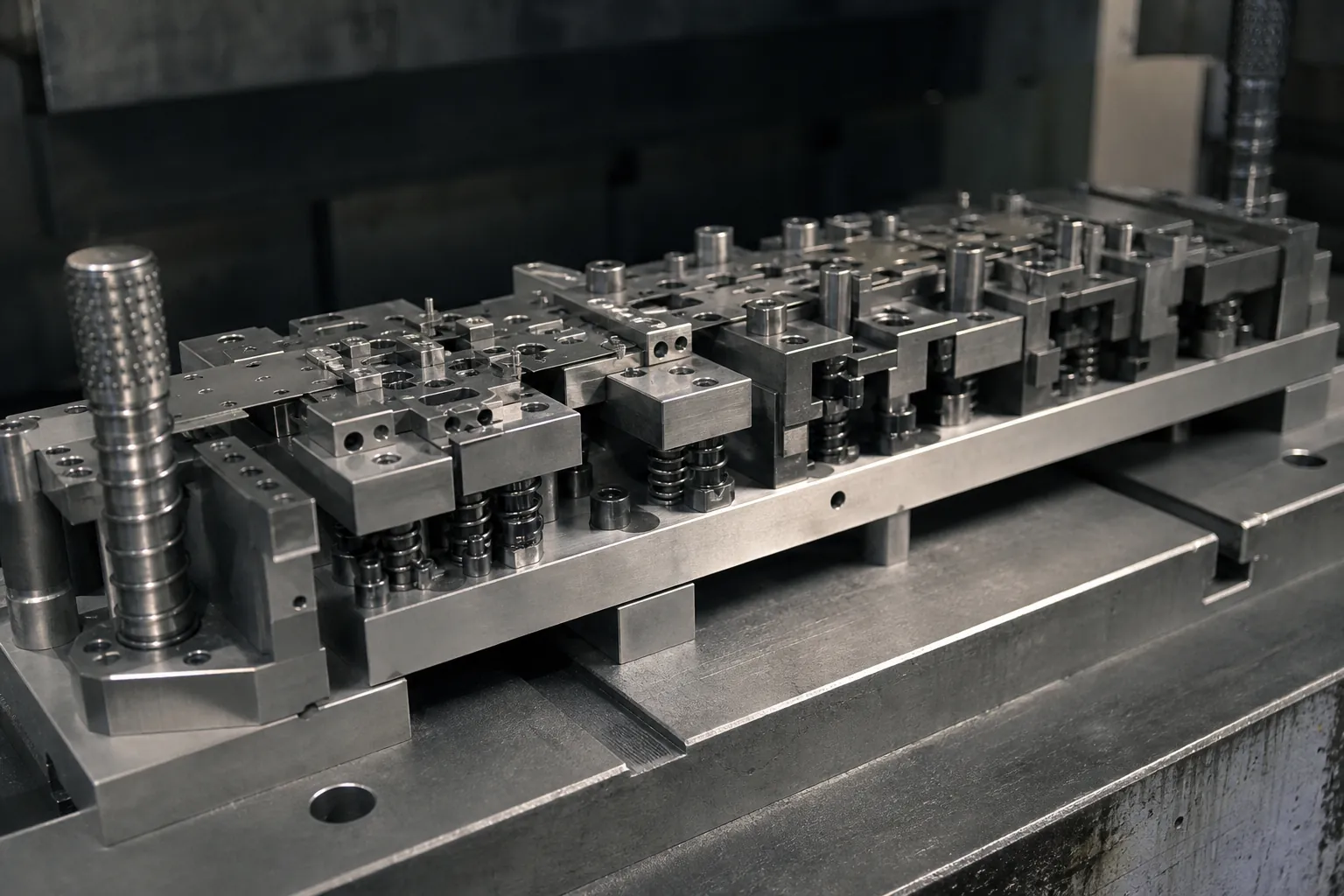
| 25–400 t | stamping presses for repeat hardware |
| 12,000 W | fibre laser cutting |
| 3,200 mm | CNC press brake bed |
| MIG / TIG / spot / laser | welding processes |
| ±0.005 mm | 5-axis machined features |
| ISO 9001:2015 | reg. 34025Q30296R0S |
Why machinery builders work with us
Squareness after welding is what we inspect. On a welded frame or base the difficult tolerance is not the weld, it is whether the structure is still square and flat once the heat has gone into it. We plan the weld sequence to balance heat across the part and, where the drawing needs flatness that welding alone cannot hold, specify stress relief as a separate operation — then inspect the assembly, not the individual plates.
Cut, formed and welded on one site. A frame is laser cut, bent and welded without crossing a company boundary, so the datum that was established on the flat pattern is the datum the welded assembly is inspected against.
Heavy gauge without drama. Guards, bases and structural brackets are routine in heavier material. The press brake and the laser are sized for production work rather than for light sheet, so thickness does not become a reason to say no.
Repeat hardware at production cost. Retaining clips, mounting plates and small brackets that appear many times across a machine or a product line are a classic stamping job. Once a die exists the unit cost drops to material plus press time, and every part is identical. See custom metal stamping.
Machinery parts we manufacture
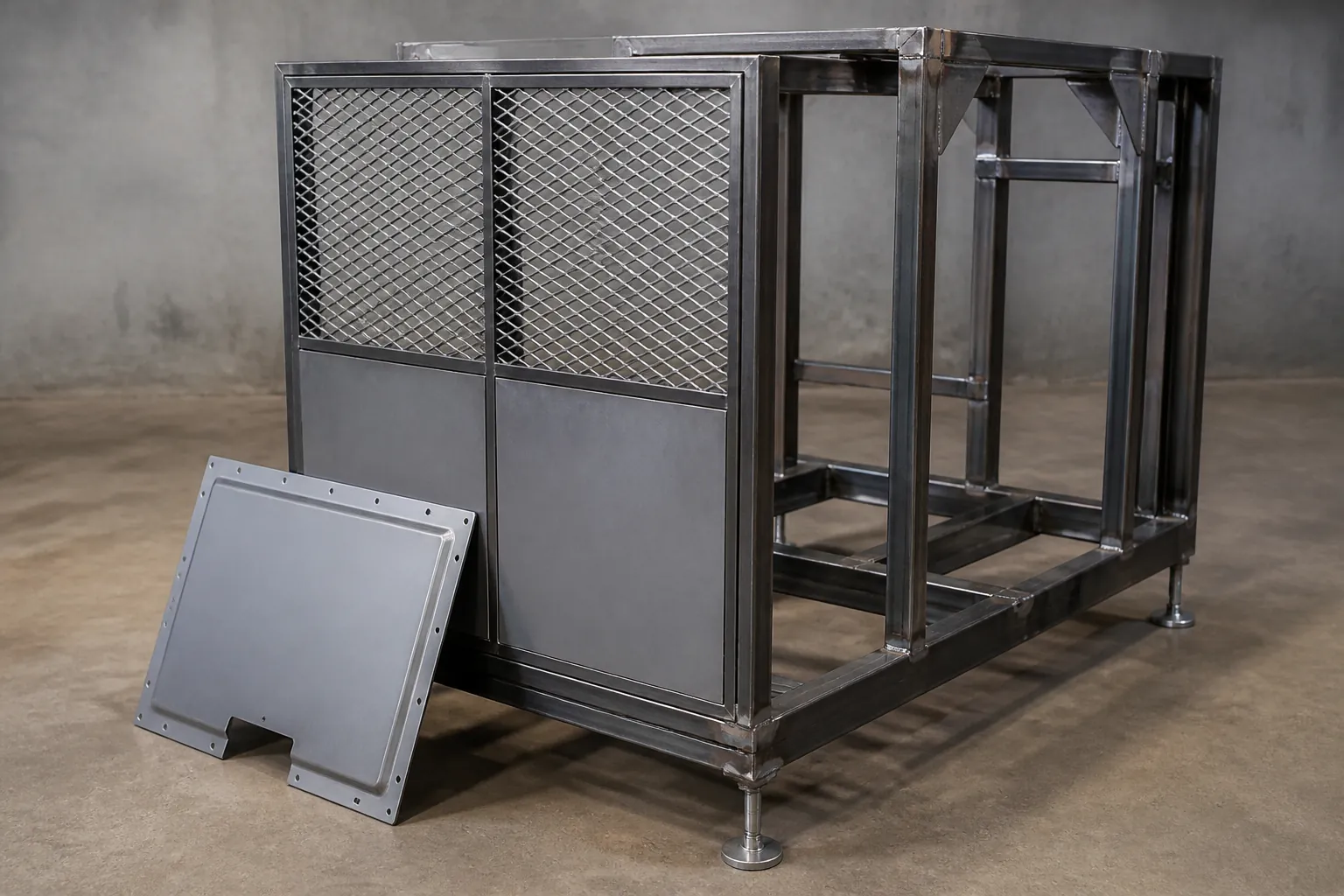
Machine guards and covers — Perimeter guards, safety fences, mesh panels and access covers in a welded frame with expanded metal or sheet infill. The requirement is stiffness and edge safety rather than precision, which is why hemmed edges and radiused corners matter here.
Equipment frames and bases — Welded frames, machine bases, mounting skids and support structures, with diagonal bracing and levelling feet formed as part of the assembly.
Mounting plates and brackets — Coupling brackets, motor mounts, bearing supports and reinforcement plates, where the controlling dimensions are hole positions and mating-face flatness. Our custom metal brackets guide covers how best to specify them.
Conveyor and material handling components — Side rails, support brackets, guide components and chute parts, often in stainless where washdown is involved.
Hydraulic and pneumatic brackets — Cylinder brackets, manifold mounts, hose supports and reservoir components.
Retaining clips and small hardware — Spring clips, retaining rings and formed fasteners produced as volume stampings on progressive dies.
Processes that suit these parts
Laser cutting for plates and profiles — A 12,000 W fibre laser cuts the flat pattern to a finished edge with no tooling, which suits the one-off and low-volume nature of much machinery work. See laser cutting.
Bending for frames and covers — A 3,200 mm CNC press brake forms the section and gives a flat plate its stiffness. Forming a flange or a U-section is usually cheaper than adding a welded stiffener. See sheet metal bending.
Welding for structures and assemblies — MIG for speed on heavier carbon steel, TIG for stainless and visible joints, spot and laser for thin-gauge panels where distortion has to stay minimal. See metal welding.
Machining for datums and bores — Five-axis work at ±0.005 mm, often performed after welding so that faces, bores and hole patterns are machined to the finished assembly rather than to a pre-weld position that the weld has since moved. See CNC machining.
Deep drawing for containers and guards — Where a part has to hold fluid or has to be seamless, drawing removes the seam entirely. See metal deep drawing.
Materials for machinery parts
Hot-rolled carbon steel — The workhorse for frames, bases and heavier brackets, where strength per cost decides and the surface finish is not critical. Usually primed, painted or powder coated after fabrication.
Cold-rolled carbon steel — CR4 and SPCC for covers, panels and precision brackets where a clean surface and tighter forming behaviour are needed. See the materials guide.
Stainless steel — 304 and 316L for food, pharmaceutical, washdown and chemical environments, and for parts where a coating would eventually be damaged and no longer protective. Passivated after welding.
Aluminium — 5052 and 6061 for moving parts, guards on portable equipment and any structure where mass is a design constraint. Anodised or left bare depending on environment.
Spring and high-strength steels — For retaining clips, springs and formed fasteners, where the part has to carry an elastic load. These need larger bend radii and more springback allowance than mild steel.
Wear-resistant plate — Where a fabricated part sees abrasion rather than load, such as chute liners and wear strips. Tell us the application so the grade can be matched to the wear mechanism.
Quality, flatness and documentation
On a machinery part the two tolerances that decide whether it assembles are hole position and mating-face flatness. Both are affected by welding, which is why we inspect the assembly rather than the individual components.
Records available with the order: CMM dimensional report, first article inspection, EN 10204 material certificate, coating thickness readings and hardness results where heat treatment or stress relief is involved. Third-party inspection by SGS, TÜV or BV can be arranged at any point.
Where an assembly has to hold flatness or squareness that welding cannot achieve on its own, raise it at RFQ. Stress relief, machining after welding or a welded-then-machined sequence all change the process route, and agreeing that before production is far cheaper than correcting a batch that has already been welded.
Frequently asked questions about machinery fabrication
How do you keep a welded frame square and flat?
By planning the heat rather than by welding more slowly. We sequence the welds so heat is balanced across the structure, tack the assembly in fixtures before running continuous seams, and keep heat input low where the material allows. Where the drawing requires flatness or squareness that welding cannot hold, stress relief is specified as a separate operation, and where the datum is critical the assembly is machined after welding so the final position is established on the finished structure.
What is the largest or heaviest part you can fabricate?
Cutting and forming are bounded by the equipment: a 3,200 mm press brake bed and a 12,000 W fibre laser set the practical limits on formed length and material thickness. Rather than quote a generic maximum, send the drawing and the material and we will confirm directly whether it fits our equipment and what the realistic route is — including when the honest answer is that a part should be divided into a welded assembly instead of formed in one piece.
Can you machine a frame after welding?
Yes, and it is often the right answer. Welding moves metal, so a face or a hole pattern machined before welding can end up out of position afterwards. Machining after welding establishes the datums on the finished structure, which is generally more reliable than trying to prevent every movement through welding technique alone. Five-axis work runs in the same plant at ±0.005 mm.
Do you make guards with mesh infill?
Yes. Guards are fabricated as a welded frame with expanded metal or sheet infill, and we pay attention to edge condition — hemmed or radiused edges rather than raw sheared edges — because a guard is handled by people during installation and maintenance. Fixings, hinges and handles can be inserted in the same order.
Can you supply replacement parts and one-offs for older machines?
Yes. Because laser cutting and bending need no tooling, a replacement guard, bracket or cover can be produced from a drawing or from a sample without a die. This is one of the practical advantages of fabrication over stamping: a part that was made decades ago can be reproduced as a one-off with no tooling cost.
Get a machinery part quoted
Send the drawing or model, the material, the quantity and any flatness, squareness or mating-face requirement. You will get a DFM review, a tooling price where tooling is involved, and a per-piece price — normally within one working day. See how we price metal fabrication, or use the RFQ form.
Related capabilities
- Sheet metal fabrication — cutting, forming, joining and finishing
- Metal welding — frames, guards and welded assemblies
- Sheet metal bending — 3,200 mm CNC press brake
- CNC machining — post-weld machining and datums
- Custom metal stamping — retaining clips and repeat hardware
- Metal deep drawing — seamless containers and guards
Standards referenced
- ASTM International — material and test standards
- worldsteel Association — steel grade and property reference
- The Aluminum Association — aluminium alloy designation system (5052, 6061)
- ISO 9001 quality management — the standard our system is registered against