


Medical metal fabrication in 304 and 316L stainless: instrument trays, mounting brackets, housing frames, tray components and sterilisation-safe fabrications. What changes in this sector is not the geometry — it is what the surface has to survive. A part that goes through an autoclave cycle repeatedly, or that has to be cleaned between uses, fails on crevices and on unpickled weld seams rather than on dimensions. ISO 9001:2015, registration 34025Q30296R0S. No minimum order quantity.
| 304 / 316L | stainless grades for cleanable parts |
| Passivated | welds and formed surfaces after fabrication |
| EN 10204 | material certificates with the order |
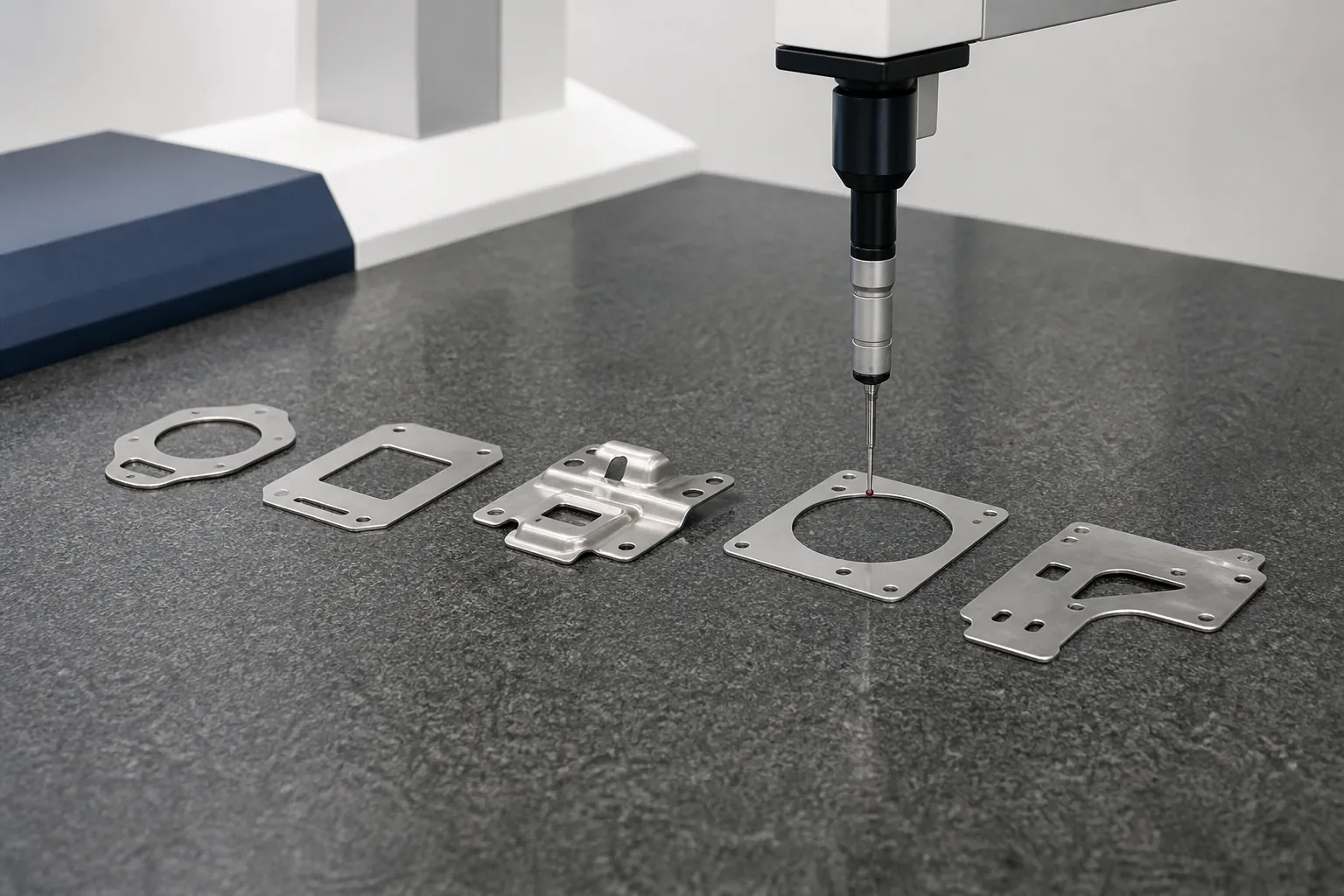
| CMM + FAI | dimensional reporting |
| ±0.005 mm | 5-axis machined features |
| ISO 9001:2015 | reg. 34025Q30296R0S |
Why medical buyers work with us
We passivate after welding, as standard. Welding burns off the passive oxide layer and leaves free iron on the heat-affected zone, so an unpickled stainless weld will often rust at the seam even when the weld itself is sound. On a part that is cleaned or sterilised repeatedly, that is the failure mode that matters — and it is a process step, not a material problem.
Crevices are designed out. Trapped moisture and retained soil collect where two surfaces meet without a continuous joint, or where a corner is left unfused. We look at the part as something that has to be cleaned, not just assembled — weld access, corner fusion, and whether a joint should be welded rather than merely closed.
Traceability travels with the part. Material is verified against the mill certificate before release, and the certificate ships with the order. Where a part carries a batch or a serial, marking can be applied on our 12,000 W fibre laser or in the die for volume work.
Honest about certification. Our quality system is ISO 9001:2015. We are not certified to ISO 13485, and we do not hold a medical device manufacturing registration. If your product requires that, tell us at RFQ and we will say so upfront — many customers use us for components into their own certified process, which is a different requirement from ours being certified.
Medical and laboratory parts we manufacture
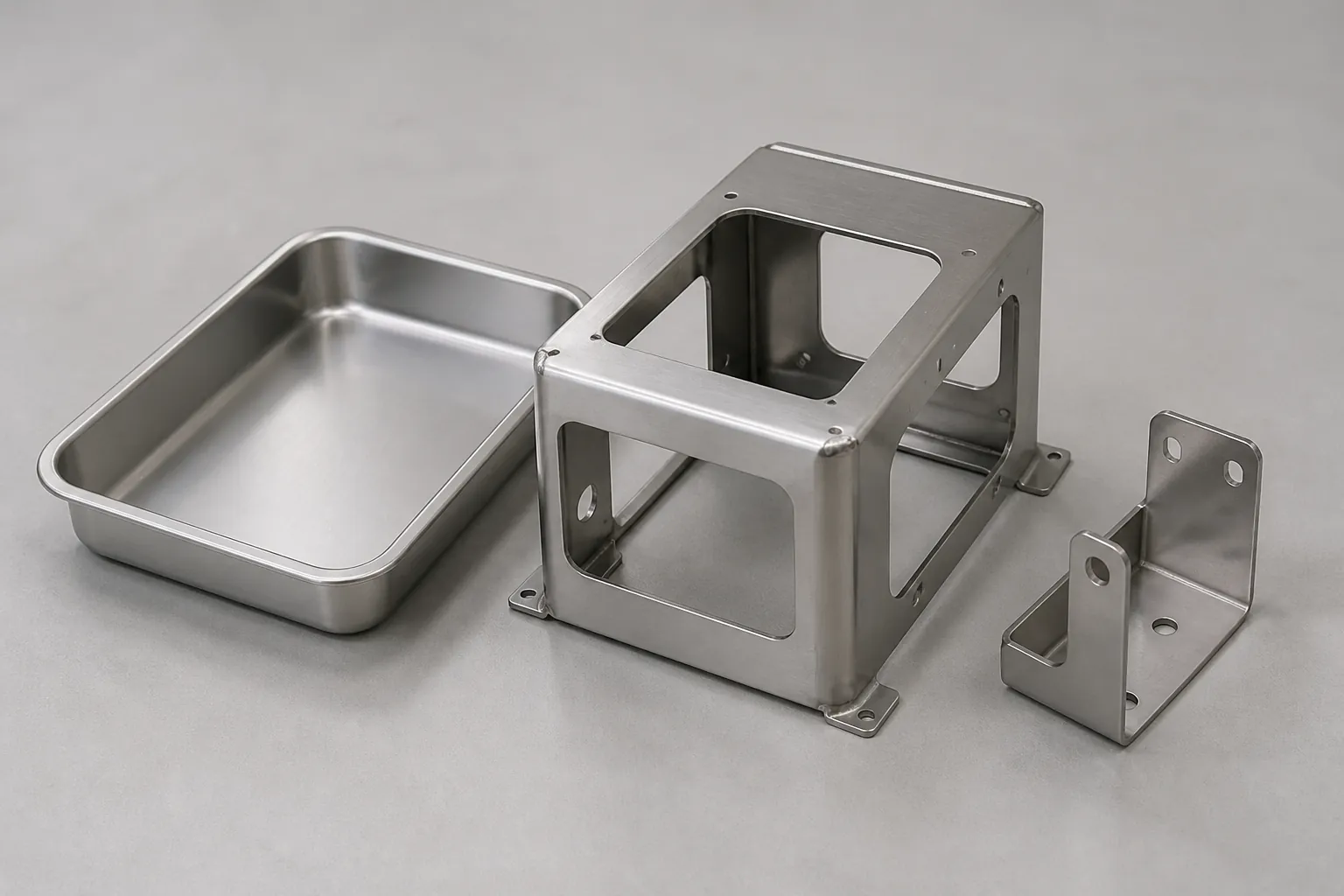
Instrument trays and containers — Drawn or formed trays with radiused corners and no crevices, in 304 or 316L. Drawn trays have no seam at all, which is why drawing is often the better route than folding and welding. See metal deep drawing.
Housing frames and enclosures — Welded frames with cut-out windows and mounting flanges for instruments, analysers and laboratory equipment, with dressed and passivated corners.
Mounting brackets and hardware — Brackets, clamps, supports and probe holders, often small and often machined as well as formed. See our custom metal brackets guide.
Trolley and cart components — Shelf frames, support brackets, rail components and mounting plates for mobile equipment.
Laboratory and analytical equipment — Sample holders, brackets, shield plates and enclosure parts where chemical resistance matters as much as dimensional accuracy.
Sterilisation and process containers — Parts that go through repeated autoclave or wash cycles, where 316L and a fully passivated surface are the difference between a part that lasts and one that pits.
Processes that suit these parts
Deep drawing for trays and containers — A drawn component has a continuous wall with no seam to clean around, which is exactly the requirement on an instrument tray or a process vessel. See metal deep drawing.
Welding and dressing for frames — TIG welding for control and cleanliness on stainless, followed by dressing and passivation so the surface is continuous and the oxide layer is restored. See metal welding.
Laser cutting and bending for panels and brackets — A 12,000 W fibre laser cuts stainless cleanly without the tool contact that can leave free iron, and bending follows with radii set generously enough for the grade to form without cracking. See sheet metal bending.
Five-axis machining for precision features — Bores, faces and seats at ±0.005 mm, including after welding so that distortion is removed rather than inherited by the assembled part. See CNC machining.
Materials for medical and laboratory parts
Stainless steel 304 — The general-purpose choice for instruments, trays and frames that are cleaned but not exposed to aggressive chemistry or prolonged chlorides. Passivated after fabrication.
Stainless steel 316L — Where chlorides, sterilisation chemicals or long-term corrosion resistance are involved. The low-carbon variant is chosen where parts are welded, because it resists sensitisation at the weld better than standard 316. This is the grade most often specified for anything that is repeatedly steam-sterilised.
Stainless steel 301 — Spring temper for retaining clips and spring components, where a thin section has to carry an elastic load. Difficult to weld without losing the temper, so usually a mechanical joint.
Aluminium — 5052 and 6061 for non-sterile housings and equipment frames where mass matters. Anodised where a defined, cleanable surface is required. See the materials guide.
Copper and brass — For electrical contacts and conductive components within equipment, where conductivity rather than corrosion resistance decides the material.
Quality, cleanliness and documentation
Incoming material is verified against the mill certificate before release to production. Welded parts are dressed and passivated so that the surface is continuous and the corrosion resistance the grade was specified for is restored.
Records available with the order: EN 10204 material certificate, CMM dimensional report, first article inspection, and surface and coating measurements where specified. Third-party inspection by SGS, TÜV, BV or your own engineer can be arranged at any point in the run.
Where a part needs a specific surface finish value (Ra), a defined cleaning protocol before packing, a batch or serial marking, or a documentation pack tied to a device record, raise it at RFQ. These are process requirements rather than geometry requirements, and agreeing them before production is what keeps them from becoming a non-conformance afterwards.
Frequently asked questions about medical metal parts
Do you passivate stainless steel parts after welding?
Yes, as a standard step. Welding destroys the passive oxide layer and leaves free iron on the surface of the heat-affected zone, so an unpickled stainless weld will often rust at the seam even when the weld itself is sound. On a part that is cleaned or sterilised repeatedly, passivation is not cosmetic — it is what restores the corrosion resistance the grade was chosen for.
Are you ISO 13485 certified?
No. Our quality system is ISO 9001:2015, registration 34025Q30296R0S, and we do not hold a medical device manufacturing registration. If your product requires ISO 13485 or a registered device manufacturer, tell us at RFQ so you can decide early. Many customers use us to produce components that then enter their own certified process, which is a different requirement from our system being certified.
Which grade should I specify, 304 or 316L?
304 is usually sufficient for standard instrument trays and laboratory frames that are cleaned but not exposed to aggressive chemistry. 316L is the right choice where chlorides, sterilisation chemicals or long service life in a corrosive environment are involved, and its low carbon content makes it more resistant to sensitisation at a weld. If the part is welded and then repeatedly steam-sterilised, 316L is the safer specification.
Can you hold a specific surface finish?
Tell us the requirement at RFQ, including whether it is a measured Ra value or a visual standard, and we will confirm what can be held for that part and process. Surface finish depends on the forming method, the tooling condition and any post-processing, so it needs to be agreed as a process requirement rather than assumed from the material.
Do you supply material certificates for medical parts?
Yes. EN 10204 material certificates are available with the order, and material is verified against the mill certificate before it is released to production — so the certificate that ships corresponds to the material actually used in your parts. CMM dimensional reports and first article inspection are available as well.
Get a medical or laboratory part quoted
Send the drawing or model, the grade, and any cleaning, surface finish, marking or documentation requirement. You will get a DFM review, a tooling price where tooling is involved, and a per-piece price — normally within one working day. See how we price metal fabrication, or use the RFQ form.
Related capabilities
- Metal deep drawing — seamless trays and containers
- Metal welding — TIG welding, dressing and passivation
- Sheet metal fabrication — frames, panels and brackets
- Custom metal stamping — spring clips and small volumes hardware
- CNC machining — precision bores and seats at ±0.005 mm
- Surface finishing — passivation, pickling and deburring
Standards referenced
- ASTM International — material and test standards
- ISO 13485 medical devices — the standard medical device manufacturers work to (we hold ISO 9001:2015, not ISO 13485)
- worldsteel Association — steel grade and property reference
- ISO 9001 quality management — the standard our system is registered against