


In practice, Electronics sheet metal fabrication for chassis, enclosures, shielding and the contacts inside them. What makes electronic parts different from general fabrication is what the specification actually controls: flatness rather than thickness, plating thickness rather than finish appearance, and conductivity rather than strength. We stamp the contacts, cut and bend the chassis, machine the features forming cannot reach, and finish the parts in one plant. ISO 9001:2015, registration 34025Q30296R0S. No minimum order quantity.
Key facts: electronics and electrical metal parts
| Materials | Stainless steel 304 and 316, cold rolled steel, aluminium 5052 and 6061, copper and brass |
| Sheet thickness | From 0.5 mm upward, with heavier plate quoted on request |
| Processes | Laser cutting, CNC punching, press brake bending, stamping, deep drawing, welding, hardware insertion, assembly |
| Machining tolerance | ±0.005 mm on features that require it, on an HDL-OKK DMU38 five-axis machining centre |
| Measurement accuracy | Coordinate measuring machine with a stated measuring accuracy of ±0.002 mm |
| Finishes | Deburring, zinc plating, powder coating, anodising, passivation, brushing |
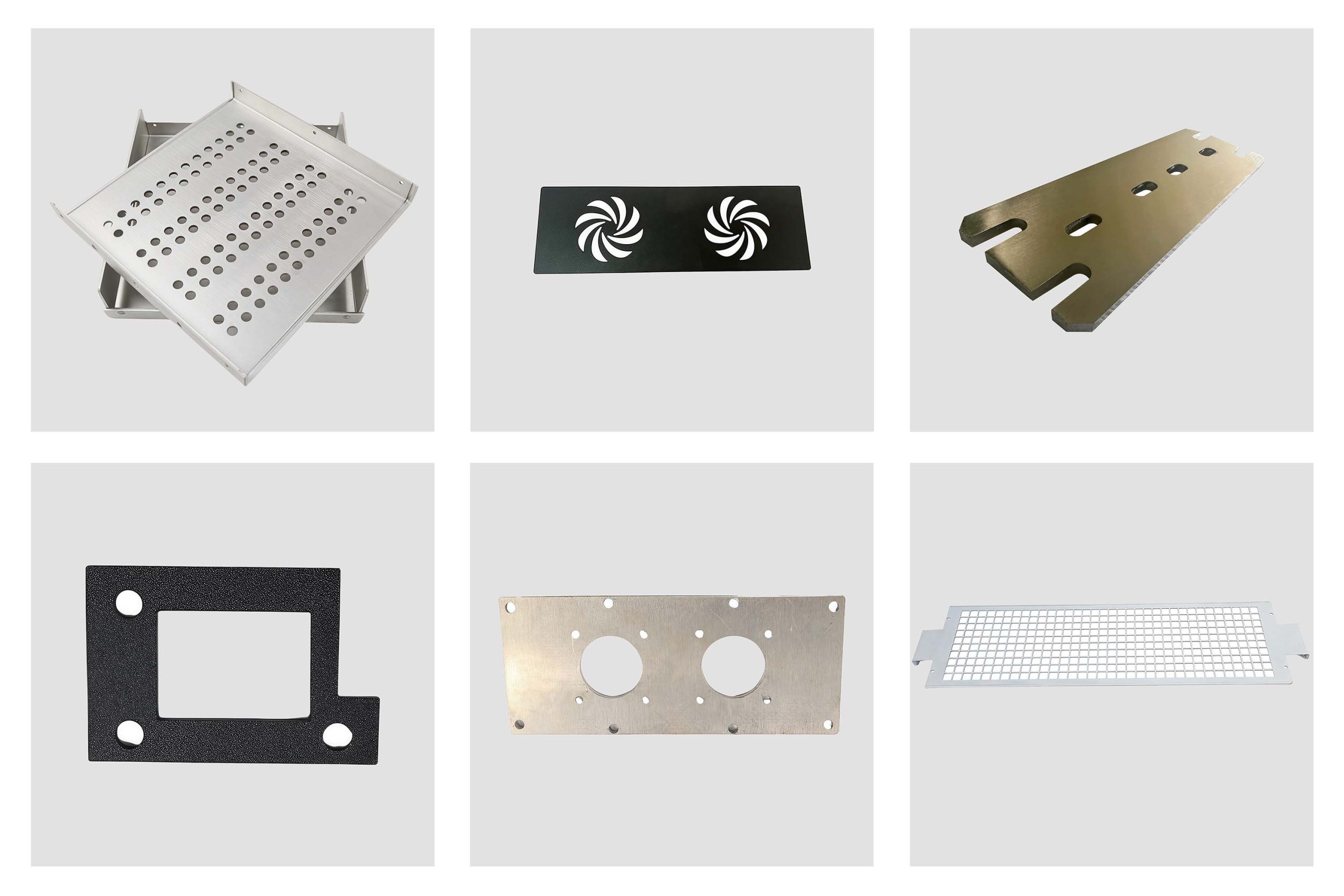
| Typical parts | Enclosure panels, chassis and base plates, mounting brackets, card guides, shielding covers, heat sink brackets, terminal hardware |
| Documentation | CMM dimensional reports, first article inspection reports, EN 10204 material certificates, coating thickness readings |
| Minimum order quantity | None — a single prototype is quoted on the same basis as a production run |
| Sample lead time | 7 days typical; quotation, DFM review and lead time within 24 hours |
| ±0.02 mm | on critical stamped features |
| ±0.005 mm | 5-axis machined features |
| 12,000 W | fibre laser cutting |
| Zinc / anodising / passivation | finishes with controlled thickness |
| CMM + FAI | dimensional reporting |
| ISO 9001:2015 | reg. 34025Q30296R0S |
Why electronics buyers work with us
For example, Flatness is inspected, not assumed. On a chassis or a card cage, flatness and hole position decide whether the board sits correctly — not the material thickness. We inspect the formed and finished part, because coating and welding both move a chassis after the flat pattern was correct.
As a result, Plating thickness is specified, not decorative. On a shielding can or a grounding bracket the coating is doing electrical work. We specify the plating thickness range and supply coating thickness readings, so the finish that was designed for conductivity or shielding is the finish that arrives.
In addition, Forming, machining and finishing on one site. A chassis that is laser cut, bent, machined at the mounting bosses and then plated does not cross a company boundary — which matters most exactly here, because plating a chassis whose threads and bores are already correct is where most electronic enclosures go out of tolerance.
That said, Contacts and shielding at production volume. Copper, brass and thin spring-steel parts are stamped on progressive dies built in our own tool room, so a contact that starts as a prototype can move to volume without changing supplier or datum.
Electronic and electrical parts we manufacture
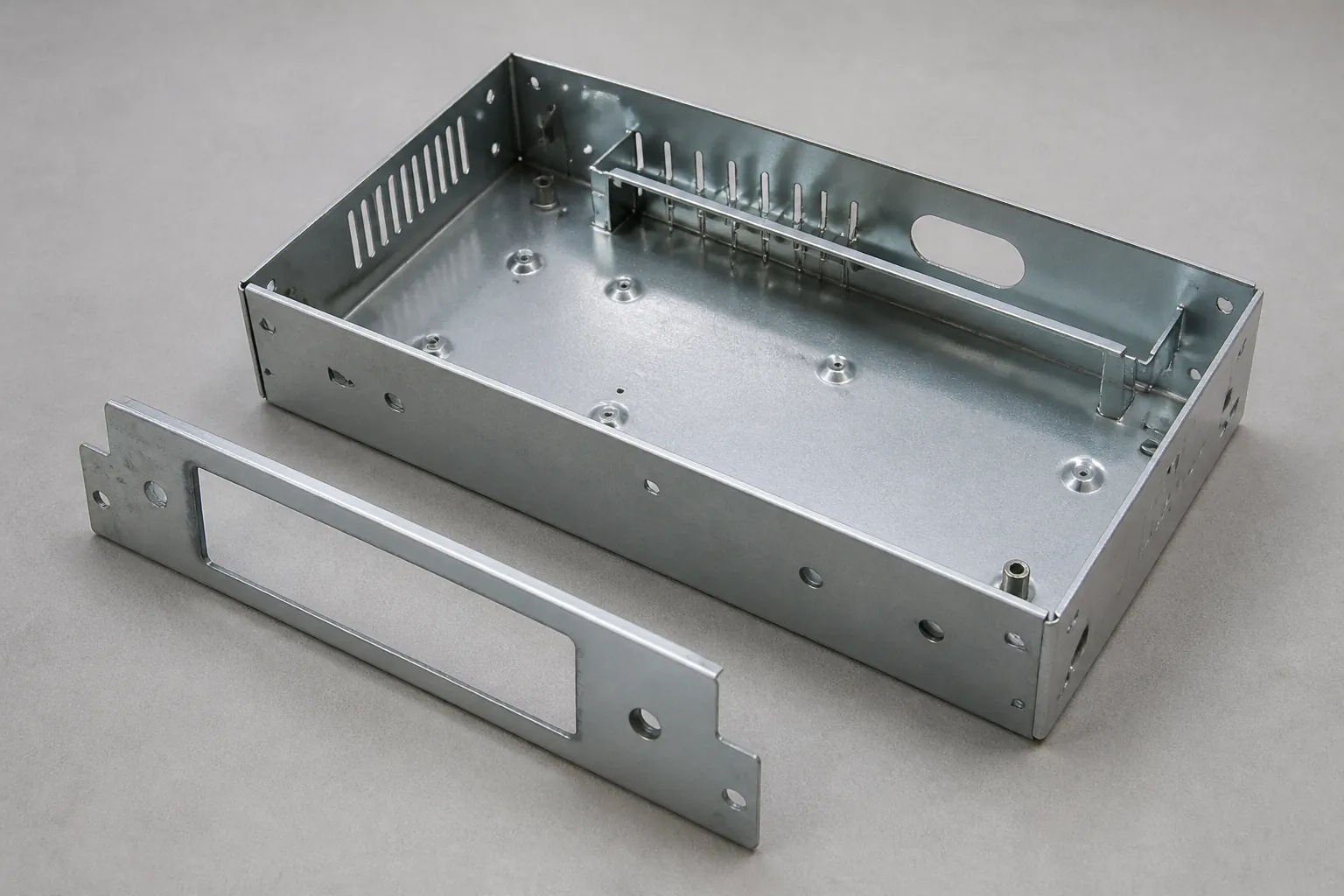
Meanwhile, Chassis, subracks and card cages — Fabricated steel or aluminium chassis with formed card guides, mounting bosses, ventilation slots and connector cut-outs. Typically laser cut, bent, hardware inserted and plated.
Enclosures and housings — Instrument enclosures, power supply housings, junction boxes and control housings, including gasket channels and gland entries. See sheet metal fabrication for the process detail.
EMI and RF shielding — Shielding cans, covers and gaskets. Drawn cans give a continuous wall, which contains better than a folded one; see deep drawing for that route.
Connectors, contacts and terminals — Stamped copper and brass contacts, terminal blocks, pin headers and busbar components, where conductivity and solderability decide the grade.
Heat-sink brackets and mounting frames — Brackets and frames that hold a heatsink or a board in position, where flatness against the mating surface is the controlling dimension.
Panel and fascia hardware — Front panels, bezels, blanking plates and access covers, where appearance and cut-out position both matter.
Processes that suit these parts
Stamping for contacts, terminals and shielding — High volumes, thin material and features that only a die can hold: multiple contacts on a carrier strip, fine pierced slots, formed spring fingers. Progressive dies keep the pitch consistent, which is what a connector actually needs. See custom metal stamping.
Laser cutting and bending for chassis and panels — A 12,000 W fibre laser cuts the flat pattern with no tooling, which is the right route from one prototype enclosure to a few thousand. Bending follows on a 3,200 mm CNC press brake with bend deduction calculated per material. See sheet metal bending.
Deep drawing for seamless shielding and housings — Where the wall has to be continuous for shielding performance or for a sealed enclosure, drawing removes the seam. See metal deep drawing.
Machining for anything forming cannot hold — Five-axis work at ±0.005 mm for connector bores, machined flats and features that must be square to a datum, including after welding so distortion is removed rather than inherited. See CNC machining.
Materials for electronic parts
Cold-rolled carbon steel — SPCC and CR4 for chassis, brackets and enclosures, normally zinc plated. The default where the part is structural rather than electrical.
Copper — C110 for busbars, contacts and conductors, chosen for conductivity. Where the part must also be solderable, the surface finish after forming matters as much as the grade.
Brass — C260 for terminals, pins and contacts: good conductivity, good machinability and better corrosion resistance than plain copper.
Aluminium — 5052 for formed enclosures because it forms without cracking, and 6061 where the part needs machined features or higher strength. Anodising gives both protection and a defined surface resistance if the part is also a heatsink. See materials guide.
Stainless steel — 304 and 316L for enclosures in wet, marine or hygiene environments, and for parts where a passive surface is required without a coating.
Pre-tinned and pre-plated strip — Where the contact has to be solderable as formed, with the plating already on the strip. Tooling is set so the plating is not cracked at the bend or the shear.
Quality and compliance
Incoming material is verified against the mill certificate before release to production. In-process checks track the critical dimensions across the run; final inspection produces the records that ship with the order.
Records available: CMM dimensional report, first article inspection, EN 10204 material certificate, coating and plating thickness readings, and flatness measurements where the part has a seating requirement. Third-party inspection by SGS, TÜV or BV can be arranged.
Where a product has to comply with RoHS, REACH or another material restriction, raise it at RFQ and we will confirm what declarations can be provided for the specific material and finish. We would rather tell you upfront whether a declaration is obtainable than assume it and have it fail at your incoming inspection.
Frequently asked questions about electronics sheet metal parts
Can you supply RoHS or REACH declarations?
Tell us at RFQ and we will confirm what is obtainable for the specific material and finish you have specified, rather than assuming a declaration exists. Material declarations depend on the mill and on the plating chemistry, so the answer can differ between two parts that look similar. Raising it early is what keeps it from becoming a hold at your incoming inspection.
How flat can you hold a chassis or mounting bracket?
Flatness is usually the controlling tolerance on an electronic part, and it is affected by bending, welding and plating — not just by the flat pattern. We inspect flatness on the formed and finished part rather than on the blank, and we can measure and report it against your requirement. If your seating requirement is tight, tell us at RFQ so the process route can be set for it.
Do you make the contacts as well as the enclosure?
Yes. Copper and brass contacts, terminals and pins are stamped on progressive dies built in our own tool room, and the enclosures and chassis are fabricated in the same plant. A connector assembly can therefore arrive as one finished unit rather than as a housing from one supplier and contacts from another.
Will plating affect my tolerances?
It can, which is why plating thickness is specified rather than left to the standard range. A coating closes out a hole and builds up a shaft, so on parts with a mating fit the finish thickness has to be allowed for from the start. We call this out at DFM review, before the parts are made, rather than after plating.
Can you produce shielding cans with a seamless wall?
Yes, by deep drawing. A drawn can has a continuous wall with no seam, which contains electromagnetic interference better than a folded one. Where the can also needs pierced openings or a machined lip, those operations run in the same plant after drawing.
Can you make enclosures that keep electromagnetic interference inside the case?
Partly, and the limit matters. A welded or seam-fastened steel or aluminium enclosure does attenuate interference, because the metal forms a conductive barrier. However, attenuation depends on the joint quality, the number and size of openings, and the material. Our contribution is mechanical: correct material, tight joints, controlled aperture sizes, and consistent flatness where gaskets seat. Where a program requires certified shielding performance, that verification is the buyer’s compliance step, not something a fabricator can assert.
How do you hold flatness on a thin enclosure panel?
Flatness on thin panels is a forming problem, not a cutting problem. Three things control it. First, we calculate the bend deduction against the real material rather than a default, so the panel reaches the intended geometry instead of over-forming. Second, we control heat input during any welding, because distortion follows heat. Third, where a frame must stay flat after welding, in-house stress relief is available. You should still tell us which face is the datum and how flat it must be.
Which tolerances should I put on an electronics part drawing?
Only put a tight tolerance where the function needs one. A laser cut profile holds positional accuracy of a fraction of a millimetre, but it is not a machining tolerance. Bores, bearing seats and faces that must be flat to ±0.005 mm are machined after cutting. Marking the critical features is the single most useful thing on a drawing, because it decides how much the part costs to make.
Can you supply parts with hardware already pressed in?
Yes. We insert rivet nuts, standoffs, threaded inserts and press-fit hardware, and we assemble sub-assemblies so the part arrives as a unit rather than as a kit. Hardware insertion is a press operation, so it is planned into the process route rather than added afterwards.
Do you provide material certificates for electronics work?
Yes, EN 10204 material certificates ship with the order, together with CMM dimensional reports and first article inspection reports on production runs. Coating thickness readings and hardness results are added where the finish or heat treatment requires them. Third-party inspection by SGS, TÜV or BV can be arranged.
What is the minimum order quantity for an enclosure?
There is none. A one-off prototype enclosure and a 100,000-piece production run are quoted on the same basis: by drawing, material, tolerance and volume. Where volume is likely to grow, we will quote both the laser-cut-and-bent route and the stamping route so you can see where tooling starts to pay.
Get an electronics part quoted
Send the drawing or model, the material and finish, the flatness requirement if there is one, and any compliance or inspection documentation the product requires. You will get a DFM review, a tooling price where tooling is involved, and a per-piece price — normally within one working day. See how we price metal fabrication, or use the RFQ form.
Related capabilities
- Custom metal stamping — contacts, terminals and shielding at volume
- Metal deep drawing — seamless shielding cans and housings
- Sheet metal fabrication — chassis, enclosures and panels
- Sheet metal bending — 3,200 mm CNC press brake
- CNC machining — connector bores and machined datums
- Surface finishing — plating and anodising with controlled thickness
Standards referenced
- ASTM International — material and test standards
- The Aluminum Association — aluminium alloy designation system (5052, 6061)
- EU RoHS Directive — restriction of hazardous substances, relevant to material declarations
- ISO 9001 quality management — the standard our system is registered against