


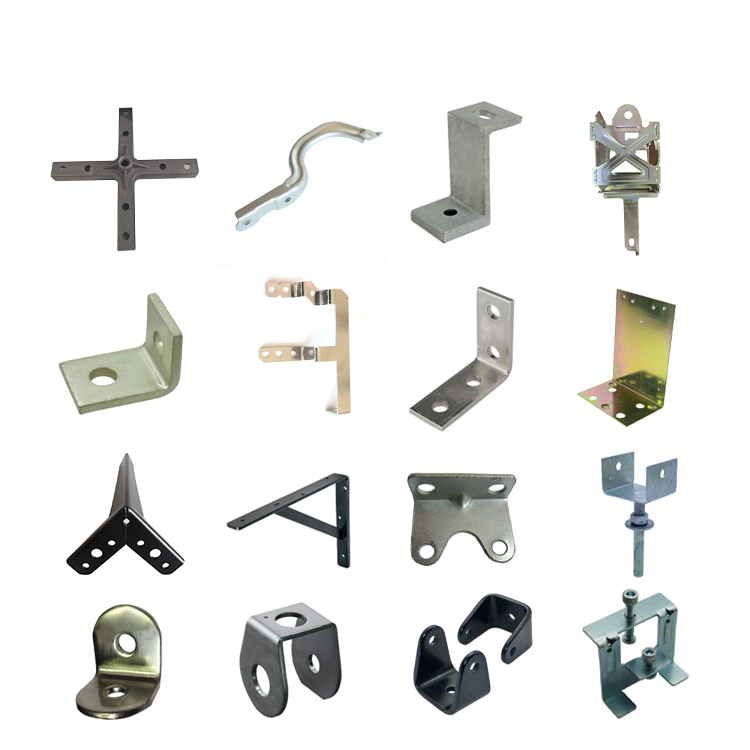
Types of Custom Metal Brackets
- Stainless Steel Brackets
- Corrosion-Resistant: Ideal for outdoor or high-moisture environments (e.g., marine equipment, food processing).
- Grades: 304 and 316 stainless steel for varying strength and chemical resistance.
- Common Designs: L-shaped brackets, U-channels, mounting plates.
- Aluminum Brackets
- Lightweight & Durable: Perfect for aerospace, automotive, and electronics.
- Machinability: Easily shaped into complex designs (e.g., angle brackets, hinge supports).
- Anodized Finishes: Enhanced aesthetics and oxidation resistance.
- Iron Brackets
- Cost-Effective Strength: Used in heavy-duty construction, machinery, and infrastructure.
- Galvanized Options: Rust-proof coating for extended lifespan.
- Common Types: Shelf brackets, beam clamps, flanges.
Applications of Custom Brackets
- Construction: Stainless steel brackets ; iron brackets for structural beams.
- Manufacturing: Aluminum brackets for assembly lines and robotic arms.
- Renewable Energy: Custom brackets for solar panel mounts and wind turbine frames.
- Consumer Goods: Decorative aluminum brackets for furniture; stainless steel for appliances.
Why Choose Custom Metal Brackets?
- Precision Fit: Tailored dimensions ensure seamless integration with existing systems.
- Material Optimization: Select the best alloy for your project’s load, environment, and budget.
- Scalability: Prototype-to-mass production support for startups and enterprises.
Conclusion
Whether you need corrosion-resistant stainless steel brackets, lightweight aluminum solutions, or heavy-duty iron supports, custom metal brackets offer unmatched versatility. Partner with experienced manufacturers to design brackets that meet your exact specifications and industry standards.
Call to Action: Contact us today to request a quote for custom stainless steel, aluminum, or iron brackets tailored to your needs!
Related capabilities
We produce parts of this type with sheet metal fabrication. We also manufacture for Electronics and electrical and Construction and building hardware programmes.
Related pages
- custom metal brackets
- metal stamping for brackets
- sheet metal bending for brackets
- bracket applications by industry
- custom metal brackets manufacturing guide
Key facts
| Item | Detail |
|---|---|
| Material families | Stainless steel 304 and 316, aluminium 5052 and 6061, carbon steel, copper and brass |
| Processes | Laser cutting, press brake bending, stamping, welding and finishing under one work order |
| Formed tolerance | Approximately +/-0.1 mm on formed features, tighter where the drawing specifies it |
| Equipment | 12,000 W fibre laser, 3,200 mm CNC press brake, presses from 25 to 400 tonnes |
| Sample lead time | 7 days typical |
| Minimum order quantity | None, from 1 piece |
| Quality system | ISO 9001:2015, registration 34025Q30296R0S |
What custom metal brackets suit
A bracket is the most common bent part there is: a folded angle, a formed U or a plate that carries a load and provides the mounting holes. It suits a mounting plate, an angle or channel that stiffens a panel, a support that joins two components, and a formed section that replaces a heavier solid part for the same stiffness. Because the part is normally cut and folded from sheet, a bracket can be prototyped without tooling and then moved to a die once the design is frozen and the annual volume justifies it.
What to send for a bracket quote
Send a STEP or STP model, or a folded drawing with the bend lines and a flat pattern. Include the material and grade, the thickness, the quantity and the annual volume, the finish, and which dimensions are functional rather than reference. If a bracket must fit an existing assembly, say which features are the interface. The quotation, lead time and initial DFM feedback are returned within 24 hours. There is no minimum order quantity, so a single bracket can be quoted on the same basis as a batch.
What affects bracket cost and lead time
Every bend adds an operation and a setup, so a simpler fold sequence is often a cheaper bracket. Material choice follows, with stainless and copper carrying the highest cost per kilo and carbon steel with zinc plating or powder coating the economical choice for indoor work. Where the eventual volume is high enough to justify a die, stamping moves the unit cost down; below about 1,000 pieces, laser cutting and bending is normally cheaper, and the same drawing can be priced both ways. A sample is typically 7 days from a frozen drawing, and production runs 20 to 30 business days after sample approval.
How bracket tolerances are held and checked
On a bent bracket the dimensions that actually move are the bend angle and the flange lengths, because springback affects those more than the cut profile. Bend deduction is calculated against the actual material rather than left at a default, and the formed part is inspected rather than only the flat blank. Records available with the order include a CMM dimensional report, a first article inspection report on a coordinate measuring machine with a stated measuring accuracy of +/-0.002 mm, and an EN 10204 material certificate. Third party inspection by SGS, TUV or BV can be arranged.
Common mistakes buyers make with brackets
The most common mistake is an inside bend radius below the material thickness, which cracks the part on stainless or on a pre coated strip. Others are a hole placed too close to a bend line, a fold sequence that cannot be run in the real order of operations, and a tolerance on a formed feature that only a machined part could hold. Sending the material, the thickness and the functional dimensions up front lets these be caught in the review rather than on the press.
Frequently asked questions
What is the minimum inside bend radius for a bracket?
As a rule the inside bend radius should be at least equal to the material thickness for mild steel, and larger for stainless and for 6061 aluminium, because both spring back further and work harden at the bend. Send the material and the thickness and we will confirm the minimum for the part rather than quote a generic figure.
Which material is best for a bracket?
It depends on the load and the environment. Stainless steel 304 suits general corrosion resistance, 316 for chloride, food or marine exposure, aluminium 5052 is the workhorse where weight matters because it forms without cracking, and carbon steel with zinc plating or powder coating is the economical choice for indoor structural work.
How long does a bracket sample take?
A sample is typically 7 days from a frozen drawing, and there is no minimum order quantity, so a single bracket can be cut, formed and inspected on the same basis as a production run.
For independent reference on aluminium alloys used in formed parts, see the Aluminum Association.


