


Introduction
If you’re sourcing custom metal brackets for industrial machinery, electronics enclosures, automotive assemblies, or construction hardware, you already know one thing: not all brackets are built equal. The wrong material, thickness, or bending tolerance can cost you failed assemblies, warranty claims, or worse — a full production shutdown.
This guide is written for B2B buyers, mechanical engineers, and OEM procurement teams who need to specify, source, and validate custom metal brackets from an overseas manufacturer. Beijing JCEN has been fabricating custom brackets since 1997, and this article distills what we’ve learned from thousands of orders across the automotive, aerospace, medical, and electronics sectors.
By the end of this guide, you will know:
- The 6 main types of custom metal brackets and which applications they suit
- How to choose the right material — stainless steel, aluminum, carbon steel, or brass
- Design tolerances that matter — bend radius, hole positioning, edge treatment
- Cost drivers — material, tooling, quantity, finishing, and surface treatment
- How to vet a bracket manufacturer — a 12-point supplier scorecard
Let’s start with the fundamentals.
1. What Are Custom Metal Brackets?
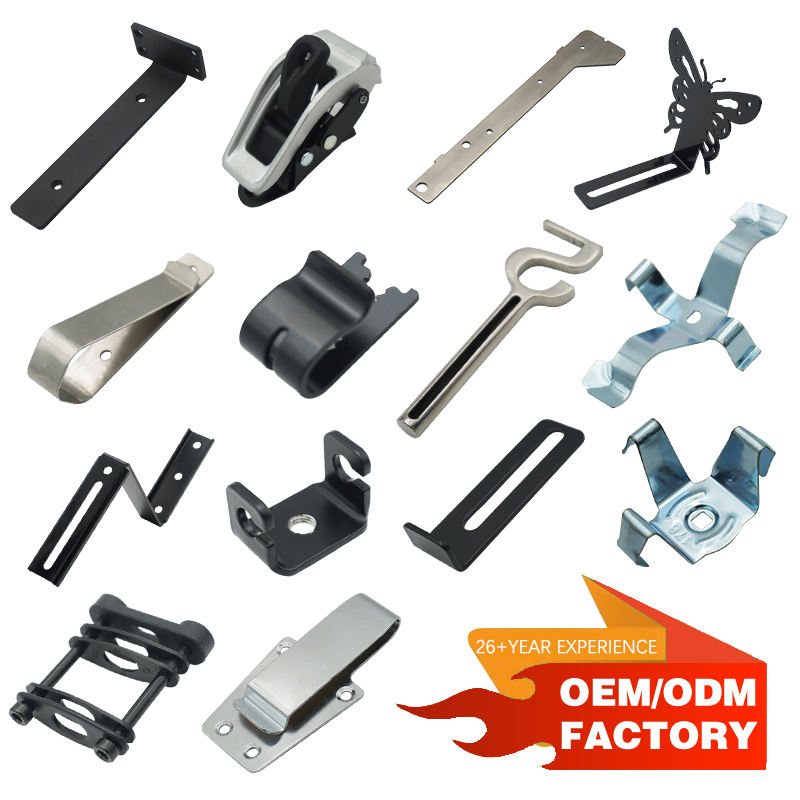
A metal bracket is a fabricated structural component used to support, mount, join, or reinforce assemblies. Custom brackets are made to specific dimensions, hole patterns, materials, and finishes — as opposed to off-the-shelf hardware from a catalog.
Typical applications include:
- Electronics & telecom: server rack brackets, PCB mounts, antenna supports
- Automotive: engine mounts, dashboard brackets, sensor housings
- Medical devices: equipment mounts, adjustable arms, cart supports
- Construction: shelving supports, HVAC hangers, solar panel frames
- Industrial machinery: motor mounts, conveyor supports, guarding brackets
- Consumer products: furniture connectors, appliance mounts
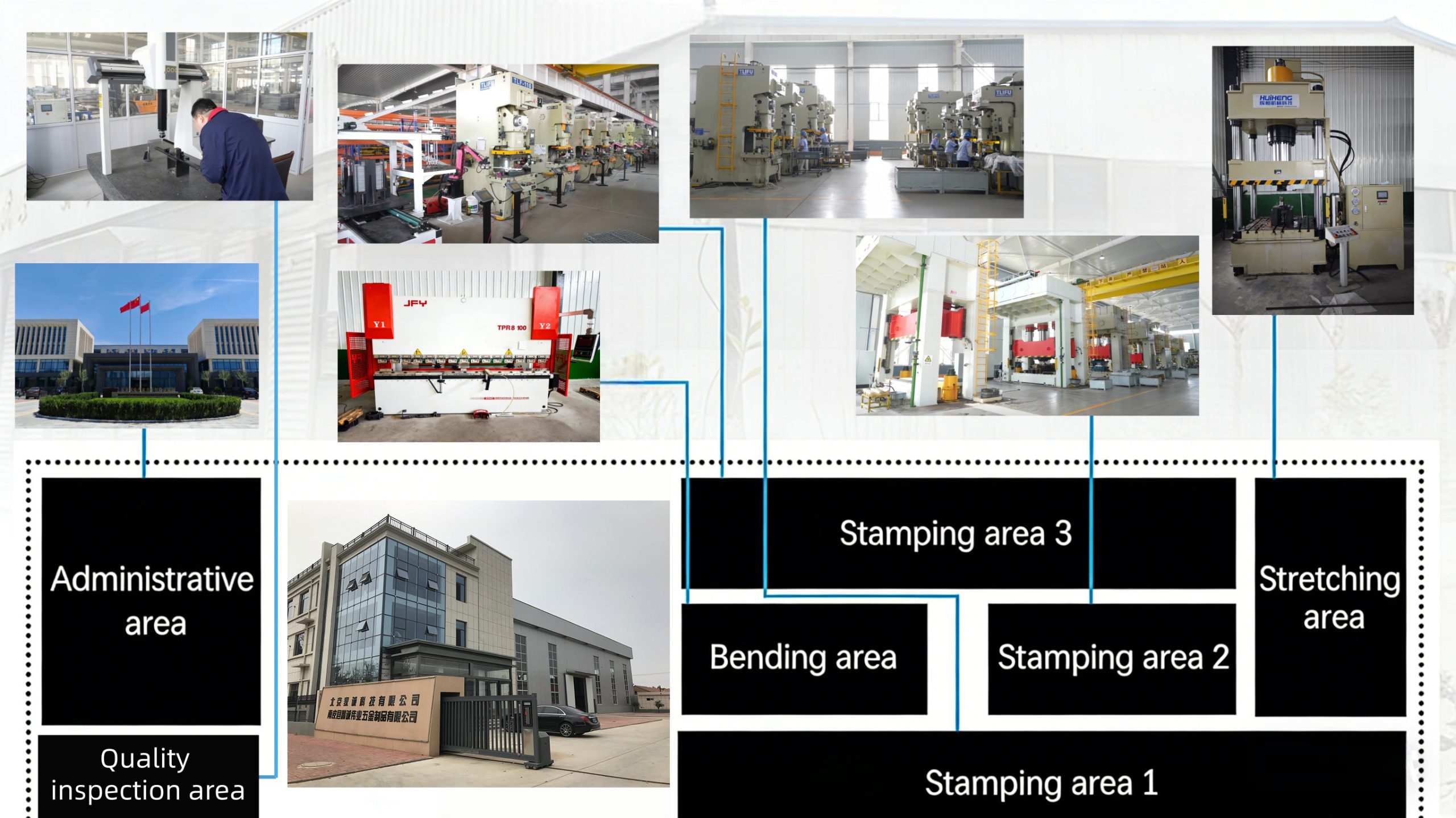
The custom bracket market is dominated by two manufacturing processes: sheet metal fabrication (bending, laser cutting, punching, welding) and metal stamping (progressive dies for high volume). We’ll cover both below.
2. The 6 Most Common Types of Custom Metal Brackets
Different geometries solve different structural problems. Here are the six shapes we produce most often at our Nanpi County, Hebei facility:
2.1 L-Brackets (Angle Brackets)
- Shape: 90-degree angle formed by a single bend
- Best for: Shelf supports, wall-to-object mounting, corner reinforcement
- Typical material: 1.5–3.0 mm cold rolled steel or stainless steel
- Manufacturing: Laser cut → press brake bending → deburring → zinc plating or powder coat
2.2 U-Brackets (Channel Brackets)
- Shape: Two 90-degree bends forming a U-channel
- Best for: Cradling cylindrical parts, motor mounts, cable guides
- Typical material: 2.0–4.0 mm carbon steel or aluminum 5052
- Manufacturing: Progressive stamping or laser + bending for lower volumes
2.3 Z-Brackets (Offset Brackets)
- Shape: Two opposing 90-degree bends creating a Z profile
- Best for: Joining two parallel surfaces at different elevations
- Typical material: 1.2–2.5 mm galvanized steel or aluminum
- Manufacturing: Sheet metal bending on a CNC press brake
2.4 T-Brackets (Tee Supports)
- Shape: A T profile, either welded from two pieces or stamped as one
- Best for: Multi-directional load support, structural joints
- Typical material: 3–6 mm hot rolled steel
- Manufacturing: Laser cutting + MIG welding + surface finishing
2.5 Mounting Plates & Flat Brackets
- Shape: Flat with precision hole patterns
- Best for: Motor mounting bases, sensor plates, gasket flanges
- Typical material: 1.0–5.0 mm stainless steel 304 or aluminum 6061
- Manufacturing: Laser cutting + CNC drilling + tapping — precision to ±0.1 mm
2.6 Complex Formed Brackets
- Shape: Multi-bend, sometimes with embosses, ribs, or drawn features
- Best for: Automotive interior parts, appliance housings, medical carts
- Typical material: 0.8–2.5 mm stainless steel or cold rolled steel
- Manufacturing: Metal stamping with progressive dies (for 5,000+ units) or press brake sequence for prototypes
Pro tip for buyers: Ask your supplier which bracket types they’ve produced in your material and thickness range. A shop that specialises in 6 mm structural brackets is not the right partner for 0.8 mm precision electronics mounts.
3. Materials — How to Choose the Right Metal for Your Bracket
Material selection drives 40–60% of your bracket’s total cost, plus its entire performance profile. Here’s a decision framework based on the 6 most commonly requested materials.
3.1 Stainless Steel (304 & 316)
When to choose it: Marine, food processing, medical, pharmaceutical, outdoor telecom.
- 304 stainless: Great corrosion resistance, formable, weldable. Uses 18% chromium + 8% nickel. Cost baseline.
- 316 stainless: Adds ~2% molybdenum for chloride resistance (seawater, chlorine). Costs ~30% more than 304.
- Bracket thickness range: 0.5–6.0 mm
- Best manufacturing method: Laser cutting + bending; avoid excessive welding (heat discolours the finish)
3.2 Aluminum (5052, 6061)
When to choose it: Weight-sensitive assemblies, electronics enclosures, outdoor mounting.
- 5052-H32: Best for bending and forming (marine, fuel tanks, sheet metal enclosures)
- 6061-T6: Machinable and weldable, stronger — used for structural brackets
- Bracket thickness range: 0.8–8.0 mm
- Best surface finish: Anodizing (silver, black, clear) or powder coat
3.3 Cold Rolled Steel (SPCC / 1008)
When to choose it: Indoor industrial brackets where cost is critical and painting will follow.
- Advantages: Cheapest workable steel, smooth surface, excellent formability
- Drawback: Rusts if unpainted — always specify powder coat or zinc plating
- Bracket thickness range: 0.5–4.0 mm
3.4 Hot Rolled Steel (Q235 / A36)
When to choose it: Heavy-duty structural brackets, load-bearing supports.
- Advantages: Stronger, cheaper per kg
- Drawback: Rougher surface, thicker minimum (usually 2.0 mm+)
- Bracket thickness range: 2.0–20 mm
3.5 Galvanized Steel
When to choose it: Outdoor brackets for HVAC, solar, agricultural equipment.
- Advantages: Pre-coated with zinc — cheap corrosion protection
- Drawback: Zinc layer can crack at tight bend radii; welding releases toxic fumes
- Bracket thickness range: 1.0–4.0 mm
3.6 Brass & Copper
When to choose it: Decorative brackets, electrical grounding, marine hardware.
- Advantages: Corrosion resistance + aesthetic appeal + conductivity
- Drawback: 3–5x cost of steel; requires specialised tooling
- Bracket thickness range: 0.5–3.0 mm
4. Design Considerations That Reduce Cost and Failures
Most bracket cost overruns come from design mistakes made before the drawing reaches the supplier. Here are the 8 rules our engineers wish every customer knew.
4.1 Bend Radius Rule
- Minimum inside bend radius = 1x material thickness (for mild steel)
- Tighter radii cause cracking; larger radii add spring-back
- For stainless steel 304, use 1.5x thickness minimum
4.2 Hole-to-Edge Distance
- Distance from hole edge to sheet edge must be ≥ 2x material thickness
- Any closer risks tear-out during punching or drilling
4.3 Hole-to-Bend Distance
- Distance from hole to the nearest bend line must be ≥ 2.5x thickness + bend radius
- Violating this causes hole distortion during forming
4.4 Minimum Flange Length
- Minimum bend flange = 3x material thickness + bend radius
- Shorter flanges cannot be gripped by the press brake tooling
4.5 Tolerance Realism
- ±0.1 mm on hole diameters is standard for laser + drilling
- ±0.5° on bend angles is standard on a CNC press brake
- ±0.2 mm on formed dimensions across a bend
- Asking for ±0.05 mm on every dimension doubles cost — reserve it for critical mating features
4.6 Corner Relief
- Add relief cuts at internal corners where two bends meet
- Prevents tearing during forming and reduces stress concentration
4.7 Countersinks & Threads
- Specify tapped threads directly on the drawing (M3, M4, 1/4-20, etc.)
- Countersinks add ~$0.05–0.15 per hole depending on quantity
4.8 Surface Callouts
- Specify visible surfaces (Class A, B, C) so the shop knows which side must be blemish-free
- This determines whether to protect the sheet with film during forming
Download link: For a printable version of these 8 design rules, ask your Beijing JCEN account manager for the “Bracket Design Cheat Sheet” PDF (bilingual EN/CN).
5. The 5-Step Manufacturing Process for Custom Brackets
Understanding how brackets are made helps you time your order accurately and negotiate realistic lead times.
Step 1 — Drawing Review & DFM (1–3 days)
- Your STEP / IGES / PDF drawing goes to the engineering team
- We check bend radius, hole positions, tolerances against DFM (Design for Manufacturing) rules
- 60% of drawings need at least one revision suggestion at this stage
Step 2 — Material Sourcing & Cutting (1–3 days)
- Sheets pulled from stock or ordered from mills
- Laser cutting for thin gauge (0.5–8 mm) — fastest, best edge quality
- Turret punching for high-hole-count parts
- Waterjet for materials that can’t be heated
Learn more about our OEM Metal Laser Cutting Service.
Step 3 — Forming (2–5 days)
- Press brake bending for 1–4 bends per part
- Progressive stamping for high-volume runs (5,000+ pieces)
- Bend sequence planning matters — wrong order can prevent later bends
- Deep drawing for cup-shaped or box-shaped brackets
For complex formed parts, see our Custom Deep Drawing Parts service.
Step 4 — Secondary Operations (2–4 days)
- Welding, tapping, riveting, hardware insertion
- CNC machining of critical features that can’t be formed to tolerance
- For precision holes and slots, we use CNC machining to ±0.005 mm
Step 5 — Finishing & QC (2–5 days)
- Deburring — mandatory for handling safety and cosmetic finish
- Powder coat, anodizing, zinc plating, passivation, or brushing
- 100% first-article inspection + AQL 1.5 sampling on production runs
- Packaging designed for freight (no rust in transit)
Typical total lead time:
- Prototype (1–50 pcs): 7 days
- Small batch (100–500 pcs): 14–21 days
- Volume production (5,000+ pcs): 25–35 days
6. Cost Drivers — Why Bracket Quotes Vary So Widely
Two suppliers quoting the same drawing can differ by 3x. Here’s what’s inside the price.
6.1 Material (30–50% of cost)
- Priced per kg — thicker + more expensive alloys = higher cost
- Nested layout efficiency matters: a good CAM programmer saves 15–20% on material waste
6.2 Setup & Tooling (5–40%, depending on volume)
- Prototype (1–50 pcs): Setup is 30–40% of cost — you pay for programming, tool changes
- Volume run (5,000+ pcs): Setup drops below 5% — economies of scale kick in
- Progressive stamping dies: 3,000–25,000 upfront, but reduces per-piece cost to pennies
6.3 Labor (15–30%)
- Bending complexity, hand-deburring, welding hours all bill into labor
- Chinese labor cost is roughly 25–35% of US/EU rates — main reason overseas sourcing works
6.4 Surface Finish (5–25%)
- Bare metal → cheapest
- Zinc plating → +$0.10–0.30 per bracket
- Powder coat → +$0.30–1.50 per bracket (color-dependent)
- Anodizing (aluminum) → +$0.50–2.00 per bracket
- Mirror polish (stainless) → +$1.00–5.00 per bracket
6.5 Quality Requirements (2–15%)
- Basic AQL 1.5 sampling → baseline cost
- 100% inspection → +5–10%
- PPAP documentation (automotive) → +10–15%
- IATF 16949 / ISO 13485 medical → adds engineering time
6.6 Volume Discounts
Typical price break points from a Chinese factory:
Actual pricing depends on geometry, material, and finish. Get a free quote from Beijing JCEN for your specific drawing.
7. How to Choose the Right Bracket Manufacturer — 12-Point Scorecard
Not every “China metal fabricator” on Alibaba can actually deliver production-grade brackets. Score your candidates on these 12 factors:
Beijing JCEN scorecard:
- ✅ ISO 9001:2015, IATF 16949 and ISO 14001 certified (verifiable)
- ✅ 28 years in business (since 1997)
- ✅ 15,000 m² facility, 85 staff
- ✅ Export to US, Germany, UK, Netherlands, Canada, Australia
- ✅ English-speaking project managers
- ✅ Prototypes shipped in 7 days
- ✅ CE, RoHS, REACH compliance documentation available
Compare us against 2–3 competitors before you commit — that’s the mark of a professional buyer.
8. Frequently Asked Questions
Q1: What is the minimum order quantity for custom brackets?
A: 1 piece for prototyping. Cost per piece drops significantly at 100 units and again at 1,000+. We schedule repeat production according to tooling, part complexity and annual demand.
Q2: How long does it take to get a quote?
A: 24 hours or less if you send a drawing (STEP, IGES, DWG, or dimensioned PDF), material spec, quantity, and required finish. Complex assemblies may take 48 hours if a full DFM review is needed.
Q3: Can you match brackets from a US or European supplier?
A: Yes. Send us the sample or drawing and we’ll reverse-engineer it, quote a match, and ship a prototype for approval before starting mass production. This is one of our most common projects.
Q4: What file formats do you accept?
A: STEP, IGES, DXF, DWG, PDF (dimensioned), Solidworks .SLDPRT, and hand sketches with photos. Native CAD files preserve tolerances better than PDF exports.
Q5: What surface finishes do you offer?
A: Powder coat (200+ RAL colors), zinc plating (clear or yellow chromate), anodizing (silver, black, gold, red, blue, clear), passivation, brushing, mirror polishing, hot-dip galvanizing, electrophoretic (E-coat), and painting.
Q6: Are your brackets suitable for medical or aerospace applications?
A: Yes. We produce brackets under ISO 9001:2015, and we hold IATF 16949 and ISO 14001. Additional documentation is available for medical (material certs, biocompatibility) and aerospace (traceability, first article reports).
Q7: Do you offer assembly with hardware?
A: Yes. We can insert PEM nuts, standoffs, threaded studs, and rivets, weld sub-assemblies, and pack ready-to-install kits with hardware bagged separately.
Q8: What are your shipping options?
A: FOB Tianjin/Qingdao (default), CIF to any major port, DDP door-to-door (US, EU, AU, CA), or air freight for urgent orders. Small orders under 30 kg ship via DHL/FedEx in 5–7 days.
Ready to Get a Quote?
If you have a drawing ready — or even a hand sketch and a rough quantity — send it to our engineering team and get a quote within 24 hours, free of charge.
📩 Request a free bracket quote: Contact Beijing JCEN
🏭 Visit our bracket manufacturing page: Custom Metal Brackets Manufacturer
📚 Related resources:
- OEM Sheet Metal Fabrication Service
- Metal Stamping Parts Manufacturer
- CNC Machining Service ±0.005 mm
- Sheet Metal Fabrication Material
Beijing JCEN is a China-based custom metal fabrication manufacturer serving OEM customers worldwide since 1997. ISO 9001:2015, IATF 16949 and ISO 14001 certified. 15,000 m² facility. 85 in-house staff.
Related capabilities
We produce parts of this type with high-volume production. We also manufacture for Electronics and electrical and Medical and laboratory programmes.


